



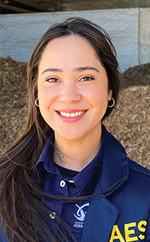
Kristen Rossiter is the first female operations manager in the Western Cape at Associated Energy Services (AES). SA Instrumentation & Control’s editor caught up with her and AES director Dennis Williams to find out more about her career path as an engineer.
When Rossiter joined AES as an in-service trainee, she was fresh out of university and new to the realities of industrial steam generation. Today, she is responsible for 10 sites and 24-hour operational performance across a fleet of boilers. She describes what it takes to build and sustain a career in engineering.
Her interest began early. “My father was a physics and technology teacher and he regularly brought home experiments that he conducted with his students,” she says. “These experiences sparked my curiosity and encouraged me to explore how science and technology could be applied in practical ways.” At university she chose chemical engineering, a discipline she describes as understanding how raw materials move through a process and how these processes can be improved. She says that people often assume that chemical engineering is primarily laboratory-based. In reality, the discipline has become centred on industrial processes, process optimisation and systems thinking.
She found that there was a major transition from lecture hall to the plant floor. “During my studies, problems were approached under ideal conditions. In industry, we have boilers fouling, valves leaking and sensors giving inaccurate readings. The operators also have practical workarounds that are not taught in textbooks.” Her first year in industry taught her that operations cannot be viewed in isolation. Maintenance, reliability, process control and people all influence performance simultaneously. She also encountered the financial implications of engineering for the first time. “Every hour that a boiler is down there is a cost involved. Decisions have to balance technical excellence with production requirements, safety considerations, risk management and financial impact,” she explains. “The greatest influence on my career has been the experienced leaders I have worked with at AES, particularly those who were willing to share their knowledge, invest time in my development, and trust me with increasing levels of responsibility,” she continues. She adds that good mentorship involves more than technical knowledge transfer, it involves cultivating independent thinking. The engineers who shaped her development explained how systems work and also why decisions were made, and they treated mistakes as learning opportunities rather than occasions for blame. This approach gave her confidence, sound technical judgment and the ability to make decisions under pressure.
Site exposure was equally important. Every installation presented different challenges that required adapting textbook principles to real conditions. AES also supported her growth by funding her chemical engineering degree. The lesson she drew, and now applies with her own operators, is that encouraging them to investigate, troubleshoot and identify root causes builds far stronger long-term capability than simply giving them solutions immediately.
One of the most significant developments during her time at AES has been the increasing role of digital technology. The company operates a remote monitoring system (RMS) that collects real-time operational data across all client sites. “I use our RMS daily to monitor sites remotely and access real-time operating information,” she says. “Sometimes operators don’t inform me of an operational anomaly immediately. I can see it on the dashboard and inform the client before the operator has even reported it.” The system also supports predictive maintenance. By analysing trends in CO2 sensor data, for example, she can flag calibration needs or check on cleaning before a fault develops. “A number displayed on a system is simply a number, unless someone is sitting behind a computer trying to understand its context,” she adds.
AES has also introduced biomass as an alternative fuel on selected sites. Among these is a hot-water generator fired by wood chips at a Western Cape food production facility. Rossiter says the operational differences from coal are considerable. Particle size, moisture content and fuel density vary with seasons and supply, requiring constant adjustment of boiler settings. The experience has broadened her technical range considerably, and illustrated the pace at which the industry is evolving.
She has faced some challenges. Early on she encountered operators with over 15 years of site experience who were initially reluctant to take direction from a newly-appointed manager. “I had to build a good working relationship first, and only then approach problem solving,” she says. Once mutual respect is established, problem solving follows more naturally, and she counts earning that trust among her proudest achievements.
For her, effective engineering begins with listening. When she visits a site, she seeks out the operators first, recognising that the people running the equipment are the real operational experts. Her aim is not to interrogate them, but to create an environment where concerns can be raised without fear of blame, and where problems are treated as something to be solved rather than assigned.
The same approach extends to client work, where Rossiter has found that people engage openly with her. She attributes this partly to her habit of absorbing information before reacting. When a problem is presented, her instinct is to reach for solutions rather than reactions, and she believes this calm, focused style encourages others to raise issues early before they escalate. She believes that engineering, rather than finding fault, involves understanding root causes, working collaboratively, improving both processes and the relationships which sustain them.
South Africa produces capable women engineering graduates, yet many leave the profession within a decade. She identifies the absence of visible role models as a key factor. In some workplaces, women have fewer role models in senior technical or leadership positions, making it harder to see a clear career path for themselves. The solution, Rossiter says, involves inclusive leadership, fair promotion practices, meaningful mentorship and, where feasible, flexible working arrangements. The answer is not to lower the standard. It’s ensuring that everyone has the same opportunity to succeed.
AES director Dennis Williams notes that approximately 43% of new appointments at the company over the past two years have been women, and around a quarter of skilled technical (24,4%) and professional roles (25,5%) are now held by women. He acknowledges that site-based work involving call-outs at night, remote locations and limited on-site facilities presents challenges that the industry has not fully resolved. “I think industry by industry it can vary. We really try to make sure it is inclusive, but the nature of our work might not be to the taste of some people, whether they are women or men,” he explains.
Rossiter’s advice to women considering engineering is not to allow perceptions or stereotypes to discourage them from entering the profession. Engineering requires attention to detail, analytical thinking and the ability to understand complex systems. These are all qualities that women already bring. Technology has also removed the physical demands that were once a deterrent. “Modern workplaces use pulleys, chains and hydraulic presses. Engineering is no longer dependent on physical strength alone,” she adds. In her experience, chemical engineering now attracts a majority of women students, even if other disciplines have been slower to change.
“Companies need people who are adaptable, open to learning and willing to develop within the organisation. There is no reason for young women to fear going into engineering. The qualities they bring are exactly what the industry needs,” she concludes.
For more information contact AES,






© Technews Publishing (Pty) Ltd | All Rights Reserved
 printer friendly version