



Most solid fuels produce ash, and effective ash management is crucial. “This encompasses safety, efficiency, environmental maintenance and sustainability,” says Dennis Williams, commercial director of boiler operations and maintenance specialist, Associated Energy Services (AES).
In South Africa, ash management ranges from sophisticated overhead storage systems and wet conveyors to manual trolley-based solutions, and AES is meticulous about how ash is handled, stored and disposed of.
A solid approach to ash management
Typically, local ash generation and management relates to solid fuels. “The most common solid fuel source in South Africa is coal. Differing composition due to different seams and geographic locations means it fires differently, a key factor when recovering ash after combustion,” says Williams.
In comparison, biomass produces a significantly smaller volume of ash than coal, reducing system requirements. However, the ultimate ash management solution depends on individual client preferences, with location of the boiler in relation to the production facility and specific operational preferences varying radically.
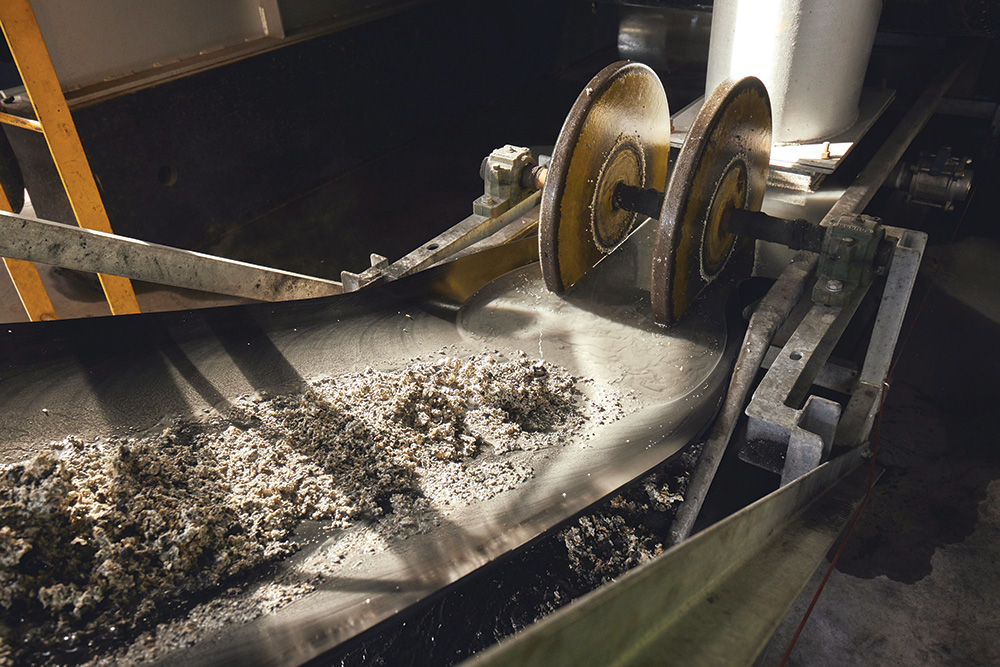
Larger plants typically include a wet submerged conveyor belt. Ash discharges into a water-filled ash conveyor, creating a water seal which prevents air from moving back through the ash port into the boiler. Ash is then carried away via the conveyor to an ash receiving skip or storage point.
Ash may also be conveyed to an overhead hopper, beneath which a truck can be positioned for loading or placed into bins for later transport. “With old Dutch oven-fired biomass boilers there is a lot of manual ash removal. However, on the newer systems, a wet ash system, similiar to that used in coal-fired boilers, removes wet ash. Ash solids are carried out and water is returned to the ash system. Williams says that this is particularly valuable for clients concerned about dust or site cleanliness.
From ash types to water
There are two main ash classifications: bottom ash and fly ash. Bottom ash is coarser, featuring larger particles. Depending on coal type, varying degrees of clinkering occurs when ash components fuse together. In some ash, there is also unburnt carbon, something which AES tries to limit: “Every carbon molecule we do not burn is a loss in terms of what we paid for that energy,” Williams says.
Then there are fine particles that move through the boiler into the flue gas stream during steam generation. These are removed by grit arrestors, bag filters or electrostatic precipitators.
Fly ash and bottom ash differ in composition, and this is relevant when determining handling and disposal methods. Ash management requires close attention to operational detail; excessive buildup of hot ash behind the stoker damages the rear roller around which the chain grate rotates. That is why periodic inspections are needed to identify and clear buildup.
Water temperatures in submerged ash conveyors must also be carefully managed. If the rubber conveyor belt is continually exposed to heated water, the ash system must be rinsed to top it up with cooler water. Any buildup of fines underneath the conveyor belt must also be cleaned out. Without this, the conveyor belt will fail. When the ash system is down, boilers must be de-ashed manually, which causes considerable health and safety risks.”
Water run-off from ash storage is another major consideration: “Usually, there is a point at which we would separate out the particulate such as fine ash and coal dust. Water overflow then goes to the effluent treatment plant,” Williams explains.
“Where ash is stored before being uplifted, run-off water must ideally pass through settling traps before entering the effluent system. If you have an overhead hopper with a conveyor belt carrying wet ash up to the top, you will have water slowly leaching out of it and dripping onto the ground. That water needs to be managed.”
Legislation, safety and sustainability
Ash is categorised as waste in terms of the National Environmental Management Act 2008, and must be tested and classified at least every five years to determine how it is managed. Mostly, qualifying boiler ash can be sent to general landfill. However, appropriate personal protective equipment is required, such as gloves and dust masks.
“Significant risk points need to be managed across the entire chain of generating, handling, storing, collecting, transporting and disposing of ash. In every instance, we look at optimisation, proposing a solution to the client that addresses all of the operational standards and legal risks associated with the generation and disposal of ash as cost-effectively as possible,” continues Williams.
The same legislation also provides for the declassification of ash so it can be recycled and reused, either as an aggregate in concrete products such as cinder blocks, in brick manufacturing, or in the case of biomass, ash for the production of eco-friendly fertiliser. However, viability depends on location. “The big thing is proximity; as soon as the ash is transported any significant distance, value is eroded on both sides,” he explains.
Symbiotic ash disposal
Instead, AES has used ash disposal as a way to incentivise entrepreneurs as part of its enterprise development initiatives. Alternatively, although never likely to be a viable income generator, the sale of ash can also be used to offset disposal costs for major clients. “As part of a recent contract, we saw that a client’s production facilities operating in close proximity in a remote area could benefit from an integrated logistics solution. The volumes, together with the relationship which AES leveraged, created a competitive solution for all,” Williams concludes.
For more information contact AES,






© Technews Publishing (Pty) Ltd | All Rights Reserved
 printer friendly version