



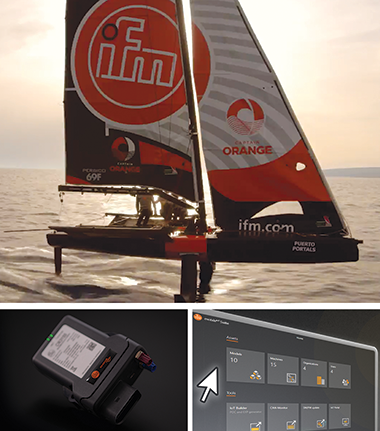
With mobile IoT, the benefits of digitalisation are becoming a reality for mobile machines. You can get the most out of your machine fleet through performance monitoring, needs-based maintenance planning and software updates over the air.
Mobile IoT is a fully integrated, scalable end-to-end solution consisting of hardware and software. The hardware maintains the dialogue between the machine and the cloud software where the information from all the networked machines converges centrally. This makes it possible to find out the exact status and location of the machine at any given time. Similarly, you can efficiently distribute software updates to your fleet via the mobile IoT cloud.
Regardless of whether you require a solution to permanently analyse and optimise prototypes in real field tests, to plan and prepare your rental fleet management more effectively, or to establish a convincing after-sales service, mobile IoT is the right choice for a wide variety of applications.
Simple steps for more overview and efficiency
Mobile IoT is a perfectly matched combination of hardware and software that offers the user a high degree of flexibility when digitalising mobile machines. The first step is selecting the appropriate mobile IoT gateway and connection option. The device is then activated online and a suitable data and/or service contract is selected.
There are a number of benefits of Mobile IoT gateway products:
• Reliably managed: With mobile IoT, individual components, complex machines or even the entire fleet can be managed and individually configured.
• Wireless connection: Mobile IoT enables a fast, simple and secure remote connection to the machine.
• Clearly structured: With the mobile IoT DataPortal, all relevant machine data can be collected, analysed and visualised cyclically.
System overview
Whether via mobile network or Wi-Fi , mobile IoT offers an optimally matched end-to-end solution consisting of hardware and software for mobile machines. On the hardware side, a mobile IoT gateway tailored to the machine architecture is required. The gateway communicates with the mobile IoT Suite or the DataPortal. For machine-to-machine communication, it is possible to use a CANwireless module.
Thanks to mobile IoT, needs-based maintenance can be planned and prepared in a targeted manner. Not all maintenance or troubleshooting requires onsite intervention, and the mobile IoT solution offers the convenience of remote access for updating or changing software, parameters and configurations. Remote access is not only convenient, but also contributes significantly to cost savings.
Here are some application examples:
• Remote access: Mobile IoT enables simple and secure remote access to machines. This enables better planning of maintenance and servicing, for example, which increases efficiency and reduces costs.
• Fleet management: Intelligent fleet management ensures a complete overview of the mobile machinery at all times. Real-time data on location and machine status enable optimum planning and utilisation of resources. In addition, the machines can be configured and access to the machine can be regulated by means of comprehensive rights and role management.
• Machine maintenance and updates: The ecolog interface integrated in ecomatmobile components makes it very easy to update an entire machine from a central location in the field. Information on the installed components can also be read.
• Data management: Recording and evaluating machine data creates the basis for efficient operating processes and for informed decisions regarding operational planning and machine optimisation. Thanks to bidirectional communication, individual signals can be transmitted from the machine to the cloud while parameters can be relayed from the cloud to the machine.
During the 69F Cup, ifm sponsored one of the sailing boats. To test whether ifm sensors would still work under these very special and unusual conditions, the hardware was mounted to the foiling sailboat.
The peculiarity of these boats is that once they are fast enough, they completely lift out of the water, which makes the measuring of the distance between the boat and the surface of the water crucial. To measure the distance, two different level sensors, one radar-based sensor and one ultrasonic, were mounted onto the boat. An inclination sensor was used to measure the roll angle, which is very important for the crew.
All the data from the sensors was gathered and shown live on the display. A modem sent all the data in real time into the cloud of the ifm mobile IoT suite. Thanks to the hardware, the sailors were able to rely less on their feelings and more on the data. Teamwork, reliability and constant technical development must always be in focus in order to be successful.
To see this product in action, visit ifm at Electra Mining Africa, 7 to 11 September 2026 on stand A06 in Hall 7.
| Tel: | +27 12 450 0400 |
| Fax: | +27 12 450 0412 |
| Email: | [email protected] |
| www: | www.ifm.com/za |
| Articles: | More information and articles about ifm - South Africa |






© Technews Publishing (Pty) Ltd | All Rights Reserved
 printer friendly version