


Fieldbus & Industrial Networking


Next-level CAN Software enables easy access to CAN XL

March 2026 Fieldbus & Industrial Networking

With the release of its PCAN-Explorer 7, PEAK delivers a major update that adds full support for CAN XL, multiple symbol files per connection, Python scripting and flexible licensing including floating licenses. Existing users will appreciate the familiar usability, and engineering teams building for the next generation of automotive and industrial CAN networks get the powerful functionalities they need.
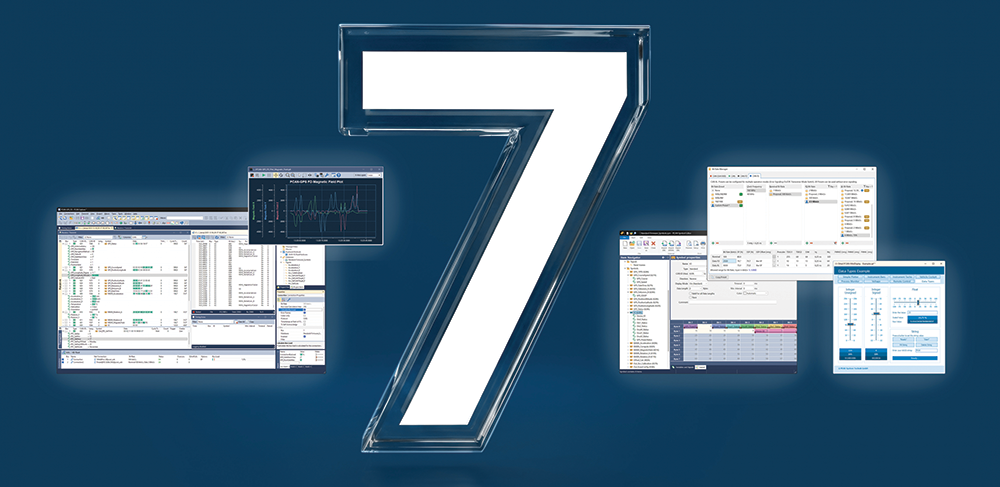
The next major evolution of PEAK’s professional CAN communication software for analysing, monitoring and simulating CAN, CAN FD, and CAN XL networks contains many helpful features for engineers.

PCAN-Explorer 7 marks a significant step forward, adding full CAN XL support for faster bit rates (up to 20 Mbit/s) and higher payload (2048 bytes). Users can now assign multiple description databases per connection such as symbol files or CANdb files, which makes it easier to work with several data bases in parallel, therefore avoiding manual merging effort. The addition of Python scripting brings a modern automation environment to the platform, and is heavily used in automotive testing applications.

Another major improvement is the introduction of a new licensing system based on CodeMeter. Customers can choose between single-user or floating licenses. In addition, USB license dongles are available to make single-user licenses portable. For users who want to test the software, trial licenses are available. These options make the Explorer software more flexible for both individuals and teams.

New features that convince

Another helpful functionality is the fine-grade trace playback, allowing users to step through trace files message by message, pause automatically on defined breakpoints, and create highly controlled test and replay scenarios. PCAN-Explorer 7 also introduces support for J1939 FD, enabling engineers who work with heavy-duty and off-highway applications to analyse and simulate next-generation protocol variants. Another practical enhancement is the highlighting of data changes in the receive list. This makes it easier to spot dynamic values, detect anomalies and follow changing signals in real time.

Product manager for the PE7, Kristofer Koch, summarises the goal of the new version as follows: “With PCAN-Explorer 7, we are anticipating the shift to CAN XL and empowering our users to be futureproof today. Plus, we succeeded in delivering these advanced capabilities without changing the familiar interface and established workflows of version 6.”

Users who have relied for many years on previous versions of the most famous CAN software on the market, can still relate to its core functionalities, its user interface and well-established add-ins, and now also benefit from strong new features of the future. “The new version is the essence of all previous editions combined with new capabilities”, adds Koch. “This means we have integrated profound user feedback over years and added state-of-the-art technologies and functionalities to lift the Explorer to the next evolution stage.”

PCAN-Explorer: The standard CAN software

PCAN-Explorer has long been known as a powerful and versatile Windows software tool for working with CAN and CAN FD networks. Its core functionality is built around simultaneous access to multiple CAN channels, which allows users to observe, analyse and log communication in complex network environments. A central element is the symbolic representation of messages, which transforms raw CAN data into readable and meaningful signal information using symbol files. In everyday use, PCAN-Explorer enables both manual and periodic transmission of messages, making it ideal for testing, network trouble shooting and system development. Visit www.peak-system.com/explorer7 to find out more.

For more information contact Industrial Data Xchange (IDX), +27 11 548 9960, [email protected], www.idx.co.za


Credit(s)


Share this article:
Share via emailShare via LinkedInPrint this page

Further reading:

Why secure industrial communication depends on deployment as well
Fieldbus & Industrial Networking
The Industrial Security Harmonisation Group has released a joint industry perspective highlighting a critical truth in industrial cybersecurity: secure communication is not determined by protocols alone, but by how they are deployed and managed in real-world environments.

Read more...
A single platform for all automation functions
Beckhoff Automation Fieldbus & Industrial Networking
The introduction of TwinCAT in 1996 marked a decisive evolutionary step for PC-based control. Today, the TwinCAT platform combines all automation functions in a strictly deterministic real-time environment, from PLC and motion control through CNC and measurement technology and beyond, to vision, robotics and pioneering AI tools.

Read more...
Loop signature Part 2-4: Feedforward Control: Part 3
Michael Brown Control Engineering Editor's Choice Fieldbus & Industrial Networking
In the previous articles in this series, the basic theory behind feedforward control was discussed, and it was also shown how to apply feedforward in practice. In this article, it will be shown how well feedforward can work in practice by giving a couple of examples.

Read more...
Control Station and Dimension Software partner to connect control performance monitoring with enterprise operations intelligence
Fieldbus & Industrial Networking
Control Station has entered into a strategic technology partnership with Dimension Software, a leading provider of industrial operations management platforms. The collaboration connects Control Station’s PlantESP control loop performance monitoring platform with Dimension Software’s Asset Intellect operations intelligence environment, enabling manufacturers to operationalise control performance insights across their organisations.

Read more...
PCIe digitiser cards for optimal GHz signal acquisition and analysis
Vepac Electronics Fieldbus & Industrial Networking
The addition of two new PCIe Digitiser cards from Spectrum Instrumentation extends the company’s flagship M5i series to deliver optimal GHz signal acquisition and analysis capabilities.

Read more...
Precise, synchronised control for automated steel mesh handling system
Fieldbus & Industrial Networking
Automation specialist Hambi Maschinenbau has developed a world-first system that automates the cutting, handling and stacking of heavy reinforcing steel mesh – a task that previously required up to six human operators.

Read more...
Loop signature Part 2-3: Feedforward Control: Part 2
Michael Brown Control Engineering Editor's Choice Fieldbus & Industrial Networking
Feedforward control tuning is not nearly as critical as feedback tuning, and fairly simple models are usually fine for the purpose in hand.

Read more...
Upgrading radiological surveillance systems in nuclear facilities
Omniflex Remote Monitoring Specialists Fieldbus & Industrial Networking
Nuclear plant operators face an uncomfortable reality. Many of the control and monitoring systems still in use today were never designed to support the full operational lifespan of the facilities they serve.

Read more...
Loop signature Part 2-2: Feedforward Control: Part 1
Michael Brown Control Engineering Fieldbus & Industrial Networking
Feedforward control is a powerful technique that can dramatically improve control variance in cases where load changes cause big deviations from setpoint and the actual process dynamics are too slow to allow the feedback controller to operate fast enough to catch these disturbances.

Read more...
10G TSN endpoint IP core for deterministic high-speed Ethernet networks
Fieldbus & Industrial Networking
The Fraunhofer Institute for Photonic Microsystems has introduced a new 10G TSN endpoint IP core, enabling deterministic real-time communication at data rates of up to 10 Gbit/s.

Read more...


While every effort has been made to ensure the accuracy of the information contained herein, the publisher and its agents cannot be held responsible for any errors contained, or any loss incurred as a result. Articles published do not necessarily reflect the views of the publishers. The editor reserves the right to alter or cut copy. Articles submitted are deemed to have been cleared for publication. Advertisements and company contact details are published as provided by the advertiser. Technews Publishing (Pty) Ltd cannot be held responsible for the accuracy or veracity of supplied material.


© Technews Publishing (Pty) Ltd | All Rights Reserved

