Automotive Ethernet media converter
July 2026
Fieldbus & Industrial Networking
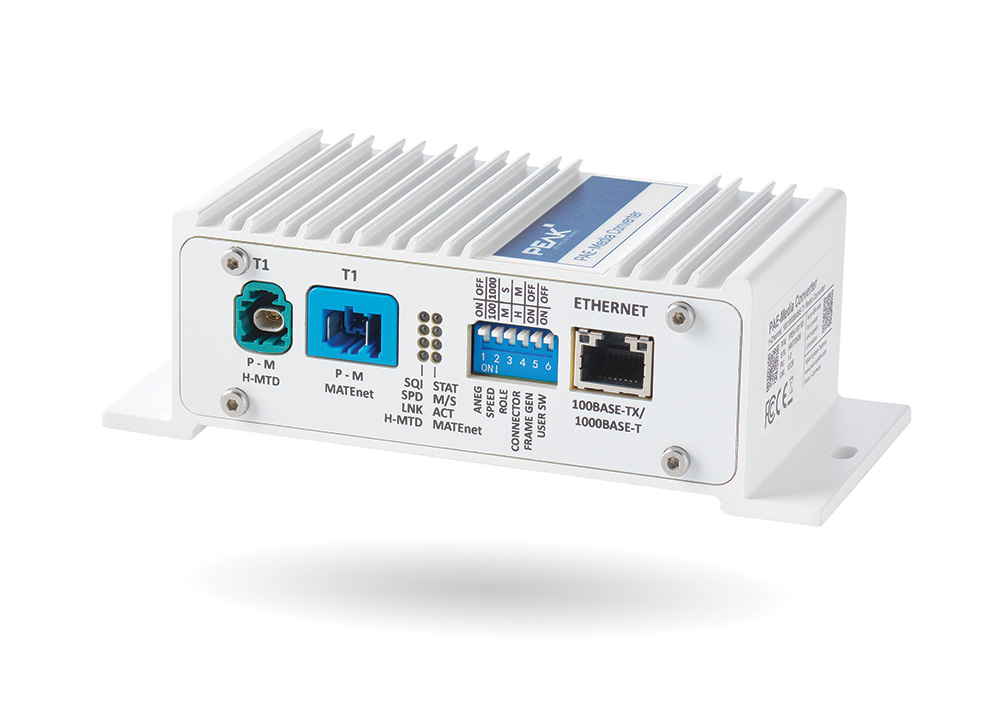
HMS Networks has introduced its first automotive ethernet product under the PEAK brand. The PAE-Media Converter is a compact device designed to connect automotive Ethernet, 100BASE-T1 or 1000BASE-T1, with standard Ethernet, 100BASE-TX or 1000BASE-T, networks. As a media converter, it enables automotive engineers to simplify development, testing and validation workflows within the 100 Mbit/s and 1000 Mbit/s domains.
Unique features for automotive testing
The PAE-Media Converter addresses key challenges in automotive development and validation with three core capabilities. It enables realistic fault simulation by allowing physical interruption of the automotive ethernet link, triggering directly on the device or via an application programming interface to support reproducible and controlled test scenarios.
“We empower engineers with simple and powerful tools. With our unique physical link interruption functionality, we enable them to create real fault conditions in test scenarios without unplugging the device, saving time and wear,” says Kristofer Koch, product manager at HMS Networks.
The device combines H-MTD and MATEnet connector support in one unit, reducing hardware complexity, investment risks and enabling faster setups. “With only one device we cover the two de facto connection standards in the market, with no additional adapters needed,” says Koch.
The PAE-Media Converter provides plug-and-play operation with optional API control and selectable dual-speed conversion,100/1000BASE-T1, via a DIP switch. This hardware-only configuration means engineers can start immediately without software while retaining the flexibility to integrate the device into automated test environments.
Designed for practical engineering use
The PAE-Media Converter features a robust aluminium housing of 145 × 61 × 46 mm, and an extended operating temperature range from -40 to 85°C, ensuring reliable performance in testing environments. LED indicators provide direct feedback on link status, signal quality and errors for intuitive on-device diagnostics, supporting efficient troubleshooting during development and testing.
Flexible integration and automation
The media converter connects directly to standard tools, enabling immediate use in development and analysis workflows. An integrated frame generator supports link validation and wiring tests.
Available accessories include H-MTD and MATEnet cables for automotive ethernet connections, as well as a DIN-rail adapter for integration into test benches and industrial setups.
“Automotive ethernet, especially within the 100/1000 Mbit/s domains, is a key technology for software-defined vehicles,” says Koch, highlighting PEAK’s strategic move into this emerging market. “With our strong background in CAN, PEAK has long been a proven expert in in-vehicle communication. With the addition of automotive Ethernet, we are now extending this expertise to cover the full in-vehicle network landscape. For engineers, this means one reliable partner across both technologies. With the PAE-Media Converter, we provide a first simple, yet powerful, tool to bridge development and testing environments, with a lot more to come in the future.”
For more information contact HMS Networks, [email protected], www.peak-system.com
Further reading:
Isolated Modbus gateways with built-in Wi-Fi for industrial IoT applications
Vepac Electronics
Fieldbus & Industrial Networking
Vepac Electronics offers the Sielco Sistemi SS10680 series of isolated Modbus gateways with built-in Wi-Fi, providing three configurations for industrial data acquisition: cloud publishing via MQTT, local USB and FTP logging, and straightforward Modbus TCP to Modbus RTU conversion.
Read more...
XPlanar aids innovation in laser processing
Beckhoff Automation
Fieldbus & Industrial Networking
Aalborg University is among the first in the world to test Beckhoff’s XPlanar intelligent transport system in advanced laser processes, opening the door to faster, tool-free production of metal parts.
Read more...
Belden expands edge computing portfolio with ProLinx Edge Gateway
Fieldbus & Industrial Networking
Belden has released the ProSoft Technology ELX3 ProLinx Edge Gateway, combining operational technology protocol conversion with Docker-based edge application hosting on a single ruggedised hardware platform for deployment in harsh industrial environments.
Read more...
Anybus Communicators are CRA-ready
Industrial Data Xchange (IDX)
Fieldbus & Industrial Networking
HMS Networks has upgraded its Anybus Communicator range to meet new EU cybersecurity rules, giving industrial manufacturers and integrators an easier path to compliance.
Read more...
Remote I/O modules provide flexible options for distributed applications
Fieldbus & Industrial Networking
Dinkle International is now stocking the iO-GRID NEMO industrial-grade remote input/output modules, offering support for five leading industrial Ethernet protocols and a range of discrete channel configurations for distributed automation applications.
Read more...
Local energy solutions rewiring resilience across Africa
News Fieldbus & Industrial Networking
Engineers across Africa are developing practical, scalable energy and mobility solutions supported by the Africa Prize for Engineering Innovation.
Read more...
Daudin expands fieldbus modular remote I/O series
Fieldbus & Industrial Networking
: The Dinkle iO-GRID X modular remote I/O family is now available, offering fieldbus coupler modules for major industrial Ethernet protocols, and over 20 types of I/O modules to help integrators and equipment builders create flexible, efficient control systems.
Read more...
Siemens and HighByte partner to scale industrial AI
Siemens South Africa
IT in Manufacturing Fieldbus & Industrial Networking
Siemens is expanding its Industrial Edge ecosystem through a partnership with HighByte, enabling customers to connect, contextualise and transform data from operational technology and information technology sources to build AI models and applications at scale.
Read more...
3D electrical systems design workflow for electromechanical innovation
Siemens South Africa
Fieldbus & Industrial Networking IT in Manufacturing
Siemens has announced new 3D electrical design capabilities within its Capital software, enabling electrical and mechanical engineers to work concurrently in a shared 3D environment to reduce late-stage design changes and accelerate time to market for complex electromechanical products.
Read more...
Long-distance signal delivery is critical to rail safety
Omniflex Remote Monitoring Specialists
Fieldbus & Industrial Networking
A remote monitoring specialist explains why fibre optic technology is increasingly replacing copper cabling in safety-critical railway signalling systems.
Read more...










 printer friendly version