



Major infrastructure like wharves, bridges, pipelines and tanks are at constant risk of corrosion. Traditionally, infrastructure was protected using phase control cathodic protection (CP) systems, but these pose several challenges such as the expense of copper cabling and the associated power loss. This is a bigger problem than ever in the age of ESG reporting. David Celine, managing director of cathodic protection specialist Omniflex, explains how CP system design can support ESG commitments, while simultaneously lowering costs and improving maintenance capabilities.
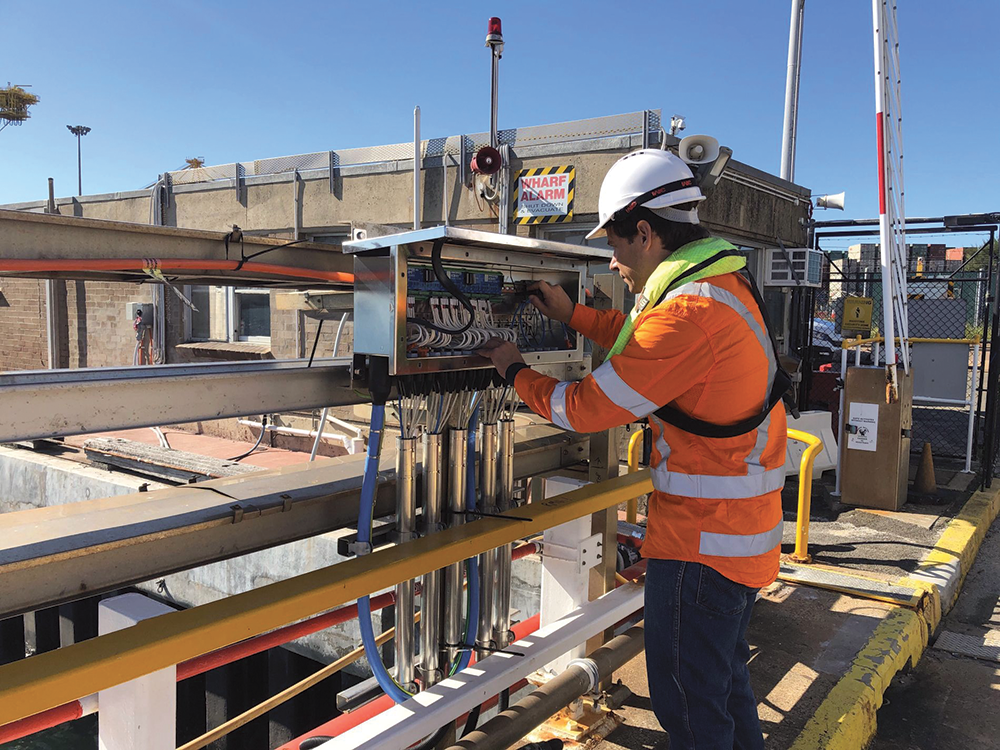
All impressed current CP (ICCP) systems use a transformer rectifier unit (T/R) to supply the necessary electrical current for ongoing protection. There are two main types of T/R to choose from for ICCP systems: phase control and switch-mode.
In phase control systems, AC power is passed through a large AC transformer before being rectified to produce a controlled DC output to the anodes. In switch-mode systems, AC power is first rectified to high voltage DC power and then much smaller high frequency transformers and rectifiers are used to create controlled DC outputs. This technique allows smaller and more efficient outputs to be created that can be more easily controlled.
While phase control systems were the historical go-to for CP consultants globally, ESG commitments, which are becoming increasingly important for asset owners, make switch-mode systems more compelling than ever. This is particularly true for concrete structures where a larger number of small zones need to be protected.
CP system design supports ESG
For asset owners and infrastructure managers, ESG is becoming increasingly crucial for driving sustainable and responsible operations while enhancing long-term value. Strong ESG practices mitigate environmental risks such as corrosion and climate change impacts, ensure worker safety and promote transparent, data-driven decision making. Furthermore, ESG initiatives align operations with global sustainability goals, reinforcing a commitment to preserving resources and fostering resilience in critical infrastructure.
Reduction of CO2 emissions, and therefore increasing electrical power usage efficiency, is a major factor when reporting ESG. This is an area where switch-mode CP systems excel compared with phase control systems. A phase control system running at 100% capacity is at best 80 to 85% efficient. However, because of oversizing, systems never run at a 100% capacity. In real-world applications, phase control systems generally operate at 60% efficiency at most.
Furthermore, as phase control systems rely on a single large T/R to distribute current across a whole structure, they require extensive copper cabling for use. This is both extremely expensive and causes power loss. In fact, phase control systems often lose around half their voltage in the cabling, further reducing the efficiency. Alternatively, switch-mode CP systems consistently operate at 90% efficiency, even when running at 50% capacity, meaning overall power consumption is dramatically lower than in phase control systems.
Small, compact switch-mode T/Rs also make the technology ideal for use in distributed CP systems on large structures, where locating T/Rs closer to the anodes significantly reduces installation costs due to reduced cabling while lowering energy costs due to reduced volt drops in the cabling. By placing T/Rs closer to individual anodes in this way, copper losses are largely eliminated and over 80% of the power supplied reaches the anodes. Beyond the lower installation costs for switch-mode systems, they are also more sustainable, with CO2 emissions often less than half of those generated when installing a phase control system.
Another way to improve ESG criteria for systems is to incorporate remote monitoring. This provides asset owners with access to real-time data on an ongoing basis including total power consumption, anode current outputs, reference electrode test data and anode health condition.
Using this live data, engineers can quickly identify abnormalities and address any problems before they escalate, ensuring ongoing asset protection. Furthermore, as CP protected infrastructure is often located in hazardous and difficult-to-access environments, using remote monitoring can lessen the need for technicians to physically inspect systems, improving worker safety.
In an increasingly ESG-conscious world, adopting a CP system design philosophy that lowers costs, power consumption and CO2 emissions while providing more data for owners and managers and improving worker safety is the answer.
To find out more about Omniflex’s cathodic protection offering visit www.tinyurl.com/y4w8vhf9
| Tel: | +27 31 207 7466 |
| Email: | [email protected] |
| www: | www.omniflex.com |
| Articles: | More information and articles about Omniflex Remote Monitoring Specialists |






© Technews Publishing (Pty) Ltd | All Rights Reserved
 printer friendly version