



Industries across the board are under constant pressure to improve uptime, reduce maintenance costs and operate with greater energy efficiency, making predictive maintenance through condition monitoring a strategic imperative.
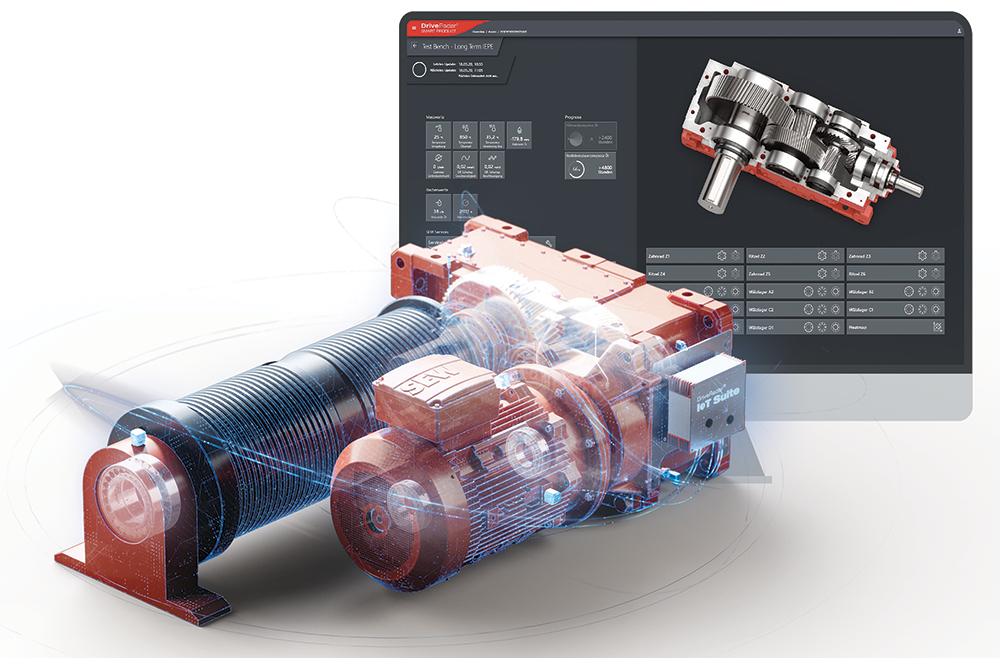

This certainly applies to the field of gears, geared motors and drive technology, which is vital to sectors from mining and automotive to harbours, airports, agriculture, food and beverage production. According to Willem Strydom, business development manager for Electronics at SEW-EURODRIVE, the take-up of predictive maintenance strategies and tools is accelerating across industries.
“We see customers increasingly demanding smarter and more reliable asset information, making our DriveRadar IoT Suite an ideal solution for industrial condition monitoring,” Strydom says. “This powerful ecosystem of intelligent sensors, edge devices and cloud-based analytics ensures that customers have full visibility and control of their operations.”
Replacing manual surveys
Werner Engelbrecht, works manager Megatronic at SEW-EURODRIVE says that these technologies are fast replacing traditional plant maintenance practices, which tend to be time consuming and labour intensive. He points out that before digitalisation one of the most common techniques for diagnosing plant health was the manual plant survey. Conducting a plant survey manually was not always very accurate, and within a year there would be many changes as equipment was replaced or repaired. In contrast, DriveRadar can record every new item of equipment that is added to the plant, so the customer has a live view of exactly what is in the plant and how it is performing.

He adds that real-time accuracy becomes increasingly important as plant layouts evolve. Unlike manual surveys, DriveRadar stays continuously up to date, automatically building and refreshing a complete digital asset list.
Avoiding failure
“If you listen to the system, you should never have a critical or catastrophic failure,” he says. “One of the biggest advantage lies in optimising your human resources, as people don’t need to walk the plant frequently to check equipment.”
Strydom explains that unlike many monitoring platforms that rely solely on add-on sensors, DriveRadar leverages SEW-EURODRIVE’s deep integration between drives, motors, gear units and digital data interfaces. “A key differentiator of our DriveRadar solution is the use of our frequency inverters, which function as perfect sensors in combination with our DDI Technology,” he says. “Each of our inverters performs as a meter to measure time of operation and energy use, as a torque sensor to measure the actual load and to protect your application, and as a vibration sensor to detect bad oscillations or shocks in your application.”
The inverters are able to generate high resolution scope measurements and hundreds of parameters per device, feeding advanced analytics and machine-learning models. Through its built-in motor sensors and optional advanced vibration sensors, DriveRadar is able to take temperature and ambient measurements, oil level and oil ageing indicators, load and torque measurements, and vibration signatures extracted directly from motor harmonics.
Digital twin
“These are fairly common parameters, but what sets our system apart is that we consider all the feedback together to create a digital twin of the equipment,” Strydom says. “Our AI-driven digital twin technology equips DriveRadar to automatically learn the baseline operating behaviour of a motor, gearbox or complete drive system once it is commissioned. That baseline is then used to monitor any anomalies in the equipment’s performance.”
This digital twin makes it possible to detect bearing damage early or to predict remaining brake lining life. The customer can also forecast oil replacement intervals, identify load inefficiencies or detect structural faults in connected machinery. Engelbrecht notes that DriveRadar’s ability to monitor ancillary equipment is another of its distinguishing features. By functioning as a holistic monitoring system for entire applications, it can monitor not only SEW-EURODRIVE components, but also non-SEW-EURODRIVE elements.
“On a conveyor system, for example, you can compare the load before and after maintenance to assess the power saving achieved,” he says. “You can also identify damaged rails or alignment issues on pick-and-place machines through vibration curves, even if that problem is on third-party equipment.”
Easy access to data
The DriveRadar IoT Suite includes edge devices, cloud analytics and mobile access, making it highly flexible for different industries and plant sizes. The system allows data to be fed into the SEW-EURODRIVE cloud, the customer’s private cloud, local plant servers or existing scada systems.
“Data can be also viewed on mobile devices and in remote regions using GSM/SIM-based communication, providing a valuable mobility advantage,” he says. “As long as you have a data connection, you can access data from every item of equipment in your plant from a phone or tablet. You can even generate the same reports from a cell phone as you can from a laptop.”
He adds that this capability is appreciated particularly by maintenance teams in large plants. “You don’t have to walk around anymore with a thermal gun to manually monitor the condition of equipment, for instance. You can see issues on your phone and act immediately.”
Warning systems
DriveRadar’s smart notification system ensures that early warnings are never missed. At the Tier 1 level, the system will immediate notify the customer of any anomaly by SMS, WhatsApp, email or a push notification on the app. At Tier 2, this notification is escalated to supervisors or engineers, and at Tier 3 the equipment can be shut down automatically to prevent failure if no one responds and the risk becomes critical.
This combination of automation and human-centred escalation drastically reduces unplanned downtime. Of course, to ensure that these tools are optimally employed, the users need to fully understand the operation and technicalities, so SEW-EURODRIVE has invested heavily in training and skills.
“The intensive training of our own people included drawing on the SEW-EURODRIVE group’s expertise at our global head office in Germany,” he says. “We can now deliver training both on customers’ sites and at our Drive Academy at our Johannesburg headquarters.”
He notes that the company has run comprehensive trials with major customers in South Africa with excellent results. To underpin the roll-out, SEW-EURODRIVE now has fully qualified local technicians and engineers to initialise and support DriveRadar installations.
For more information contact SEW-EURODRIVE,
| Tel: | +27 11 248 7000 |
| Email: | [email protected] |
| www: | www.sew-eurodrive.co.za |
| Articles: | More information and articles about SEW-EURODRIVE |






© Technews Publishing (Pty) Ltd | All Rights Reserved
 printer friendly version