


Fieldbus & Industrial Networking


Rugged, agile and scalable boards

November 2024 Fieldbus & Industrial Networking


Embedded computing pioneer, AAEON has launched the PICO-ASL4 and GENE-ASL6, both featuring the new Intel Atom x7000RE Processor Series for the edge (formerly Amston Lake). Both the 6,3 cm PICO-ITX and 8,9 cm SubCompact Board go to market with models equipped with Intel Atom x7433RE and Intel Atom x7835RE, while the GENE-ASL6 will also have the adoption of the Intel Atom x7213RE Processor, with all three maxing out at 12 W.

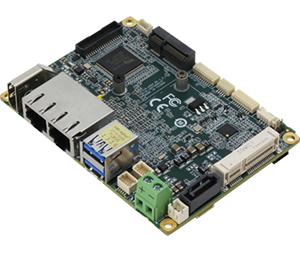
Built on the standard 100 mm x 72 mm PICO-ITX form factor, the PICO-ASL4 offers extensive onboard options, including dual LAN and six USB ports, along with Intel time-coordinated computing and time-sensitive networking (TSN). As a result, AAEON has identified this compact solution as an ideal choice for those seeking a discreet single-board computer capable of managing latency-sensitive workloads in fields such as smart transportation and manufacturing.

The PICO-ASL4 showcases innovative design by eliminating the product line’s standard heat spreader, instead employing a slim, all-in-one heatsink. This change results in a more low-profile board, while still maintaining a default temperature tolerance range of -40 to 85°C. Additionally, the PICO-ASL4 distinguishes itself from previous models with its SODIMM-based system memory, which supports up to 16 GB of DDR5.

Despite its extensive temperature range and thermal design modifications, the PICO-ASL4 maintains a fully functional I/O, featuring dual LAN ports (both 2.5GbE and 1GbE), dual USB 3.2 Gen 2 ports, and an HDMI 1.4 port. The board’s internal connectors provide access to serial communication through four COM port headers, a 4-bit GPIO, and SMBus/I2C. Enhancing its display capabilities are LVDS and optional eDP 1.4, granting users two simultaneous displays.

While the PICO-ASL4 shows promise in the smart transportation and manufacturing sectors, the GENE-ASL6 is specifically designed for edge gateway and digital signage applications. This board supports three simultaneous displays via its HDMI, VGA and LVDS interfaces, and it includes audio functionality with Line-In, Line-Out and microphone options. This combination also paves the way for potential smart kiosk deployments, where the GENE-ASL6’s optional TPM 2.0 and CPU-native encryption and decryption optimisations provide significant advantages.

For edge device applications, the GENE-ASL6 features three LAN ports, each operating at 2.5 GbE. It also supports advanced serial communication through four COM connectors (two RS-232/422/485 and two RS-232), an 8-bit GPIO, and SMBus/I2C. Additionally, the board offers an impressive array of expansion options, including an M.2 2230 E-Key, an M.2 3052 B-Key, a Nano SIM card slot, and a full-size mSATA/mPCIe slot. These options facilitate the integration of wireless communication modules for Wi-Fi and 5G, as well as high-speed storage solutions.

Much like its counterpart, the GENE-ASL6 sees schematic innovation with a solder-side design, which allows for higher component density, without compromising signal integrity or causing mechanical stress via optimised fanless heat dissipation, granting it a broad operating temperature of -40 to 85°C.


Credit(s)


Share this article:
Share via emailShare via LinkedInPrint this page

Further reading:

Introduction to Part 2 loop signatures and process transfer functions
Fieldbus & Industrial Networking
The previous series of loop signature articles dealt with the basics of control loop optimisation, and concentrated on troubleshooting and ‘SWAG’ tuning of simple processes. In this new series, consideration will be given to dealing practically with more difficult issues like interactive processes, and with processes with much more complex dynamics.

Read more...
Siemens sets new standards in drive technology
Fieldbus & Industrial Networking
Siemens is setting new standards in industrial drive technology with the launch of its new high-performance drive system, Sinamics S220. This offers a seamless and innovative drive system with comprehensive simulation and analysis capabilities and advanced connectivity features that enable full integration into digital work processes.

Read more...
PC-based control in the plastics industry
Beckhoff Automation Fieldbus & Industrial Networking
Nissei Plastic, an injection moulding machine manufacturer based in Japan is implementing a worldwide tend towards open automation systems from experienced specialists using PC and EtherCAT-based control technology from Beckhoff.

Read more...
Loop Signature 31: Non-linearity in control loops (Part 2)
Michael Brown Control Engineering Fieldbus & Industrial Networking
This article is a continuation of Loop Signature 30 published in the last issue in this series, exploring reasons for non-linearities which may be encountered in feedback control loops

Read more...
PC-based control optimises robotic parts handling on plastics machinery
Beckhoff Automation Editor's Choice Fieldbus & Industrial Networking
NEO is a cartesian robot developed by INAUTOM Robótica in Portugal for parts removal on plastics machinery. Its aim is to increase system productivity. NAUTOM Robótica has entered into a strategic partnership with Bresimar Automação to increase the working speed of the cartesian robots using advanced control and motion solutions from Beckhoff. The result is a comprehensive, future-proof automation solution for its entire family of cartesian robots.

Read more...
PC-based control for flat wire motors for electric vehicles
Beckhoff Automation Fieldbus & Industrial Networking
Special machine manufacturer, ruhlamat Huarui Automation Technologies unveiled the second generation of its mass production line for flexible stators with bar winding. This enables extremely short production cycle and line changeover times, supported by PC- and EtherCAT-based control technology from Beckhoff.

Read more...
Case History 200: The final case history – desuperheater control problem.
Michael Brown Control Engineering Editor's Choice Fieldbus & Industrial Networking
For this final article I have chosen to relate a problem that existed in a desuperheater temperature control on a boiler in a petrochemical refinery.

Read more...
PC-based control technology in additive manufacturing
Beckhoff Automation Editor's Choice Fieldbus & Industrial Networking
As an open control platform, PC-based control supports different engineering approaches, including low-code programming. The machine builder, Additive Industries uses this to create the code for the TwinCAT runtime of its 3D printers.

Read more...
Suppression and safety solutions for fire and gas in mission-critical industries
Fieldbus & Industrial Networking
By representing world-leading brands and focusing on fully integrated, certified systems, HMA South Africa is positioning itself as a trusted partner in fire detection, suppression and explosion-proof safety solutions across the continent.

Read more...
Integrating fire alarm systems into building management systems
Beckhoff Automation Fieldbus & Industrial Networking
Fire alarm systems work independently of the building automation system. Schrack Seconet has developed a flexible gateway using ultra-compact industrial PCs and TwinCAT from Beckhoff, which can be used to flexibly convert a customer-specific communication protocol to a wide range of transmission standards.

Read more...


While every effort has been made to ensure the accuracy of the information contained herein, the publisher and its agents cannot be held responsible for any errors contained, or any loss incurred as a result. Articles published do not necessarily reflect the views of the publishers. The editor reserves the right to alter or cut copy. Articles submitted are deemed to have been cleared for publication. Advertisements and company contact details are published as provided by the advertiser. Technews Publishing (Pty) Ltd cannot be held responsible for the accuracy or veracity of supplied material.


© Technews Publishing (Pty) Ltd | All Rights Reserved

