Editor's Choice


Open control system for retrofit of conveyor control system

November 2024 Editor's Choice

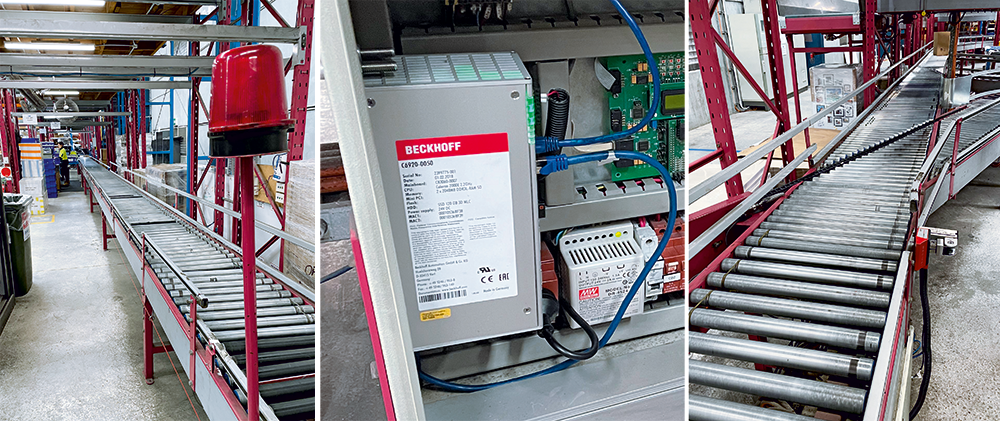
For every online retailer, warehouse logistics is part of the critical infrastructure. If the conveyor lines come to a standstill, it generally won’t be possible for any more packages to get out. To prevent this, an Australian office equipment supplier has retrofitted the warehouse logistics installation of its central warehouse. In its role as project manager, Layer Seven Automation replaced the proprietary decentralised controllers of the conveyor lines with PC-based control from Beckhoff, based on powerful EtherCAT communication.

The end user is one of Australia’s leading office equipment suppliers, with a broad portfolio ranging from office supplies and computers to office furniture. The company operates more than 100 stores across Australia, and an online store with more than 40 000 products. At the main distribution centre, the stored goods are removed from shelves and packed into boxes, then transported along various conveyor lines with a total length of 700 m and 28 distribution stations, and prepared for dispatch.

The conveyor lines operated reliably for many years, but it became apparent that the systems were reaching the end of their service life. Malfunctions were occurring more frequently, and the required spare parts had become increasingly difficult to obtain and more expensive due to the age of the system. As a result, the management of the office equipment supplier commissioned Layer Seven Automation from Bella Vista in Sydney, which specialises in warehousing and logistics projects, to develop a concept that would modernise the warehousing system.

The evaluation revealed that the mechanics of the main conveyor belt were still in a usable state, but that the control system needed to be replaced. Lucky Thommadura, co-founder and chief engineer at Layer Seven Automation, says: “One of the disadvantages of the conveyor system was its proprietary structure. Every part had to be purchased from the manufacturer, which would have made it even more difficult to expand the system.” As a result, the decision was made to configure an open system based on off-the-shelf products. “This would offer a futureproof solution and reduce maintenance costs.”

One industrial PC replaces 28 controllers

The original system configuration was based on one controller and one barcode scanner for each distribution station. Layer Seven Automation’s aim was to create a centralised control architecture that would increase the efficiency of the system, and reduce costs.

The barcode scanners at each station are essential for recording the contents of the boxes. Here, Layer Seven Automation opted for scanners that can be configured via an EtherCAT interface, and have integrated I/Os for simple control functions. The inputs are used to detect the boxes via opto sensors, for example while the outputs are used to switch the switches or pushers according to the destination station.

First, a single distribution station was converted and its scanner was connected to a C6920 control cabinet Industrial PC from Beckhoff via EtherCAT. Following successful tests, all 28 stations were migrated in stages and networked with the C6920 in a linear structure (daisy chain). Thommadura comments: “The technicians of the logistics company and I were surprised by the compactness of the solution, the fast update rates of the EtherCAT network, and the overall speed of the controller. The barcode on the box has to be scanned and forwarded to the industrial PC via EtherCAT. There, the application determines whether the switch of the corresponding station needs to be switched, and sends this information back to the barcode scanner via EtherCAT. “The Beckhoff Industrial PC manages the extensive calculations in around 100 µs, which is phenomenally fast, and yet we still have reserves.”

Even though there has not yet been a network failure, carelessness can quickly cause a cable break and thus a failure of the entire system. A shutdown of this kind would have a significant impact on productivity, especially in such a large-scale logistics installation. There are therefore concrete plans to implement cable redundancy, which is easy to retrofit with EtherCAT.

Engineering with IT methods

The engineering team at Layer Seven Automation has extensive experience in the general software and computing sector, for example in setting up databases or creating web servers. Until this project, however, Thommadura and his team had not yet come into contact with the automation environment. “We knew that all of this would be new to us. But when I discovered how EtherCAT works, what an industrial PC is, and how easily we can combine Windows with a virtual PLC, it all made sense. The virtual machine in particular enabled me to test the program via a laptop from home, at work or on site.” The fact that TwinCAT is integrated in Visual Studio was another reason for the chief engineer to invest in Beckhoff and EtherCAT. “I really believe that this is the way automation technology needs to go – away from closed systems with ladder diagram programming and outdated signal processing. We need to take established software design and architecture practices and combine them with automated testing, so that we can deliver our solutions more effectively,” Thommadura adds.

PC-based control: Secure, open and flexible

According to Layer Seven Automation, a major advantage of PC-based control is that the control architecture is easy to integrate into existing IT systems. This was another pleasant surprise for Thommadura. He says that many IT departments have very strict security requirements, but Windows is always easy to integrate. The firewall, security settings and global user administration have made our work here much easier.” The option to use Windows has also enabled Layer Seven Automation to combine its own programs with TwinCAT:

For example, an SQL database was integrated via TwinCAT 3 Database Server (TF6420), which archives the details of a box every time it is scanned. This action is permanently recorded and logged in the TwinCAT 3 EventLogger. In addition, a dedicated message queue

system was created, which uses the ADS protocol to extract data and ultimately link it to the RabbitMQ message broker software. “ADS technology from Beckhoff offers almost unlimited possibilities. We use ADS to collect the recorded volumes of data and distribute them both horizontally and vertically. It can also be used to easily integrate almost any MES or ERP system,” adds Thommadura.


Credit(s)


Share this article:
Share via emailShare via LinkedInPrint this page

Further reading:

South Africa’s space balls
Editor's Choice News
South African engineers are preparing to take low-frequency radio astronomy to the Moon with three locally developed B.A.L.L.S. spheres aboard China’s Chang’e-8 mission. This could pave the way for a 55-antenna lunar array and marks another step in the country’s growing space engineering capability.

Read more...
Practical tips to build a successful engineering career
Editor's Choice
Award-winning civil engineer, Tinashe Mukalela of AvenirHoldings shares ten practical tips for young engineers navigating a competitive job market, from professional registration and mentorship to emotional intelligence and leadership development.

Read more...
Why mining operations need local lightning early warning
Senseca Editor's Choice Electrical Power & Protection
Lightning can develop into a serious mining hazard before the first local strike, leaving crews little time to stop work and reach safety. Local early-warning technology can provide valuable lead time, allowing mines to connect developing storm conditions to defined trigger actions that protect people, explosives and equipment.

Read more...
XPlanar aids innovation in laser processing
Beckhoff Automation Editor's Choice Motion Control & Drives
Aalborg University is among the first in the world to test Beckhoff’s XPlanar intelligent transport system in advanced laser processes, achieving micrometer-precise workpiece positioning and dramatically shorter lead times compared with traditional tool-based manufacturing.

Read more...
The wireless route to safer, more efficient mining operations
Emerson Automation Solutions Editor's Choice Sensors & Transducers
Modern wireless level measurement technologies are helping mining operations improve process control, increase safety and reduce installation costs. Emerson’s Rosemount 3408 wireless non-contacting radar level transmitter uses 80 GHz frequency-modulated continuous wave radar with HART communication to reach remote assets where cabling is impractical.

Read more...
Nine things your emergency control room must now have
Oculus Operational Innovations Editor's Choice IS & Ex
A new South African regulation, effective since March 2025 with no transition period, sets out nine mandatory requirements for underground mine emergency control rooms, and specifies who must be in charge at all times.

Read more...
AES maintains a strong value and safety stance on boiler retrofits
Editor's Choice
When retrofitting and upgrading boilers, operational experience, technical knowledge of different boiler types, operating conditions and water treatment count. Through operating 79 boilers, AES knows what works and what does not.

Read more...
XPlanar aids innovation in laser processing
Beckhoff Automation Fieldbus & Industrial Networking
Aalborg University is among the first in the world to test Beckhoff’s XPlanar intelligent transport system in advanced laser processes, opening the door to faster, tool-free production of metal parts.

Read more...
The data-driven path to sustainable manufacturing
ifm - South Africa Editor's Choice Sensors & Transducers
Smart automation is closing the gap between operational efficiency and environmental responsibility, and the data to do it is already inside the plant. With ifm’s sensing and digitalisation technologies, manufacturers can turn machine intelligence into measurable sustainability gains.

Read more...
The hydrogen economy is moving from concept to industrial reality
VEGA Controls SA Editor's Choice Pressure Measurement & Control
Scaling the hydrogen economy requires safe, efficient and tightly controlled processes across generation, storage, distribution and end use, underpinned by accurate instrumentation for pressure, temperature, level and flow measurement.

Read more...


While every effort has been made to ensure the accuracy of the information contained herein, the publisher and its agents cannot be held responsible for any errors contained, or any loss incurred as a result. Articles published do not necessarily reflect the views of the publishers. The editor reserves the right to alter or cut copy. Articles submitted are deemed to have been cleared for publication. Advertisements and company contact details are published as provided by the advertiser. Technews Publishing (Pty) Ltd cannot be held responsible for the accuracy or veracity of supplied material.


© Technews Publishing (Pty) Ltd | All Rights Reserved