



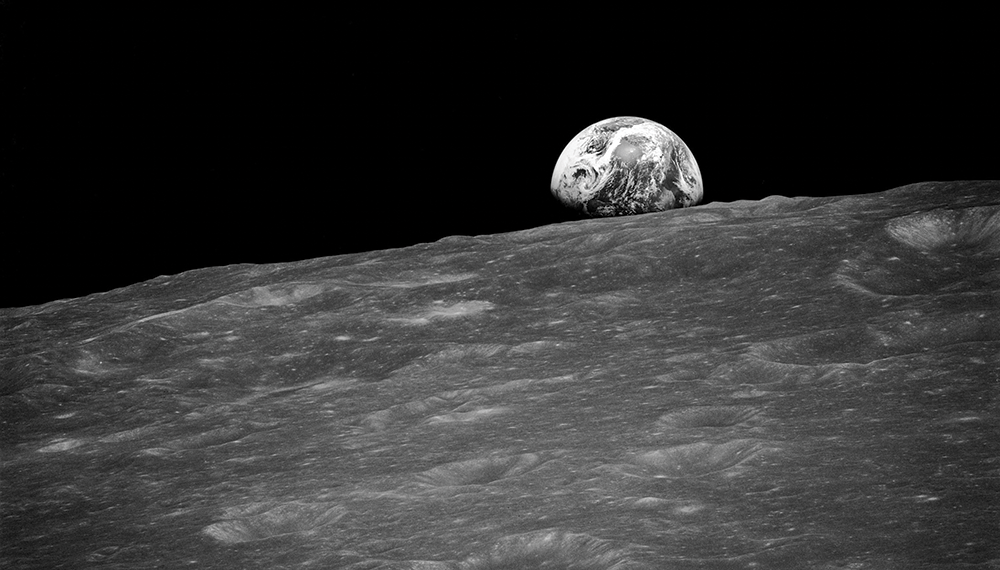
NASA is planning for a sustained human presence on the Moon, and resources such as water could eventually be harnessed from the lunar surface instead of being transported from Earth. Scientists have discovered water ice in areas of the lunar South Pole that are permanently shadowed from the sun’s rays. NASA has turned to industry to find ways to excavate and transport that icy regolith through its Break The Ice Lunar Challenge.
Responding to the challenge, Moog assembled a team of engineers with expertise in mechanical, electrical, systems and robotics engineering to participate. Liam Hilbert, Moog’s technical project lead, explains how the team developed a robotic excavator concept designed to withstand extreme conditions on permanently dark areas of the moon.
In 2022, the Moog team developed a robotic lunar excavator concept based on NASA’s targets for size, scale and duration of a potential mission. The goal was to dig the icy regolith out of the ground and bring it to a site where the volatiles could be extracted, all while operating in an extremely cold environment. Turning the icy mixture into water was a separate challenge.
While the technology draws on Moog’s experience in space, and new ventures into construction, there are unique challenges associated with the Break the Ice Lunar Challenge. “Temperatures can reach -233°C, and the vehicle must operate in those temperatures. The surface is extremely cold, and the loss of heat due to conduction and radiation is a concern,” says Hilbert. Another element to consider is excavating in a
low-gravity environment that makes it very difficult to dig. This must balance with mass and energy efficiency to be able to transport the regolith.
Using simulated regolith derived from a concrete mix specified by NASA, the team created and tested a prototype excavator at Moog’s facilities in New York. The concept vehicle uses a translating auger that penetrates the regolith, lifts it into the vehicle, and transports it to the processing site. On the lunar surface, the system would employ solar panels both on the vehicles and at the processing site to provide power to the vehicle batteries.
“Moog’s concept for an automated regolith excavation system is designed to withstand the harsh conditions of the lunar surface. Cold temperatures, low gravity, and lunar dust contamination are some of the primary challenges we’re going to face,” explains Hilbert.
The Moog system is designed to excavate and transport thousands of kilograms of icy regolith for long distances, while also being mass and energy efficient.
The Moog team submitted a white paper outlining the technical details to NASA’s Break the Ice Challenge. In December 2022, NASA announced Moog as one of 15 winning teams.
Before lunar rovers are sent to excavate the icy regolith, NASA will conduct resource mapping on the moon’s South Pole using its Volatiles Investigating Polar Exploration Rover (VIPER). Equipped with Moog radiation-hardened avionics hardware, including the main computer and power management source for the rover, VIPER will land on the lunar surface at the end of 2024 for a 100-day mission. VIPER will help determine whether in situ resource utilisation such as water extraction may eventually enable long-term human lunar habitation.
NASA’s VIPER will give us a much better idea of what the conditions are like, and what form the icy regolith is in,” says Hilbert. Following the VIPER mission, the next milestone is NASA’s Artemis 3 mission, which will land a crew by the lunar South Pole at the earliest in 2025. Moog’s space products play a critical role during every stage of the Artemis missions, from liftoff to landing.
After winning NASA’s Break the Ice Challenge Phase 2, Level 1, the Moog team is excited to continue its involvement in lunar exploration. “There’s a lot of work to be done before Artemis III brings astronauts back to the moon, and we want to be a part of it,” concludes Hilbert.






© Technews Publishing (Pty) Ltd | All Rights Reserved
 printer friendly version