



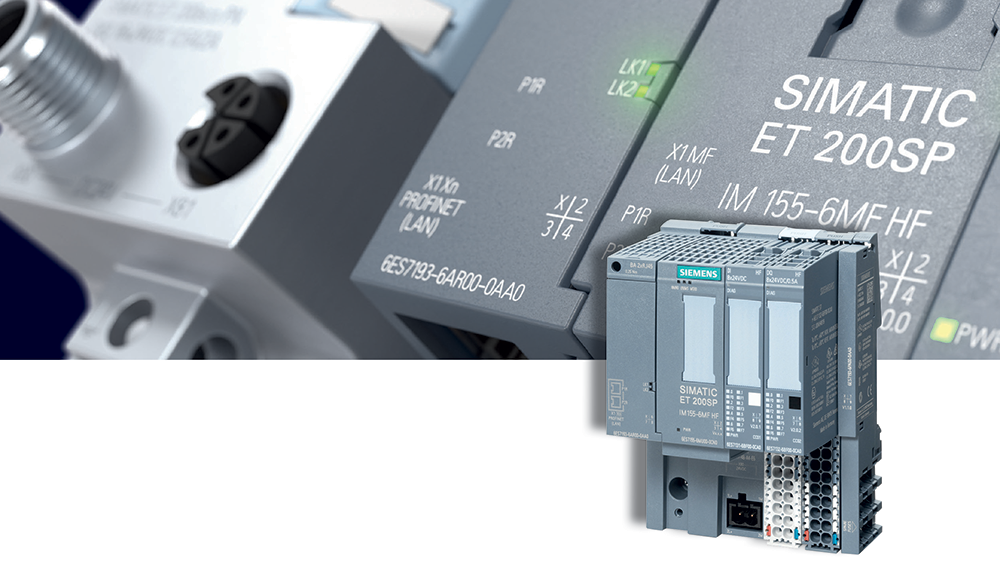
In the course of digitalisation, the communication capability of field devices is becoming increasingly important. With the MultiFieldbus module, Siemens has developed a communication interface, for the first time, that supports data exchange via the three Ethernet fieldbus protocols PROFINET, EtherNet/IP and Modbus TCP. This makes it possible for plant manufacturers to implement industry-specific or regionally-different requirements without having to change the system - and to open up new markets.
Conversely, the MultiFieldbus interface module expands the range of applications of the ET 200SP peripheral system. The MultiFieldbus Configuration Tool, developed in parallel, ensures quick and intuitive configuration of the look and feel of the TIA Portal. The development of the MultiFieldbus interface took place with the involvement of many pilot customers in all regions of the world, which ensured functionality that was closely tailored to requirements, right from the time of delivery. Great importance was placed on a high level of user friendliness. One of the first projects implemented was a tunnel automation project by Dürr Austria. This demonstrated the practical suitability and performance of the MultiFieldbus interface.
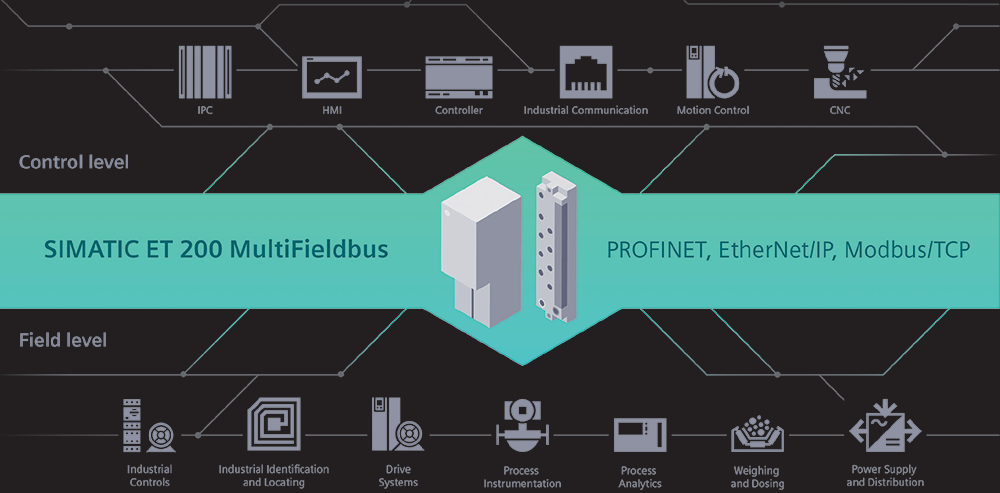
One fieldbus, multiple Ethernet protocols
With the MultiFieldbus it is possible to benefit from the openness and versatility of PROFINET, Ethernet/IP and Modbus/TCP industrial communication. There is freedom to choose between them for any application. This allows the optimal protocol to be used for an application, and makes the machine data accessible to the IT function, regardless of the type of fieldbus.
End users generally want the open source Modbus/TCP protocol, the real-time PROFINET or the frequently used Ethernet/IP as Ethernet protocols, depending on the intended use. With the MultiFieldbus, machine builders are able to tailor their machines to requirements without complex adjustments to the I/Os. The SIMATIC ET 200 MultiFieldbus interface modules can communicate simultaneously and exchange data with the controllers via the various protocols. These are some of the typical applications:
PROFINET: Due to its high performance, deterministic communication via the PROFINET protocol it is primarily used for real-time and safety-related applications in industry. With PROFINET, high-speed motion control applications are also possible. PROFINET is the ideal basis for OT/IT integration in an application.
Ethernet/IP: This is relatively easy to implement and uses the unmodified standard Ethernet protocol. This allows it to be used with standard Ethernet devices. For multi-axis motion control applications, CIP Motion is also required. Ethernet/IP enables the exchange of data from the field to layered IT systems.
Modbus/TCP: This is an easy-to-use TCP/IP-based protocol that is used for energy data collection when timing is not critical, among other applications. It is therefore also well suited for data exchange with the IT level.
Overcoming bus limits
The MultiFieldbus is located on the border between controllers and field devices. Thanks to the support of several Ethernet protocols, it is no problem if the controller has to be replaced and another protocol is used, as the MultiFieldbus interface modules can be used independently. When exporting machines to different regions, there is no need to replace the I/Os. MultiFieldbus devices are available in protection classes IP20 and IP67.
Flexible communication and limitless data distribution
With the MultiFieldbus, there is no need to replace the I/Os, and it can flexibly meet the requirements placed on the machines. The MultiFieldbus Configuration helps to efficiently configure for the Modbus/TCP and Ethernet/IP protocols. Thanks to its versatility, the data can be easily distributed and used at all levels in the company.
Automation with SIMATIC ET 200SP: flexible, powerful, smart
SIMATIC ET 200SP is the scalable I/O system for the control cabinet, and supports all important Ethernet protocols with the IM155-6MF high feature MultiFieldbus interface module. No matter whether you are looking for space-saving solutions for the control cabinet, or robust modules with IP65/IP67 degree of protection, with the SIMATIC ET 200 range you can fulfill almost any requirement cost effectively. Permanent data availability, from engineering to plant operation, makes the ET 200 an integrated data hub. You are investing in the futureproofing of your machines, ready for new business models such as ‘production as a service’.
Integrated and optimised data availability along the entire value chain is the basis for innovative business models. This also places special demands on your distributed I/O, for example flexible scalability of the systems, high-performance hardware in the field, and smart features. With SIMATIC ET 200 you get more out of your data, and tap the full potential of your I/O system.
In particular, the SIMATIC ET 200SP is easy to install and extremely user friendly, and is known for its reliability and safety. Its features include:
Easy station setup: Both the modules and the terminal boxes can be replaced during operation. Thanks to mechanical coding of the I/O modules with the BaseUnit, mix-up of the modules is prevented during installation.
Fast wiring: Thanks to the push-in terminal, you do not require a tool while wiring, and you require only a screwdriver when removing the cable.
Interchangeable BusAdapters: With BusAdapters, your SIMATIC ET 200SP gives you free choice of connection system. Exchanging the BusAdapters is easy and user friendly.
Reliable diagnostics: SIMATIC ET 200SP continuously provides detailed information on the system state. The diagnostics take place channel-specifically via the signalling at the I/O module, without any additional engineering.
SIMATIC ET 200eco PN: the block I/O for cabinet-free setup
The compact ET 200eco PN is the new generation of extremely robust block peripherals and includes the Multifieldbus function to support the relevant Ethernet protocols. It is a particularly rugged I/O device, with IP65/67/69K protection. The special zinc pressurised housing guarantees protection, even in challenging environmental conditions and temperatures from -40 to 60°C. Its block I/O allows flexible configuration, simple installation and fast commissioning. It is especially well suited for use at machine level.
With the ET 200eco PN, fail-safe digital, analogue and IO-Link signals can be processed in PROFINET. These I/O devices, with M12-L coded power connectors, are designed for use on a wide range of Ethernet controllers. This is due to the support of the PROFINET, EtherNet/IP and Modbus TCP protocols.
Here are some of the features of the SIMATIC ET 200eco PN modules:
• Signal modules allow a scalable and cost-optimised structure. Digital and analogue signal input and output modules are available.
• Fail-safe components realise safe applications. The safety functions required for fail-safe operation are integrated into the fail-safe input/output module.
• IO-Link allows sensors and actuators from different manufacturers to be integrated easily. Configuration can be performed using a GSD file or S7-PCT.
Benefits of the SIMATIC ET 200eco PN include simple and flexible installation and wiring thanks to the intelligent product design; shorter commissioning times and plant downtimes thanks to channel-specific diagnostics; and the compact design.
ET 200eco PN I/O devices can be easily installed in every position, so vertical or horizontal installation is possible. They are screwed from the front or side into a machine or assembly line directly on site, where they use M12 connections to connect sensors and actuators.
Bus coupling with the PN/MF Coupler
With the new PN/MF Coupler bus coupling you can connect an Ethernet/IP
network to a PROFINET subnet or connect two PROFINET subnets with each other. You can achieve maximum data security in both networks. It allows quick and easy data exchange between two controllers, even across network boundaries. Compared to a programmed communication between two controllers, the PN/MF Coupler offers the following benefits:
• Simple configuration using I/O data modules, regardless of whether via PROFINET or EtherNet/IP protocol.
• Large configuration limits.
• Almost delay-free coupling of data between the subnets, and thus deterministic data exchange because it is an I/O communication.
• Complete network separation, so there is no influence on neighbouring subnets through fault states.
• Diagnostics of fault states of own and neighbouring subnet.
• Redundant power supply if needed.
Further information on MultiFieldbus can be found at SIMATIC MultiFieldbus - Distributed IO - Global (siemens.com).
| Tel: | +27 11 652 2000 |
| Email: | [email protected] |
| www: | www.siemens.co.za |
| Articles: | More information and articles about Siemens South Africa |






© Technews Publishing (Pty) Ltd | All Rights Reserved
 printer friendly version