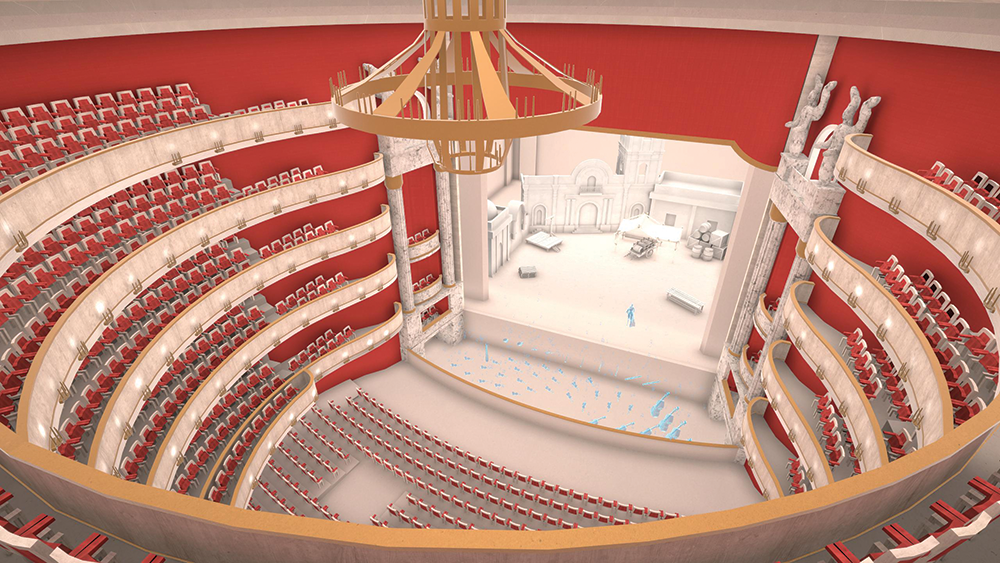
Siemens and the Bavarian State Opera are digitalising the acoustics in Bavaria’s National Theatre in Munich, Germany. The result is a digital twin that simulates sound effects, orchestral setups and venue configurations in a realistic 3D acoustic model so that musicians, the director and conductors can assess a concert hall’s acoustics even before the first rehearsal. The Sound of Science, a mixed-reality application, allows users to acoustically test various orchestral setups and audience positions in Bavaria’s National Theatre with the help of virtual reality goggles, independently of the users’ physical location.
Siemens launched the Sound of Science at the Salzburg Festival in 2024. In developing the application for Bavaria’s National Theatre, the company is now using it to enhance the performance of yet another internationally renowned cultural institution. Released just in time for the Munich Opera Festival, the current version includes additional concert hall configurations and new acoustic scenarios. For example, a stage set can now be incorporated and the orchestra’s position varied. To achieve a realistic sound assessment, a vocal part sung by soprano Emilie Sierra, a member of the Bavarian State Opera, and accompanied by the Bavarian State Orchestra has been integrated into the application for the first time.
“Siemens and the Bavarian State Opera share a long-standing, trust-based partnership marked by a common pursuit of excellence and innovation,” said Serge Dorny, general director of the Bavarian State Opera. “We’re looking forward to the new perspectives that our digital strategy will create and are excited by the variety of possible applications that will emerge from the joint Sound of Science project.”
“The idea for the Sound of Science application was spawned by the trend toward increasingly shorter rehearsal times and rising concert logistics costs. Our simulation of realistic stage productions enables theatre professionals to plan much more precisely in advance, while giving audiences a preliminary impression of the acoustic conditions,” added Stephan Frucht, artistic director of the Siemens Arts Programme.
The technology underlying the Sound of Science is provided by Siemens Simcenter, a portfolio of simulation and testing solutions that has been part of the company’s core business for more than 15 years. Simcenter processes impulse response measurements and uses ray tracing to calculate how sound waves propagate in space. Different materials influence reflection, creating a venue’s specific acoustics.”
“The benefits of digital twin technology extend well beyond the concert hall, offering transformative advantages across various industry sectors,” said Jean-Claude Ercolanelli, senior vice president for simulation and test solutions at Siemens. “The Siemens digital twin facilitates cost reduction, resource optimisation, time savings, risk mitigation, enhanced decision making and improved collaboration. By visualising potential challenges in advance, our comprehensive digital twin empowers us to make more informed decisions in the physical world.”
Siemens provides a Sound of Science demonstration application free of charge to selected partners in the international cultural scene. There are currently no plans to commercialise the application. However, the simulation solutions used in the application are available for purchase. Information regarding the possibilities that the Sound of Science can offer other opera houses and concert halls is available on request from the Siemens Arts Programme.
How sustainability unlocks real business impact Rockwell Automation
IT in Manufacturing
Sustainability has moved from a compliance obligation to a strategic driver of resilience and value for manufacturers. Rockwell Automation explains how its Triple A framework and connected-data approach help producers cut energy, water and waste while improving productivity.
Read more...Mining’s AI future will depend on people as well as technology
IT in Manufacturing
South Africa’s mining industry is embracing digitalisation and AI, but AvenirHoldings chief executive officer, Tshidi Mndzebele says the real test is whether the people behind the industry are equipped to move forward with it, and outlines five things mining needs to get right.
Read more...How BIC overcame operational silos to integrate technology and people Rockwell Automation
IT in Manufacturing
Manufacturing giant BIC deployed Plex MES from Rockwell Automation at its Bizerte plant in Tunisia, replacing fragmented, partly in-house software with a single cloud-based execution system that broke operational silos and improved shop-floor visibility.
Read more...AI in industry is an early warning system, not a guarantee Schneider Electric South Africa
IT in Manufacturing
Schneider Electric’s Paul Steyn argues that AI in industrial maintenance is only as good as the infrastructure and people behind it, and explains the three layers a facility needs before predictive maintenance can deliver on its promise.
Read more...SA’s mining industry must put people at the heart of its digital future
IT in Manufacturing
South Africa’s mining industry employs around 470 000 people while its digital transition accelerates. Avenir’s chied executive officer, Tshidi Mndzebele argues that technology should enable and upskill the workforce rather than replace it, setting out five ways mining can make technology work for its people.
Read more...Quality control supports efficient tissue production Valmet South Africa
IT in Manufacturing
Valmet’s advanced quality control technology is helping tissue producers improve product consistency while reducing energy and raw material consumption. Its latest installation at KORO Paper in Vietnam combines real-time measurement, process optimisation and non-contact, nuclear-free quality control.
Read more...Patented algorithm maximises operator efficiency Rockwell Automation
IT in Manufacturing
Rockwell Automation piloted a patented anomaly detection algorithm and FactoryTalk DataMosaix at its Twinsburg electronics plant, giving operators 30 to 60 days’ advance warning of stencil failure, improving fail rates by 22% and achieving a 200% return on investment.
Read more...Measure, Manage, Maintain: The operating model behind SA’s water resilience Siemens South Africa
News
South Africa’s growing water crisis is putting pressure on infrastructure, municipalities and the economy. Siemens highlights how digital technologies, smarter operations and safe water reuse could help shift the country from crisis response towards a more resilient and sustainable water future.
Read more...Cybersecurity must become part of the next era of industrial automation Adroit Technologies
IT in Manufacturing
The EU’s Cyber Resilience Act is setting a global benchmark for connected products, making cybersecurity a core engineering requirement in industrial automation. Adroit Technologies and Mitsubishi Electric explain how building security into controllers, PLCs and drives from the outset helps South African manufacturers protect production and meet international expectations.
Read more...The next generation of engineers is building living labs of innovation Schneider Electric South Africa
IT in Manufacturing
Graduate engineers at Schneider Electric East Africa designed, integrated and commissioned the smart building systems in the company’s new Nairobi head office, demonstrating how practical, real-world project experience accelerates engineering capability and confidence.
While every effort has been made to ensure the accuracy of the information contained herein, the publisher and its agents cannot be held responsible for any errors contained, or any loss incurred as a result. Articles published do not necessarily reflect the views of the publishers. The editor reserves the right to alter or cut copy. Articles submitted are deemed to have been cleared for publication. Advertisements and company contact details are published as provided by the advertiser. Technews Publishing (Pty) Ltd cannot be held responsible for the accuracy or veracity of supplied material.










 printer friendly version