



E-mobility is shaking the global automotive market. Car manufacturers are not alone in feeling the impact of the increasing demand for alternative drive solutions, of which battery-powered electric vehicles are the most important. The whole supplier structure is being challenged to meet changing demands.
The production of lithium-ion batteries needs to keep up with the pace set by demand for electric vehicles. “We have customers that need to scale their operations aggressively in order to meet the demands of the electric vehicle makers,” says Martina Costa, business development analyst for the Automotive team at Intralox in Amsterdam, a company specialising in conveyance and material handling technology for numerous industries. “Battery manufacturers won’t be able to do that just by building new greenfield plants. They will need to increase the throughput of their existing facilities.”
Scalable, flexible and pallet-free
Besides the increasing demand for scalability, Intralox identified two other criteria that would separate the wheat from the chaff when battery producers look for a conveying solution in their next battery production plant. One is flexibility, since the number of different types of batteries will increase dramatically over the next five years. Plants need to be able to handle a large number of different types on the same intralogistics system. The equipment transporting the batteries through the production line must handle a variety of weights, dimensions and other properties. The other is the need for a solution without pallets and workpiece carriers. These increase complexity and cost on the production line as the pallets need to be collected, returned and checked continuously. Manipulating batteries directly on the conveyance surface reduces investment cost and time to market.
Conveying innovations
Intralox is an inventor’s company, with more than 1400 patents in force around the world. With an inventor as its founder, the focus is on developing new solutions where the patents add value. Intralox solutions are part of the logistics infrastructure of market leaders in almost every industry. An example of this inventive spirit is the Intralox activated roller belt (ARB) technology. With conventional roller conveyors, pop-up belts are used to separate goods or to move them perpendicular to the conveying direction. These belts pop up between the rollers and are separately motorised to allow for lateral movement of the goods. A downside of this technology is that belts in between the rollers do not offer support throughout the whole surface of the product, and therefore limit the size of the items being conveyed.
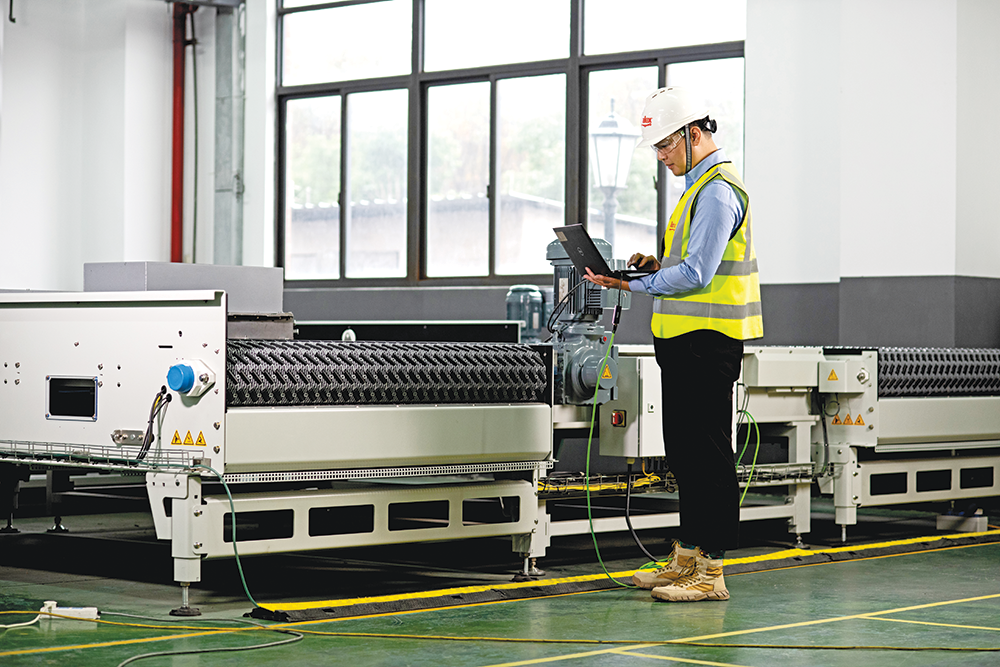
Intralox’s ARB technology solves this problem by using a belt in which small rollers are embedded at an angle to the direction of belt travel. Especially when high throughput and very sensitive handling and separation is needed, ARB equipment and especially DARB equipment can be a problem solver. DARB is a special version of ARB – the dual-stacked angled roller belt – which is able to move items up to 90° perpendicular to the line of travel.
The DARB technology complies perfectly with the three critical demands for EV battery production logistics stated above: scalability, flexibility, and the ability to handle batteries directly without pallets. It improves scalability as it is able to increase the throughput of battery lines significantly by eliminating stop and start times before perpendicular movements. It is also more flexible, as full width support removes most restrictions on item dimensions. The only limit set is the dimension of the belt itself. Finally, DARB equipment eliminates the need for pallets, since it supports the EV battery over the whole baseplate.
Problem: Central PLC solutions poorly scalable
Costa explains that some lithium-ion battery manufacturers are already benefiting from the capabilities of DARB equipment in their production. But the company has identified more room for improvement. Intralox is the OEM, but the automation of DARB equipment is traditionally done by the integrator of the intralogistics systems using Intralox guidelines. “We realised that this process is not always efficient, as much know-how is lost in communication. We sell DARB constantly, but the integrator only does it now and then,” explains Martin Benavidez, Intralox product manager for ISC.
The main drawback of having one PLC controlling several machineries is that debugging during commissioning and changes in the operation are time consuming and risky. Integrators sometimes need to leverage another PLC in the line to control the DARB equipment. To solve this problem, Intralox expanded its offer to include automation of the DARB system. “We started using a separate PLC to automate the DARB, but this is not cost efficient, especially in the small ones. We had to offer different PLCs and build big electric cabinets following different customer requirements and regional regulations. Product development and maintenance is complex because of this,” explains Benavidez. He adds that traditional PLC technology is difficult to scale because of the effort required to engineer and assemble the control cabinet and maintain different PLC platforms that have been established for years in factories. ”Scalability is very important for us. Therefore we looked for a solution where we can channel our experience and knowledge gained over many years into a small device that is easy to use,” adds Lazlo Kleczewski, product design manager for ISC.
Solution: Decentralised IP67 controls bring flexibility
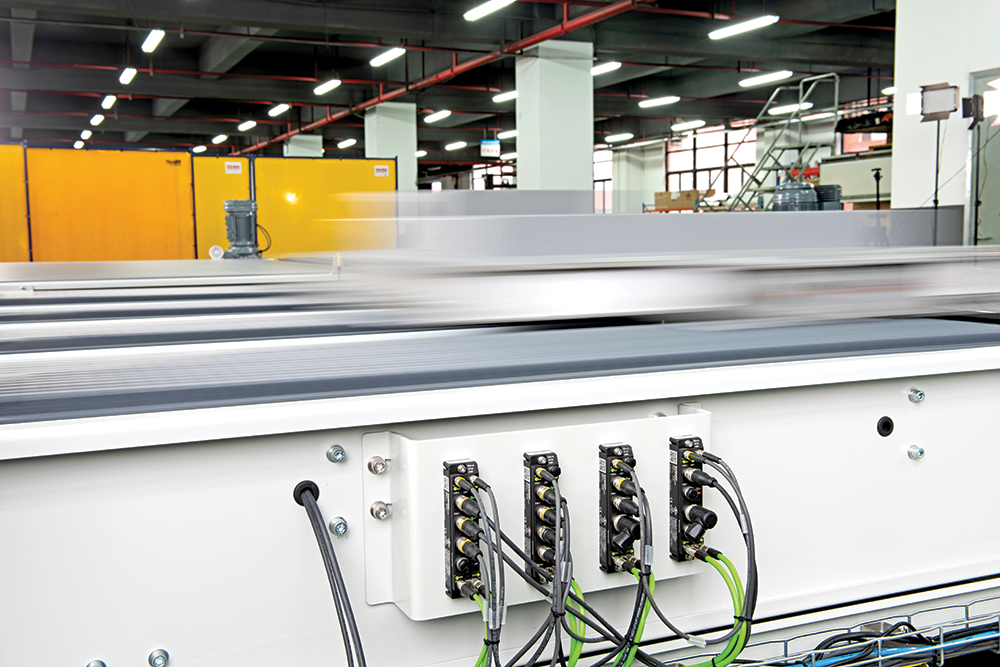
The solution is the ISC CAM, a small IP67 block module that contains Intralox software logic to maximise the performance of the equipment without needing an electric cabinet. Turck’s TBEN-S provides the hardware platform for the ISC CAM. Thanks to its multiprotocol capabilities, it can service a wide range of customers, with minimal product variations. Turck’s multiprotocol devices support the Profinet, Modbus TCP and Ethernet/IP protocols and adjust themselves to the Ethernet protocol on the network, without user intervention. This allows for an improvement for all parties involved. The integrator only needs to program his PLC to communicate a few basic instructions, thus reducing the effort and risk of integrating and commissioning DARB equipment. “The ISC CAM solves many of the problems that classical automation structure raised,” says Kleczewski.
DARB demo loop with decentralised automation
To showcase DARB technology as a key conveying solution for the EV battery industry, Intralox has built a demo loop in Shanghai, where potential customers can get an impression of the capabilities of the technology. The loop also demonstrates the benefits of decentralised automation. Each piece of DARB equipment has its own ISC CAM for the carryway automation, and other key automation functions in the loop like motor control and safety are distributed into other simple modules. The result is a high level of modularity of both the hardware and software, which facilitates setup, troubleshooting and modifications like adding or removing a conveyor.
Full-range IP67 portfolio for decentralised automation
There is no need for a physical HMI because the loop can be controlled, adjusted and changed through a virtual HMI that is hosted in the web server of the ISC. This is easily accessible with any device with a web browser. The automation of the motors and safety systems in the loop is decentralised by a combination of field controllers from the Turck TBEN product line. Thanks to the large portfolio of IP67 I/O components for serial and Ethernet communication, the demo loop’s cabinet is no bigger than a shoebox. The ability of Turck Ethernet solutions to communicate with either Profinet, Ethernet/ IP or Modbus TCP eliminates the need for the development of individual solutions for customers in different regions. Turck’s robust power supply unit PSU67 simplifies the supply of the 24 V DC for running the automation components.
There are other benefits of this integrated and holistic design that Intralox proposes. For instance, not having a cabinet reduces parts, but also allows it to eliminate cables with loose ends, making the concept virtually plug and play. By using colour coding on the connectors, a high level of poka-yoke is created, thus minimising the chances of mistakes. Therefore the cabling and wiring of the equipment becomes simpler and intuitive, and it is almost impossible to connect it incorrectly. “We are trying to demonstrate that it is possible to take these complex systems and make them simple and intuitive. The only thing it requires is to think slightly differently,” the ISC team concludes.
| Tel: | +27 11 453 2468 |
| Email: | [email protected] |
| www: | www.turckbanner.co.za |
| Articles: | More information and articles about Turck Banner Southern Africa |






© Technews Publishing (Pty) Ltd | All Rights Reserved
 printer friendly version