



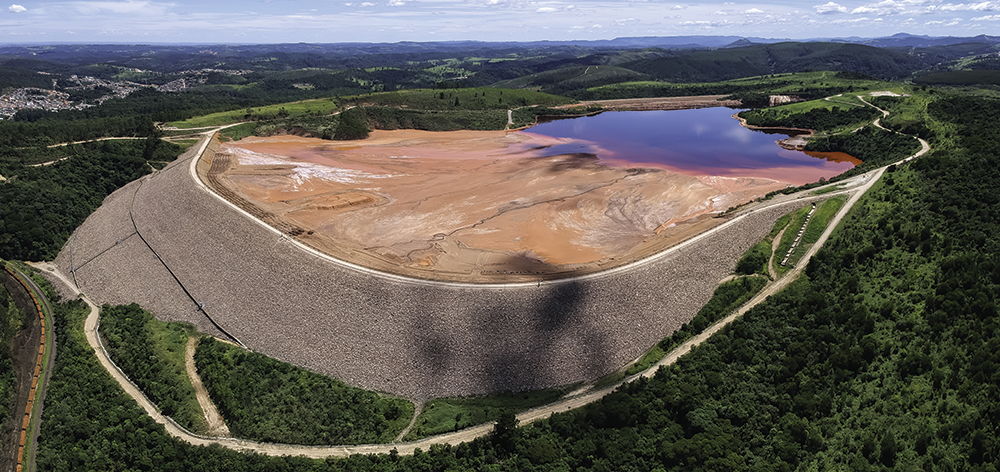
Tailings dams are built to store by-products of mining operations after separating the ore from the commercially worthless material that surrounds it. Tailings can be liquid, solid, or a slurry of fine particles, and are usually highly toxic and potentially radioactive. Solid tailings are often used as part of the dam structure itself. They have many features in common with embankment dams which are built to retain reservoirs of water.
While the methods used for the design and construction of embankment dams can be applied to tailings dams, there are major differences between the two. Embankment dams are prestigious structures used to store water profitably, whereas tailings dams are required for the storage of unwanted waste at minimum cost. Embankment dams are usually built to full height during one period of construction, having been designed and constructed by competent engineers (regulated by law in many countries). Modern tailings dams are often designed by competent consulting engineers, but because they are built slowly in stages over many years, and conditions may also change with time, supervision of their construction may become relaxed. Tailings dams can become very large. One of the biggest tailings dam in the world is in Canada, and is 18 kilometres long and 40 to 88 metres high. Worldwide there are almost 3500 active tailings dams, and research shows that they tend to fail ten times as often as conventional dams.
In September 2022 a catastrophic tailings dam failure occurred at the Jagersfontein diamond mine in the Free State, leaving the residents of the small mining town destitute. Another major disaster was recorded in Brazil, where an iron ore mine tailings dam collapsed in 2019. Two hundred and seventy people died after the dam collapsed. Around 11,7 million m3 of sludgy mining waste flattened the mining complex and tore across the countryside, damaging houses, schools, road infrastructure and motels. This incident raised concerns about the construction and monitoring of tailings dams at mines. Constant monitoring is required to help prevent disasters occurring. Endress+Hauser offers reliable instrumentation solutions to provide data for a tailings dam monitoring system.
In a dam, you can usually monitor displacement, strain, level, pressure and flow. Most mines check these manually, sending operators to the field to extract these values. The operators then capture the data on a spreadsheet. This antiquated and inaccurate method is still currently used. Smart instrumentation now exists that can send data throughout the day directly to a monitoring or control system. These tools can reduce or even eliminate human error from the readings. They can also provide more data in one day than an operator checking the dam two or three times a week. Some dams may have different needs, but most should measure level and flow measurement as a minimum. Mines typically need two level measurements, one for the water table level and one for the dam level.
For the water table, one can install a hydrostatic level sensor in a PVC tube within a water well. Ensuring that the sensor has adequate cable length is an important installation factor to consider in this simple device setup. The data can be collected using a wireless device, which provides regular updates to the mine every 15 minutes and has a long battery life.
These measurement applications are part of Endress+Hauser’s standard solutions, which can be integrated into any application. For tailings dam monitoring, wireless devices are cost effective, and can transmit large amounts of process data, not to mention remote access to sensor status and configuration. While companies may look for an inexpensive solution, it is advisable to consider a standardised protocol like WirelessHART, which provides excellent diagnostic options in the case of device failure.
Security should always be taken into consideration. A mesh network will give stable network conditions if set up correctly. It will also encrypt all the data in the network to keep the information safe. Always remember that an economical solution today may cost more in the long run. We cannot see into the future, but we can think ahead and plan for the possibililties.
| Tel: | +27 11 262 8000 |
| Email: | [email protected] |
| www: | www.endress.com |
| Articles: | More information and articles about Endress+Hauser South Africa |






© Technews Publishing (Pty) Ltd | All Rights Reserved
 printer friendly version