



Moxa, a leader in industrial communications and networking, has announced the launch of its next-generation networking portfolio. This new line-up is designed to futureproof industrial networks to accelerate digital transformation across various industrial applications, and help organisations improve operational efficiency and resilience.
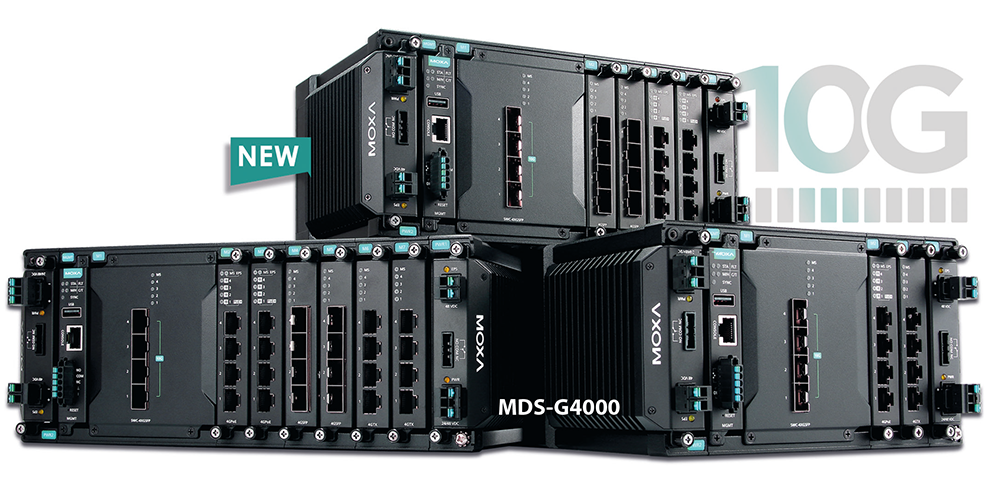
Running efficient business operations is becoming more difficult every day. Only when businesses futureproof their networks and embrace digital transformation can they respond quickly to changes. Besides just introducing new technologies, a key aspect of digitalisation is the ability to integrate all systems seamlessly on the network. “Industrial networks are evolving as the seamless transmission of data is becoming the key to success in this converged, digital future. At Moxa, we are dedicated to developing industrial network solutions that help businesses transform and futureproof their operations,” says Gary Chang, product manager at Moxa Networking. Moxa’s latest next-generation 10G product portfolio is designed to sustain networking connectivity in mission-critical applications, now and the future.
Networks are evolving to transform business operations
Digital transformation has fundamentally changed the requirements for industrial networking. For example, as net zero initiatives push organisations to invest heavily in renewable energy, power infrastructure needs to be able to adapt to variable and decentralised energy sources. Power grid systems need to be automated and secured to properly balance electricity supply and demand to avoid potential downtime and maximise performance. Resilient, security-hardened industrial networks are critical for enabling complex connectivity, while also keeping the network safe.
A similar trend is happening in the transportation field. With the prospect of connected and autonomous vehicles (CAVs) on the horizon, more devices will need to be connected to the road network infrastructure to allow agencies to monitor and manage transportation systems, and ensure smooth traffic operations. Industrial networks need to support high bandwidth and reliability to handle any future increase in data volume processed over the network.
Following the supply disruptions in recent years, organisations also need agile and adaptive production plans to make sure they can keep up with market demand in unpredictable circumstances. The flexibility of the industrial networks is the key to success.
These are just some examples to demonstrate that industrial applications are transforming, a process that requires secure, reliable industrial networks with high performance, bandwidth and flexibility to enable the transition to a digital future.
Next-generation networking to futureproof digitalisation investments
“However, the pace at which industrial networks are evolving is becoming a key challenge
for our customers, as they attempt to balance investments made today and the expected future benefits. Moxa is launching its next-generation networking portfolio to help businesses tackle this challenge,” says Chang. Moxa’s futureproof, secure networking solutions provide a solid foundation for sustainable network infrastructure. “With the IEC 62443-4-2 certified EDS-4000/G4000 Series DIN-rail switches and RKS-G4028 Series rackmount switches, we help our customers build robust, industrial-grade network security for their critical applications from edge to core.”
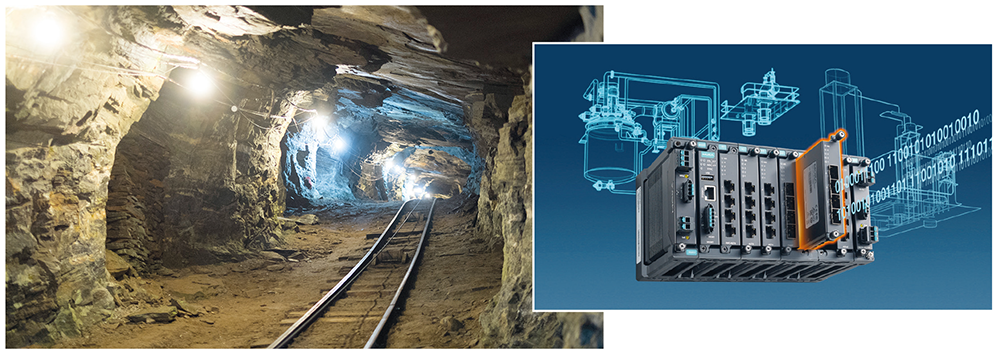
Besides the increasing need for higher bandwidth such as 10GbE, applications in harsh environmental conditions also need to be able to deal with physical factors that can affect performance, such as heavy shock and vibration. Moxa’s MDS-G4000-4XGS Series modular DIN-rail switches feature 10GbE ports to reliably transmit real-time surveillance feeds and other high volume data. Moreover, with multiple industrial certifications and a highly durable housing, the MDS-G4000-4XGS Series is a perfect fit for demanding environments such as mining sites, ITS, and wayside applications.
Lastly, to make sure customers can take advantage of any opportunities within the industry, Moxa delivers the tools to build a robust network foundation designed for future scalability. The modular RKS-G4028 Series and MDS-G4000-4XGS Series allow customers to design flexible networks that support scalable data aggregation in demanding environments.

Futureproof operations with digital transformation
Moxa’s next-generation 10G product portfolio can help customers unleash the full potential of digital technologies, and accelerate digital transformation across a wide range of industrial fields. From edge to core, Moxa’s next-generation networking solutions provide enhanced network security, exceptional reliability and flexibility, and simplified remote management to help customers futureproof their network.
| Tel: | +27 11 781 0777 |
| Email: | info@rjconnect.co.za |
| www: | www.rjconnect.co.za |
| Articles: | More information and articles about RJ Connect |






© Technews Publishing (Pty) Ltd | All Rights Reserved
 printer friendly version