



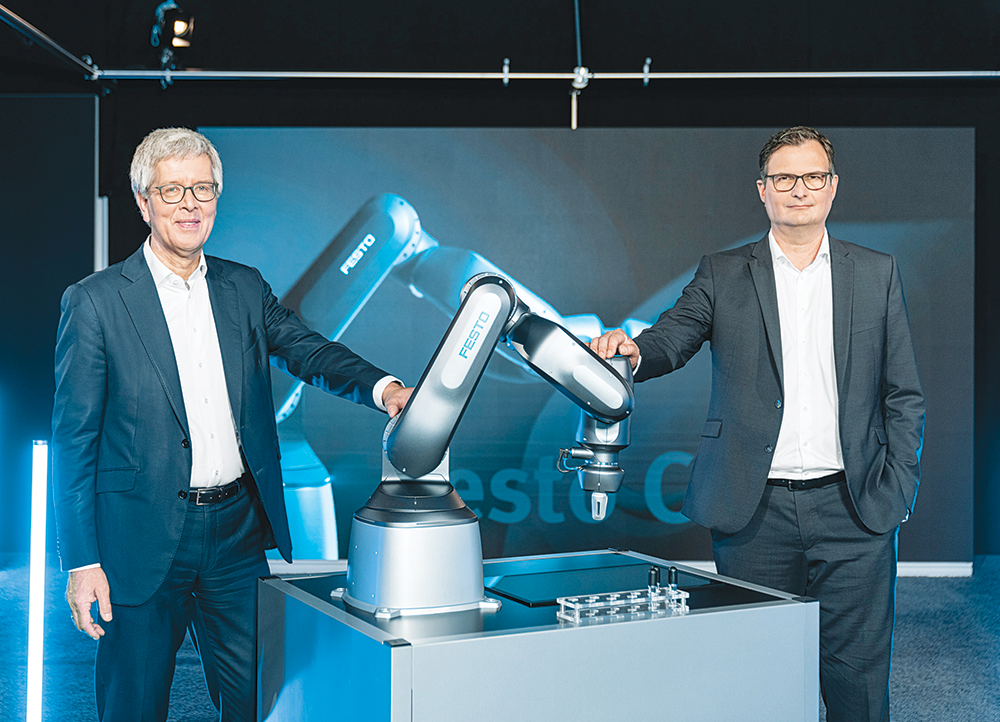
What if there was a robot that was easy to operate, did not require a safety fence, and was also attractively priced? According to Festo, that would bring about a whole new era in human-robot collaboration, which is now dawning with its world-first pneumatic robot.
The human-robot collaboration (cobot) segment is growing rapidly in the industrial market. Cobots now relieve employees of particularly strenuous or monotonous tasks, thus giving them new levels of freedom and making their work easier and healthier. No technology has such a sensitive and flexible approach to human-robot collaboration as pneumatics.
The benefits of pneumatics
The Festo Cobot owes many of its advantages – such as sensitivity, weight and value for money – to pneumatics. The direct drives in the articulated joints are very cost-effective and particularly lightweight because, unlike electric solutions, no heavy gear units or expensive force-torque sensors are required.
Cost-effective even for small and medium-sized companies
The Festo Cobot makes using cobots even more cost-effective for small and medium-sized companies, as they often rely on manual work processes. This is achieved thanks to the flexible application options that mean small batch sizes or work steps can also be processed automatically. Thanks to its intuitive and simple commissioning and programming, it is quick as well as easy to get to grips with and does not require extensive training.
The pneumatic Festo Cobot intends to be cheaper than electric cobots in the same class, and to provide excellent value for money in its main application area of small parts handling with payloads of up to 3 kg. “When it goes on sale in 2023, the Festo Cobot will set new standards in human-robot collaboration with its ease of use,” explains Dr Frank Melzer, member of the management board for product and technology management at Festo.
Easy to operate and flexible to use
The Festo Cobot consists of the hardware, a handheld module and Robotic Suite software for commissioning and programming in less than an hour. Prior knowledge of robotics is not required as the self-explanatory software contains clearly visualised and standardised function blocks. Pneumatic drives enable the robot arm to be easily guided by hand and without any resistance, so that waypoints or paths can be taught quickly and precisely.
In small and medium-sized companies, cobots are only attractive if they can quickly take on a new task and are not intended to be permanently used for the same purpose. The Festo Cobot meets these requirements as it doesn't require an additional control cabinet that is difficult to connect and cumbersome. The compact controller that is integrated into its own base makes it particularly flexible, while simple connections also allow it to be used ad hoc without long changeover times. Common bus standards enable fast connection to higher-order controllers, and it also requires less space.
Thanks to state-of-the-art and lightweight construction methods, the weight of the Festo Cobot has been reduced to well under 20 kg. Thus, it can be used quickly and flexibly at different locations.
Working safer and faster
With a length of 670 mm, the Festo Cobot is just like a human arm and has the right reach for it to be perceived as a helping third hand when working with a member of staff. It moves like a real colleague within a manageable radius. Thanks to the flexibility of the pneumatic drives, the cobot acts sensitively at a speed appropriate to the situation and with fluid, harmonious movements. It is as soft to the touch as human contact.
The cobot’s pneumatic direct drives and its light weight reduce its contact energy. Christian Tarragona, head of robotics at Festo, says: “Thanks to precise pressure regulators in the articulated joints, the robot recognises when it is being touched and responds with appropriate safety functions.” This means employees can work together with their careful technical colleague in complete safety.
| Email: | [email protected] |
| www: | www.festo.co.za |
| Articles: | More information and articles about Festo South Africa |






© Technews Publishing (Pty) Ltd | All Rights Reserved
 printer friendly version