The LASE Group (short for Labor Aiding Systems Europe) produces machines for the manufacture of automotive interiors such as dashboards, door panels, roof windows, seating systems and central consoles. It also develops solutions for mounting car bumpers, spoilers and fuel tanks, with systems for assembling drivetrains being another pillar of the company. “Around 65% of our sales come from the interior and bumper systems areas. Our systems are used by several OEMs,” explains CEO, Gert Peetersem.
Peetersem founded the LASE Group in 2001 because, by his own admission, he felt that a solution-oriented machine builder was needed to automate the assembly of car interiors. “Although car manufacturers had a certain design for their products in mind, they were unable to implement the manufacturing process as a satisfactory automation concept,” Peetersem continues. “Our machines meet global standards, so we have grown to become a globally active company. Today you can find our plants in all corners of the globe, from Australia to Europe, from North Africa to Russia.”
LASE originally started out with the production of assembly cells for objects in vehicle interiors. However, further solutions gradually followed, such as fuel tanks and systems for bumper assembly. The company acquired a very good reputation as its experience and know-how grew and since it was already engaged with several OEMs in the design process, it could use its solutions to rationalise customers’ production processes without delay.
Full vertical integration
As a supplier of turnkey solutions for the automobile industry, LASE has to be able to implement the requirements of customers quickly and reliably – and these requirements are continually changing. Digitalisation, for example, has now become an important factor. Customers want information about the state of their processes and require a clear operator interface. At the same time, data acquisition is also becoming a higher priority on their wishlist. Customers often want to manufacture several variants of the same component without any losses in production time and therefore preferably on the same machine.
The LASE Group has a specific approach to meet these requirements, Peetersem explains: “We do everything from day one with our own people. I don’t want to depend on subcontractors or be faced with suppliers that cannot keep to the deadlines. This approach enables us to achieve fast throughput times for manufacturing our machines. It is also straightforward for our customers: at LASE they have one specific customer contact who takes full responsibility for the project. This clear structure is effective and also enables us to keep our prices competitive worldwide.”
Component supplier must move forward as well
Peetersen also places demanding requirements on his component suppliers since they also have to adjust to LASE’s work method: “Turck Multiprox is a good example of this intensive and partner-based cooperation. We state the type of detection we require, specify the design and measuring distances and then work out a solution in consultation with Turck Multiprox. They are often also involved in the test phase.”
LASE uses a broad range of components from the Turck Multiprox offering: optical sensors, laser sensors, inductive proximity switches, I/O modules, tower lights, two-hand controls, etc. Turck’s Ethernet multiprotocol I/O modules are ideal for machinery that is destined to be exported worldwide, as a single module can communicate via Profinet, Ethernet/IP or Modbus TCP. This enables customers worldwide to use the systems that are locally preferred and for which they can obtain local service and spares.
Integrated solution
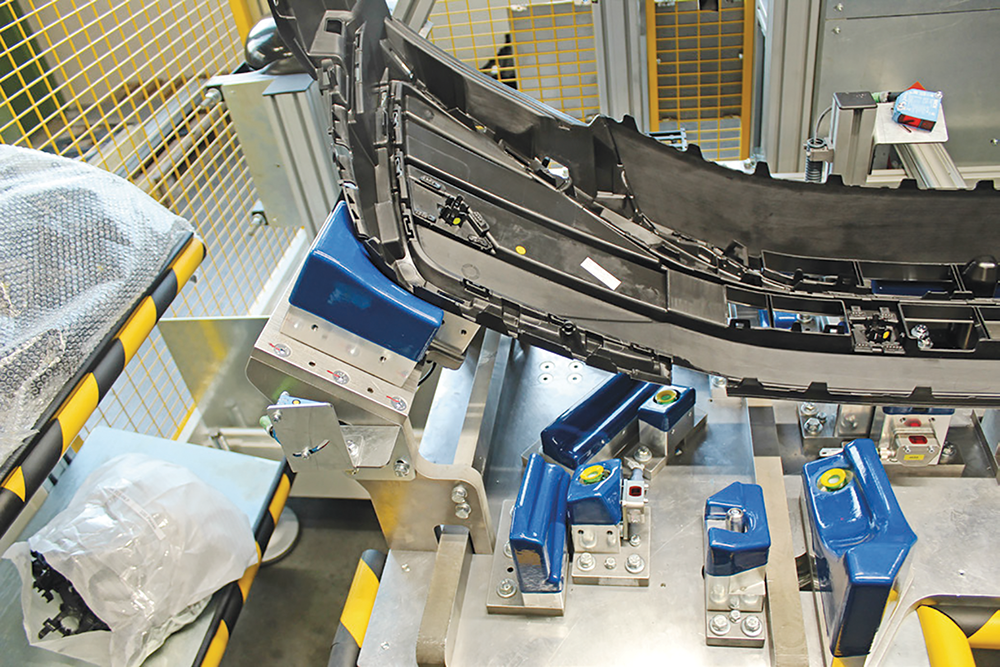
The finishing touches to a bumper assembly cell had just been made during a visit by Turck representatives to LASE’s production hall. The tremendous care taken in the development of these machines was clearly noticeable. For Peetersem, it is very important that the cells are part of the entire production line. “Island solutions require too many logistical movements with the product, which would increase the risk of damage. This is one of the success factors of our approach, resulting in an average lead time for the development of a bumper assembly cell of 24 weeks. Everyone involved always has the overall picture in mind: the mechanical and electrical engineering, the software, the manufacturing of the parts and the assembly. All processes, such as laser cutting, plasma cutting and prefabricated assembly, are carried out by the LASE co-workers themselves.”
Q4X laser distance sensor makes the difference
The painted bumpers are inserted in the first bumper assembly cell to punch the ultrasonic holes for the parking sensors. The brackets for the side reflectors are also fitted in this cell using ultrasonic welding. Although these side reflectors are not required for European cars, they are stipulated for cars on the US market. The machine can process all the variants without any problem and without any extensive retrofitting times. This process doesn’t start until after the painting has been completed, so that absolutely no processing marks are left on the bumpers. Sensors play an important role here.
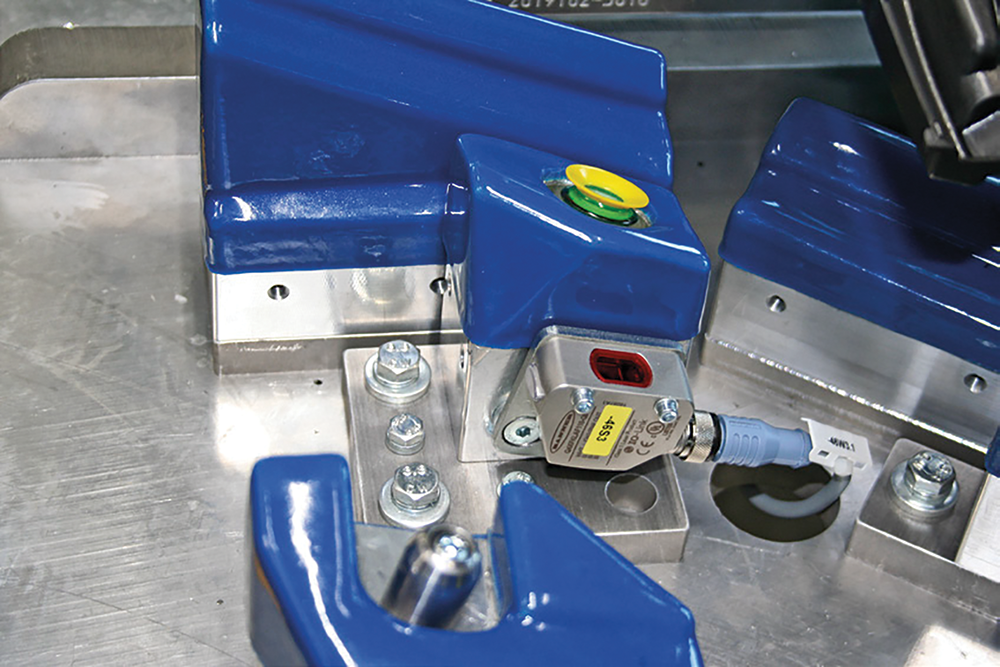
In another assembly cell, LASE uses the Q4X laser distance sensor from Turck’s optoelectronics partner, Banner Engineering. In its robust stainless steel housing, this sensor plays an important role in efficient operations at the machine builder. With protection degree IP67/69K, the Q4X can resist shock, overtightening or extreme vibration. The assembly cell not only has to detect the presence of a bumper, but also needs to distinguish between a matt black and a brilliant black bumper – this is a particular challenge because black absorbs most frequencies of the visible light spectrum.
Over and above its high excess gain, the Q4X features dual-mode detection. This enables the sensor to not only measure the distance but also analyse changes in light intensity. Besides black objects, the sensor provides reliable detection for transparent objects in bright ambient light, or with acute detection angles. It can measure differences in distance in a range from 25 to 300 mm down to 1 mm.
For Peetersem, the Q4X laser sensor is a paradigm for the good cooperation with suppliers like Turck Multiprox: fast, capable and 100% reliable. “It is also thanks to these components that we manage to achieve a production time of 30 s per bumper. Creating efficient, high-performance machinery is what we’re about,” he concludes.
| Tel: | +27 11 453 2468 |
| Email: | [email protected] |
| www: | www.turckbanner.co.za |
| Articles: | More information and articles about Turck Banner Southern Africa |






© Technews Publishing (Pty) Ltd | All Rights Reserved
 printer friendly version