



In mines, measuring sites are often located far below the earth’s surface and the conditions there push any level measuring instrument to its limits. Nevertheless, radar measuring instruments from VEGA hold their own in this difficult environment.
Two mine operators in South Africa found this to be true. They had both tried a few different methods, without success, when a breakthrough was finally achieved with 80 GHz radar sensors from VEGA.
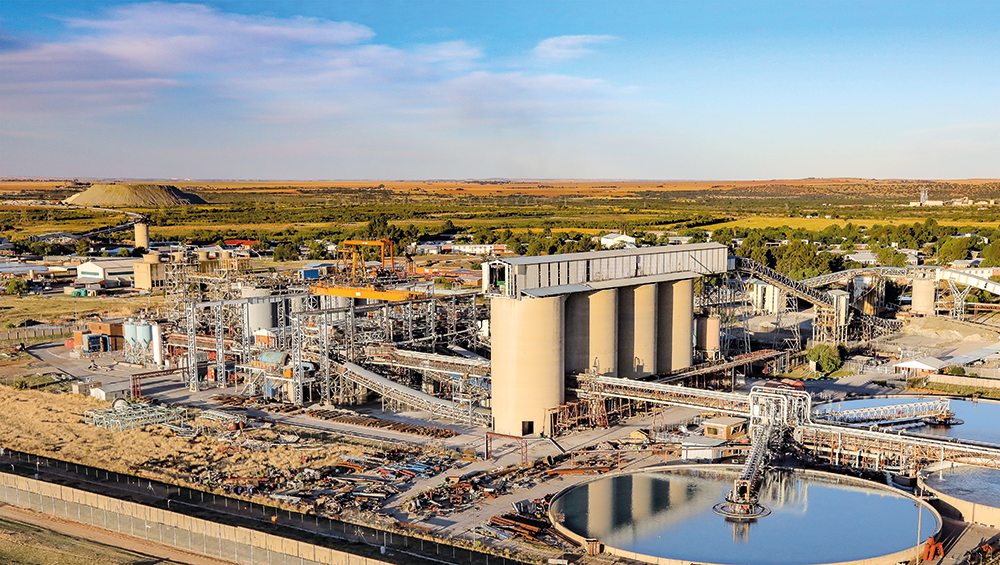
The Sibanye Beatrix 4 gold mine is situated in the Witwatersrand Basin in Welkom. Sibanye Stillwater is one of the 10 largest gold producers and the third largest platinum and palladium producer in the world. In 2017, for example, it extracted 43 600 tonnes of gold. The Sibanye Beatrix 4 gold mine is one of five gold mines operated by the company.
Deposit build-up
The ore body is accessed from the surface through vertical shafts, with the deepest operating level approximately two kilometres below earth’s surface. Dislodged rock is moved underground using gravity between the different levels to transport the material and most importantly, reduce distances. This allows the mined ore to be funnelled into loading bays or other underground containers and stored. From there it is lifted to the surface.
In one such area, the level of ore must be accurately measured. Until recently, the demanding environment – a maelstrom of dust, dirt and noise – made level measurement very difficult. The depth of this section of the quartz vein is 55 metres and the diameter approximately 5 metres. Of great concern – at least from the point of view of level measurement – is the very humid atmosphere, which leads to heavy deposits on the measuring instrument.
Technologies such as ultrasonic and laser sensors had already failed in this task. Ultrasonic was not suitable because of the noise generated by falling rocks and the laser didn’t work because of the dust and the deposits that formed on the laser lens.
VEGA suggested trying Vegapuls 69, a radar instrument based on 80 GHz technology that generates a very narrow beam angle. In the few years it has been on the market, this radar measuring instrument has already proven to be a problem solver in many difficult applications. However: although Sibanye was convinced of the capabilities of the measuring instrument, it did not want to make further investments at that time, as management had already spent a lot of money on technologies that did not work.
So VEGA offered to install a Vegapuls 69 on a trial basis and let the company test it for three months in this application. The radar sensor was installed with a plastic horn antenna, calibrated and put into operation. This measuring situation was challenging because the side walls of the quartz vein are extremely rough due to falling rocks, which often fall directly in front of the sensor. This not only brings the rocks dangerously close to the measuring instrument, but also generates enormous amounts of dust.
The instrument was therefore calibrated at a time when the quartz vein was empty and in addition, the false signals caused by falling rocks were suppressed. The results were impressive: Vegapuls 69 measured reliably even under these extreme conditions. For Sibanye, returning the measuring instrument was out of the question. In fact, the company ordered two more sensors that are also now in use in the mine.
Application in flotation cells
In another application, this time at Anglo American Platinum (Amplats), Vegapuls 64, the 80 GHz radar level transmitter for liquids, was used at the UG2 plant in Rustenburg.
The UG2 concentrator at the Waterval Smelter Complex has a capacity of 400 000 tons per month. Vegapuls 64 was installed there in a collection tank that holds the final concentrate.
Inside this tank there are several feed pipes that generate turbulence and steam. The extremely limited workspace represents an additional challenge here. What’s more, the conditions in the tank create platinum foam, which floats on top of the slurry.
Amplats had also tried other sensors in this application, including ultrasonic and 26 GHz radar sensors. However, these sensors required a lot of maintenance and adjustment to operate reliably. In contrast to this, Vegapuls 64, with its narrow beam angle of 10°, works well. Although the instrument cannot see through the foam due to its high chromium content, it still delivers a reliable and repeatable echo that provides the basis for an accurate measurement unaffected by the extreme conditions and the heavy build-up.
Conclusion
Whether gold or platinum, radar sensors perform well in the production of the two precious metals. Although the methods of extraction are quite different, they do have one thing in common: ambient conditions that are anything but gentle on the highly sensitive measuring instruments. Nevertheless, despite the adversities, the sensors deliver stable and accurate measuring results.
| Tel: | +27 11 795 3249 |
| Email: | [email protected] |
| www: | www.vega.com/en/home_za |
| Articles: | More information and articles about VEGA Controls SA |






© Technews Publishing (Pty) Ltd | All Rights Reserved
 printer friendly version