In the oil and gas industry, wellhead applications span many areas from closed-loop control and monitoring, to safety shutdown functions. Due to size and budget factors, designers often try to combine all three functions in one box. While this approach might save on cost, it carries an inherent risk as hardware and software are shared across applications. The conundrum is that a failure in the control function will likely also affect the safety function, therefore affecting safety functionality.
Operations at a well site can be described as follows:
• Control function: the control function is responsible for maintaining the well's target production by regulating the choke valve. Other auxiliary control functions such as chemical injection and hydraulic pump control are also used to maintain the production within the well.
• Monitoring function: some process variables monitored may require that an action be taken to keep the well running within desired limits, thus preventing the well shutdown and a halt in production.
• Safety: these are the critical safety functions normally carried out by safety systems designed to the IEC 61508:2010 international safety standards and providing risk reduction capability up to SIL3.
Keeping the safety and non-safety functions separate while achieving seamless integration
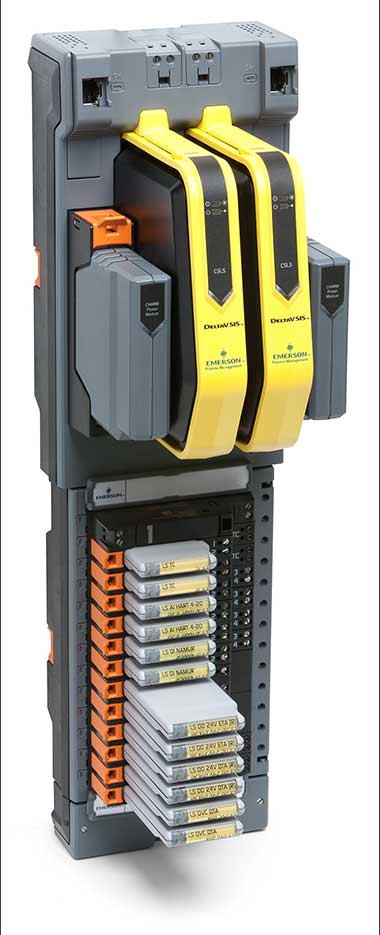
In Emerson's DeltaV SIS with Electronic Marshalling Platform, the safety function is allocated into the safety hardware. This hardware is designed to the IEC 61508 standard, achieves the targeted SIL performance (usually SIL3), and is approved by third-party certification bodies TUV and Exida. This layer is physically and logically independent from the non-safety functions. With DeltaV SIS platform the I/O related to the Safety Instrumented Functions (SIFs) with targeted SIL (SIL1 -SIL3) can be wired to the SIL3 CHARMs Smart Logic Solver (CSLS) where the safety functions are carried out separately from the non-safety functions.
The non-safety functions, on the other hand, can still be handled by the DeltaV SIS, but in a separate yet integrated manner. The non-safety I/O can be wired to the non-safety hardware and executed in a separate controller. These non-safety controllers and I/O are seamlessly integrated within DeltaV SIS with zero data mapping or integration configuration requirements.
With this modern Safety Instrumented Systems (SIS) approach, seamless integration can be achieved without compromising the segregation between functions required to meet international safety standards IEC 61508 and IEC 61511.
Outdoor cellular routers for potentially explosive areas Phoenix Contact
IS & Ex
Phoenix Contact has extended its Cellulink outdoor cellular router range with new versions approved for Zone 2 potentially explosive areas, featuring end-to-end IECEx and ATEX certification of the complete router, antenna path and antenna system.
Read more...The wireless route to safer, more efficient mining operations Emerson Automation Solutions
Editor's Choice Sensors & Transducers
Modern wireless level measurement technologies are helping mining operations improve process control, increase safety and reduce installation costs. Emerson’s Rosemount 3408 wireless non-contacting radar level transmitter uses 80 GHz frequency-modulated continuous wave radar with HART communication to reach remote assets where cabling is impractical.
Read more...Nine things your emergency control room must now have Oculus Operational Innovations
Editor's Choice IS & Ex
A new South African regulation, effective since March 2025 with no transition period, sets out nine mandatory requirements for underground mine emergency control rooms, and specifies who must be in charge at all times.
Read more...‘Control Talk SA’ podcast with Emerson on level measurement for the mining industry Emerson Automation Solutions
Level Measurement & Control
Reliable level measurement is critical to keeping South African mines safe, productive and sustainable, but harsh conditions can make accurate readings challenging. In this Emerson podcast, Shivam Misra explores how advanced radar technology and remote monitoring are helping mines improve measurement reliability while reducing operator exposure to hazardous areas.
Read more...Expanding visibility in mining operations Emerson Automation Solutions
Editor's Choice Sensors & Transducers
Advances in wireless communications, condition monitoring and sensing technologies are helping mining operators extend measurement into previously under-monitored areas, improving equipment reliability, process performance and water stewardship.
Read more...Cybersecurity for potentially explosive areas Phoenix Contact
IS & Ex
The Cellulink outdoor cellular router product range from Phoenix Contact is being extended. New versions are now also available that have been specially developed for use in Zone 2 potentially explosive areas.
Read more...Windows tablets for hazardous areas Extech Safety Systems
IS & Ex
i.safe Mobile has expanded its intrinsically safe product range with the launch of the IS945.x series rugged Windows tablets, designed for use in hazardous and demanding industrial environments.
Read more...Hazardous area inspections Extech Safety Systems
IS & Ex
The i.safe MOBILE IS940.1 tablet from Extech delivers the performance of a modern Android device, but in a package designed from the ground up for hazardous areas.
While every effort has been made to ensure the accuracy of the information contained herein, the publisher and its agents cannot be held responsible for any errors contained, or any loss incurred as a result. Articles published do not necessarily reflect the views of the publishers. The editor reserves the right to alter or cut copy. Articles submitted are deemed to have been cleared for publication. Advertisements and company contact details are published as provided by the advertiser. Technews Publishing (Pty) Ltd cannot be held responsible for the accuracy or veracity of supplied material.










 printer friendly version