



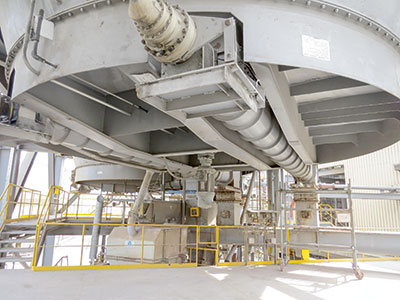
Heavy knives plough tirelessly through a mass of shredded waste which will be used later as fuel for the production of cement. One ton of this per hour is handled in a large storage silo. The Vegapuls 69 reliably monitors the filling.
The production of cement is a highly energy-intensive process. Therefore, alternative fuels and raw materials have long become a part of the daily business. With the use of alternative fuels, so-called AFR (alternative fuels and raw materials), the production process not only becomes more economical, but primary raw material and fuel resources are conserved and landfill volumes reduced. These alternative fuels consist of whole and shredded tyres, waste timber or mixtures of plastics, paper, compound materials or textiles, whereby their calorific value hardly differs from that of lignite. The value of old tyres is even comparable with coal. However, the use of these alternative fuels also has its pitfalls. They must be processed prior to use in such a way that they do not influence the later production process and, above all, the quality of the end product. And the level measurement does not remain unaffected either. Just one example: if the fuel is made from recycled Tetrapaks, the metal particles contained in the packing can create interference signals due to flying metal foils.
Unusual agitator
Cementos Molins in Barcelona has been working with VEGA for twelve years. A whole number of sensors are now in use at this site, including pressure transmitters, capacitive measuring instruments and vibration limit switches. Now it needed a special solution for the storage silo that contained the AFR. This silo has a height of more than 20 m and a diameter of 9 m. About 35% of the fuel in the plant that is required for the production of cement comes from alternative fuels.
There is an unusual agitator on the inside floor of the silo which consists of very sharp, vibrating knives to grind the waste continuously. Trucks arrive around the clock to fill up the silo. About one tonne of AFR material is unloaded into the silo per hour. The challenge here: the trucks loaded with waste must be completely emptied – the available capacity in the silo must therefore be sufficient to hold a complete truck load. The level measurement must not only provide protection against the threat of overfilling; the empty warning is at least equally important. Since complete emptying would cause damage to the agitator, a reliable measuring process is necessary to ensure continuous level measurement 365 days a year without interruption.
Challenges by the grinder
The conditions in the building material industry are generally a little harsher than in other branches. In this cement factory, the owners faced special challenges. First of all, the AFR materials are very different and stick very easily. When filling the silo from the trucks, a gigantic cloud of dust is also created which makes the measurement extremely difficult and often leads to heavy deposits on the sensor. During simultaneous stirring and chopping, an up to 2 m high wave of material is pushed along in front of the agitator blades. The stirring itself also generates a cloud of dust in the container, which never settles due to the vibrations. In other words: the cloud of dust influences the technology and the measurements.
The result
The previously installed 26 GHz radar sensor with horn antenna from another manufacturer never worked trouble-free. The dust stuck to the antenna and caused false measured values. At a transmission frequency of only 26 GHz and the constant vibrations caused by the cloud of dust, no reliable signal was possible. Moreover, the metal particles from the Tetrapaks in the silo also caused false signals in the sensor.
Accurate focusing sees through the cloud of dust
When VEGA launched the first radar level measuring instrument for bulk materials that operates with a frequency of 80 GHz, the owners of Cementos Molins were interested. The device promised more reliable operation because of better focusing. At that time, a few test measurements had already been made in comparably difficult measuring situations. It also succeeded in accurately measuring media with poor reflection properties. The high focusing also helps better differentiation of the actual measuring signal from the interference signal in containers with many internal installations. With a measuring range of up to 120 m and accuracy of 5 mm, there are sufficient reserves even for unusual applications.
Focusing depends on two factors: the transmission frequency and the active antenna area. Therefore, better focusing is achieved with a higher frequency and identical antenna size. The Vegapuls 69 operates with a transmission frequency of 80 GHz and an antenna size of approximately 75 mm. This achieves an opening angle of only 3°. In a radar sensor with 26 GHz transmission frequency, the opening angle at the same antenna size is about 10°. The 80 GHz beam also goes past installations or deposits on the container wall. This makes the measurement safer and more reliable. The measuring instrument itself is made from the robust PEEK material, which has a high temperature and chemical resistance. The lens antenna is also insensitive to deposits and dirt.
No loss of the transmission signal
The new radar sensor has good signal focusing and a high dynamic range. The 80 GHz easily penetrates the dense cloud of dust. Since the sensor has a purging air connection as standard, it can be cleaned at any time to prevent deposits. Despite the interference signals, which could not be totally avoided due to the metal particles of the packings, an almost exact level measurement is achieved.
A remote display is located prominently at eye level on the silo, to avoid the service team having to climb onto the silo during maintenance. Thanks to PlicsCom, the service personnel have an overview of all the data at all times.
The service team’s conclusion is therefore – very flexible and simple. The Vegapuls 69 has been working trouble-free since commissioning. Since the company needed a quick solution, a trial measurement was dispensed with and they relied on the functionality of the sensor. The confidence paid off, the 80 GHz provides reliable measuring results around the clock even under such extreme conditions.
| Tel: | +27 11 795 3249 |
| Email: | [email protected] |
| www: | www.vega.com/en/home_za |
| Articles: | More information and articles about VEGA Controls SA |






© Technews Publishing (Pty) Ltd | All Rights Reserved
 printer friendly version