The Ratchet P-Clamp reloaded
August 2020
Maintenance, Test & Measurement, Calibration
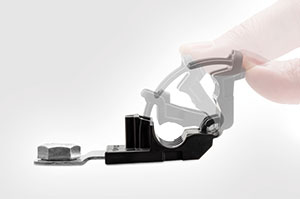
When a heavy-duty equipment manufacturer asked HellermannTyton to devise the most effective way to attach and remove cables for additional equipment, nobody imagined that a well-trodden path would lead to the birth of a new type of fixing part.
But early on, the product designers became so frustrated with the practical limitations of conventional p-clips that they decided to apply their collective cable tie engineering know-how to come up with a better solution. Their goal: an end to fiddly two-handed fastening and fixing in a single step and no damage from clips that twist when the screw is torqued down.
Metal and plastic p-clamps have evolved
The result is Ratchet P-Clamp. As the name suggests, the designers have added a ratcheting closure mechanism. This makes it possible to separate the process of fixing and orientating the clamp from the fastening of the cable or hose. What is more, it can be easily reopened and reused.
Made from toughened polyamide with a steel mounting plate, the Ratchet P-Clamp is user-friendly. The rugged clamp is ideal for fastening and fixing cables, wires, pipes and hoses in heavy-duty applications including solar farms and mining.
How it works
Quite simply, you place the bundle in and close the clamp by hand to the required diameter. The Ratchet P-Clamp comes in four flexible sizes covering the common 6,2 mm to 51 mm diameter range. Advantages at a glance:
• Preinstall the clamp before you close it.
• Easily lever it open with a flathead screwdriver for maintenance.
• Drastically reduce the number of specific clips in the inventory.
Ribbing on the inside of the clamp centres cables and helps prevent the pinching common with p-clips. Soft inserts are also available to protect sensitive insulation or hoses from abrasion. An additional cable tie fixing point on the leading edge opens up possibilities for routing other items along the clamps. A variety of mounting plate angles makes it possible to piggyback clamps on a single mounting point.
Further reading:
Infrared thermometers for electrical, industrial and HVAC applications
Comtest
Maintenance, Test & Measurement, Calibration
: Comtest, distributor of Fluke test and measurement equipment, explains how handheld infrared thermometers are transforming maintenance in electrical, industrial and HVAC environments, with three measurement strategies and a wide range of practical applications.
Read more...
Reverse-engineering legacy industrial gearbox parts
Maintenance, Test & Measurement, Calibration
WEG Africa’s turbine workshop uses 3D scanning technology to reverse-engineer components for legacy gearboxes, turbines and compressors, enabling equipment to run for decades after OEM support and spare parts have dried up.
Read more...
Unlocking ICCP remote monitoring
Omniflex Remote Monitoring Specialists
Maintenance, Test & Measurement, Calibration
Cathodic protection keeps buried and submerged pipelines safe from corrosion, but verifying it traditionally means costly, hazardous manual site visits. Omniflex explains how a retrofit module brings remote monitoring to ageing transformer rectifiers without replacing functional infrastructure.
Read more...
Microdieseling – the explosions you never hear
Maintenance, Test & Measurement, Calibration
Microdieseling is a pressure-induced thermal degradation mechanism in which entrained air bubbles are compressed so rapidly that the surrounding oil ignites, producing soot, varnish and sludge. WearCheck explains how it happens, why the damage varies, and how oil analysis detects it.
Read more...
Electrostatic spark discharge – when static strikes back
Wearcheck
Maintenance, Test & Measurement, Calibration
WearCheck technical manager, Steven Lumley explains how static electricity accumulates in modern low-conductivity lubricants, why compact system designs and fine filtration make ESD more likely, and how to recognise the degradation it leaves behind.
Read more...
High-speed cameras for crash testing
Horne Technologies
Maintenance, Test & Measurement, Calibration
Vision Research has expanded its Phantom C-series with two cameras optimised for crash and safety testing, offering 4 and 8 megapixel sensors rated to 170G, up to 1180 frames per second, and Phantom Academy application training planned for South Africa next year.
Read more...
SKF extends remanufacturing expertise to bearing clearance modification
SKF South Africa
Maintenance, Test & Measurement, Calibration
Using its clearance modification expertise, SKF helped a mining equipment OEM salvage spherical roller bearing inventory that would otherwise have been scrapped, confirming a new capability within its remanufacturing services and avoiding redundant procurement.
Read more...
When maintenance-system compliance starts replacing plant reliability
Wearcheck
Maintenance, Test & Measurement, Calibration
WearCheck ARC division manager, Annemie Willer argues that the greatest threat to effective maintenance is no longer a lack of technology, but the gradual replacement of technical judgement by CMMS compliance, leaving no one owning the machine.
Read more...
Automatic lubrication systems drive mobile mine machine reliability and uptime
SKF South Africa
Maintenance, Test & Measurement, Calibration
SKF’s Lincoln P203 progressive lubrication systems are improving reliability and uptime on mobile machines at a Zambian gold mine, with installation of 45 units completing by October 2026.
Read more...
Nitration: the acid you didn’t see coming
Wearcheck
Maintenance, Test & Measurement, Calibration
Nitration is as destructive as oxidation in many engines but far less understood. WearCheck technical manager, Steven Lumley explains how nitrogen oxide gases degrade lubricants, why the process is difficult to detect, and what oil analysis can reveal before damage occurs.
Read more...










 printer friendly version