


Fieldbus & Industrial Networking


Second-generation valve positioner uses HART or Profibus

April 2000 Fieldbus & Industrial Networking

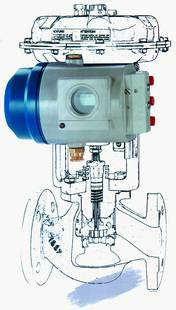
The Arcapro positioner is a valve positioner of the second-generation which is characterised by substantially increased functions, higher reliability and a more compact layout. It has been designed as a compact instrument with a modern and practical design, providing for a reliable operation even under very rough ambient conditions. The display is also visible during operation so that the operating data can be checked with a quick glance at the instrument.

The positioner allows the following modes of operation:

* Automatic operation.

* Manual operation.

* Initialisation.

* Parameterisation.

When the instrument cover is taken off the parameterisation of the positioner can be carried out by means of push-keys. The following values are adjustable:

* Direction of setpoint.

* Characteristic curve.

* Split-range operation.

* Limitation of output signal.

* Tight shut-off function.

* Function of the error report signal.

* RAM function.

Alternatively, the parameterisation can also be carried out via the HART interface or the Profibus-connection. By using the corresponding operating software all relevant values of the control valve may be indicated, eg number of valves, type of actuator, mode of operation, process and diagnostic data:

* Zero point and range.

* Setting speed.

* Setting increments.

* Dead band.

* Number of error reports.

* Number of directional changes.

* Stroke integral value.

On the user shell the current diagnostic data can be compared on-line with former maintenance data. Deviations can be seen and actuator problems may be discovered at an early stage so that repairs can be planned ahead. The preventive maintenance may thus be planned more efficiently and production stops will be reduced to a minimum.

The energy supply to the Arcapro positioner is achieved with the analog twin-core system by the input current IW. In case of three and four-core systems the auxiliary voltage EH is used. With a bus-connection, the instrument is supplied with a constant current by the bus.

The position of the actuator is transmitted to the potentiometer by a shaft and a gear with sliding clutch. The gear allows the adaption to small or large positioning angles so that strokes of 3 mm can be measured with the same accuracy as setting angles of 100°. The slide-clutch is used for the adjustment of the potentiometer when commissioning the instrument.

The major part of the positioner is the electronic board with the microprocessor and the indicating and operating elements. Here the analog, or - in the case of a bus connection – the digital setpoint signal XS is compared with the current value signal of the potentiometer. Based on a special control algorithm the controller derives signals that actuate the two piezo elements, generating the pneumatic positioning signal. Restrictor-valves allow the adaption to the volume of the actuator.

The LCD display indicates the operating conditions and the adjusted parameters or - in the case of automatic operation - the current stroke or angular value with four digits. The display is constantly visible through the screen window in the automatic operating mode.

The modular design allows optional components to be installed by lifting the cover and plugging them in.

The optional analog or binary modules are used for the transmission of the 4 to 20 mA actuator position signal or the output of two-position switches to the control system. Alternatively, the position signal can also be sent via HART or Profibus. The fault-signal output informs of power failure or deviation from a setpoint value.


Credit(s)


Share this article:
Share via emailShare via LinkedInPrint this page

Further reading:

Introduction to Part 2 loop signatures and process transfer functions
Fieldbus & Industrial Networking
The previous series of loop signature articles dealt with the basics of control loop optimisation, and concentrated on troubleshooting and ‘SWAG’ tuning of simple processes. In this new series, consideration will be given to dealing practically with more difficult issues like interactive processes, and with processes with much more complex dynamics.

Read more...
Siemens sets new standards in drive technology
Fieldbus & Industrial Networking
Siemens is setting new standards in industrial drive technology with the launch of its new high-performance drive system, Sinamics S220. This offers a seamless and innovative drive system with comprehensive simulation and analysis capabilities and advanced connectivity features that enable full integration into digital work processes.

Read more...
PC-based control in the plastics industry
Beckhoff Automation Fieldbus & Industrial Networking
Nissei Plastic, an injection moulding machine manufacturer based in Japan is implementing a worldwide tend towards open automation systems from experienced specialists using PC and EtherCAT-based control technology from Beckhoff.

Read more...
Loop Signature 31: Non-linearity in control loops (Part 2)
Michael Brown Control Engineering Fieldbus & Industrial Networking
This article is a continuation of Loop Signature 30 published in the last issue in this series, exploring reasons for non-linearities which may be encountered in feedback control loops

Read more...
PC-based control optimises robotic parts handling on plastics machinery
Beckhoff Automation Editor's Choice Fieldbus & Industrial Networking
NEO is a cartesian robot developed by INAUTOM Robótica in Portugal for parts removal on plastics machinery. Its aim is to increase system productivity. NAUTOM Robótica has entered into a strategic partnership with Bresimar Automação to increase the working speed of the cartesian robots using advanced control and motion solutions from Beckhoff. The result is a comprehensive, future-proof automation solution for its entire family of cartesian robots.

Read more...
PC-based control for flat wire motors for electric vehicles
Beckhoff Automation Fieldbus & Industrial Networking
Special machine manufacturer, ruhlamat Huarui Automation Technologies unveiled the second generation of its mass production line for flexible stators with bar winding. This enables extremely short production cycle and line changeover times, supported by PC- and EtherCAT-based control technology from Beckhoff.

Read more...
Case History 200: The final case history – desuperheater control problem.
Michael Brown Control Engineering Editor's Choice Fieldbus & Industrial Networking
For this final article I have chosen to relate a problem that existed in a desuperheater temperature control on a boiler in a petrochemical refinery.

Read more...
PC-based control technology in additive manufacturing
Beckhoff Automation Editor's Choice Fieldbus & Industrial Networking
As an open control platform, PC-based control supports different engineering approaches, including low-code programming. The machine builder, Additive Industries uses this to create the code for the TwinCAT runtime of its 3D printers.

Read more...
Suppression and safety solutions for fire and gas in mission-critical industries
Fieldbus & Industrial Networking
By representing world-leading brands and focusing on fully integrated, certified systems, HMA South Africa is positioning itself as a trusted partner in fire detection, suppression and explosion-proof safety solutions across the continent.

Read more...
Integrating fire alarm systems into building management systems
Beckhoff Automation Fieldbus & Industrial Networking
Fire alarm systems work independently of the building automation system. Schrack Seconet has developed a flexible gateway using ultra-compact industrial PCs and TwinCAT from Beckhoff, which can be used to flexibly convert a customer-specific communication protocol to a wide range of transmission standards.

Read more...


While every effort has been made to ensure the accuracy of the information contained herein, the publisher and its agents cannot be held responsible for any errors contained, or any loss incurred as a result. Articles published do not necessarily reflect the views of the publishers. The editor reserves the right to alter or cut copy. Articles submitted are deemed to have been cleared for publication. Advertisements and company contact details are published as provided by the advertiser. Technews Publishing (Pty) Ltd cannot be held responsible for the accuracy or veracity of supplied material.


© Technews Publishing (Pty) Ltd | All Rights Reserved

