October 2018Maintenance, Test & Measurement, Calibration
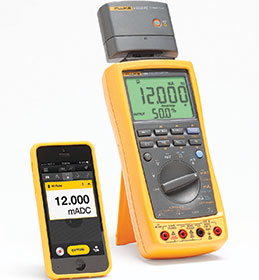
The Fluke 789 ProcessMeter is an advanced troubleshooting tool for electricians and instrumentation professionals, combining the functionality of a loop calibrator with the power of a digital multimeter. By equipping the 789 with a temperature measurement module and the wireless data logging capabilities of Fluke Connect with ShareLive video call (sold separately), process technicians can now do a lot more while carrying a lot less. And with its built-in, selectable 250 ohm HART resistor, it eliminates the need to carry a separate one.
Monitor temperature and electrical parameters at the same time
The FC Wireless K-Type temperature module can be used for day-to-day troubleshooting applications. It measures temperature in one location and then wirelessly relays the results to a smartphone (with the Fluke Connect app installed). This comes in handy for checking multiple components of heating and cooling systems simultaneously.
For example, at one site, a temperature module was set up to monitor refrigerant line temperatures while a technician worked on the refrigeration components located elsewhere. It was also used on split system chillers. In one instance the chiller, which had microprocessor-based control, was located in the basement, while the air-cooled condenser was located on the roof. The technician was able to oversee the fan-cycling controls by measuring the motor draw using the a3000 FC current clamp. At the same time, he monitored the liquid line temperature using the temperature module, and observed a specific percentage on the microprocessor in the basement. He viewed the results from all three tools simultaneously, in real time, on his smartphone.
Finding a needle in a haystack
With the Fluke Connect DC voltage module, another user measured a 0-10 VDC signal to a variable frequency drive located in a supply air cabinet. The third-party panel was inaccessible so the VFD was the only place to test. “If I had tried to monitor the third-party signal at the VFD with a standard meter, it would have tripped an alarm due to ‘no proof of air flow’ by the air flow switch,” he said. “Using the Fluke Connect DC voltage module I found that the building automation system was not sending the proper ramp signal when duct static pressure dropped.”
This same FC module also helped him to find a chronic problem in a DC power supply that was intermittently dropping the 5 V it supplied, which caused a chiller to fail and trigger an alarm. The DC voltage module was left on the power supply overnight. “The results showed that the power supply dropped voltage and then restored itself,” the technician said. “I replaced it with confidence the next day. These meters are of incredible value when tests need to be conducted outside electric panels and in remote locations.”
Infrared thermometers for electrical, industrial and HVAC applications Comtest
Maintenance, Test & Measurement, Calibration
: Comtest, distributor of Fluke test and measurement equipment, explains how handheld infrared thermometers are transforming maintenance in electrical, industrial and HVAC environments, with three measurement strategies and a wide range of practical applications.
Read more...Reverse-engineering legacy industrial gearbox parts
Maintenance, Test & Measurement, Calibration
WEG Africa’s turbine workshop uses 3D scanning technology to reverse-engineer components for legacy gearboxes, turbines and compressors, enabling equipment to run for decades after OEM support and spare parts have dried up.
Read more...Unlocking ICCP remote monitoring Omniflex Remote Monitoring Specialists
Maintenance, Test & Measurement, Calibration
Cathodic protection keeps buried and submerged pipelines safe from corrosion, but verifying it traditionally means costly, hazardous manual site visits. Omniflex explains how a retrofit module brings remote monitoring to ageing transformer rectifiers without replacing functional infrastructure.
Read more...Microdieseling – the explosions you never hear
Maintenance, Test & Measurement, Calibration
Microdieseling is a pressure-induced thermal degradation mechanism in which entrained air bubbles are compressed so rapidly that the surrounding oil ignites, producing soot, varnish and sludge. WearCheck explains how it happens, why the damage varies, and how oil analysis detects it.
Read more...Electrostatic spark discharge – when static strikes back Wearcheck
Maintenance, Test & Measurement, Calibration
WearCheck technical manager, Steven Lumley explains how static electricity accumulates in modern low-conductivity lubricants, why compact system designs and fine filtration make ESD more likely, and how to recognise the degradation it leaves behind.
Read more...High-speed cameras for crash testing Horne Technologies
Maintenance, Test & Measurement, Calibration
Vision Research has expanded its Phantom C-series with two cameras optimised for crash and safety testing, offering 4 and 8 megapixel sensors rated to 170G, up to 1180 frames per second, and Phantom Academy application training planned for South Africa next year.
Read more...SKF extends remanufacturing expertise to bearing clearance modification SKF South Africa
Maintenance, Test & Measurement, Calibration
Using its clearance modification expertise, SKF helped a mining equipment OEM salvage spherical roller bearing inventory that would otherwise have been scrapped, confirming a new capability within its remanufacturing services and avoiding redundant procurement.
Read more...When maintenance-system compliance starts replacing plant reliability Wearcheck
Maintenance, Test & Measurement, Calibration
WearCheck ARC division manager, Annemie Willer argues that the greatest threat to effective maintenance is no longer a lack of technology, but the gradual replacement of technical judgement by CMMS compliance, leaving no one owning the machine.
Read more...Nitration: the acid you didn’t see coming Wearcheck
Maintenance, Test & Measurement, Calibration
Nitration is as destructive as oxidation in many engines but far less understood. WearCheck technical manager, Steven Lumley explains how nitrogen oxide gases degrade lubricants, why the process is difficult to detect, and what oil analysis can reveal before damage occurs.
While every effort has been made to ensure the accuracy of the information contained herein, the publisher and its agents cannot be held responsible for any errors contained, or any loss incurred as a result. Articles published do not necessarily reflect the views of the publishers. The editor reserves the right to alter or cut copy. Articles submitted are deemed to have been cleared for publication. Advertisements and company contact details are published as provided by the advertiser. Technews Publishing (Pty) Ltd cannot be held responsible for the accuracy or veracity of supplied material.










 printer friendly version