


IT in Manufacturing


Yokogawa’s cybersecurity solutions for the plant of the future

September 2018 IT in Manufacturing

The evolution of the process control network from individual isolated computers with proprietary operating systems and networks, to interconnect various systems and applications employing commercial-off-the-shelf technology, has led to the full integration of process control networks with business enterprise systems and other applications through various communication networks. This is known as “the plant of the future”.

The benefits of such network and system integration include:

• Increased visibility of process control network activities (work in progress, equipment status, product schedules) integrated with processing systems from the business level. This contributes to capability improvements through analysis, which drive down costs and improve productivity.

• Integrated manufacturing and production systems that have more direct access to business level information, thus enabling a more responsive enterprise.

• A common interface, resulting in a reduction of overall support costs by permitting remote access to production processes.

• Remote monitoring of the process automation system which results in reduced support costs, allowing for quick, effective problem resolution.
Plant of the future characteristics

“The plant of the future will only have two employees: a man and a dog. The man will be there to feed the dog. The dog will be there to keep the man from touching the equipment.” Warren G. Bennis.

As the quote points out, the plant of the future will have very specific characteristics which are different from that of current plants.

These include:

• Agility and flexibility: the supply chain will be fully synchronised for optimal asset utilisation.

• Synchronisation of business and plant systems.

• Autonomous operations: nearly unmanned; event prediction mitigation; intervention by exception; integrated control and safety systems.

• Be information driven: connected systems with access from anywhere to information and context.

• Asset performance management: optimised operating performance; predictive and prescriptive alerts; highly integrated operations and maintenance.

The biggest challenge facing the plant of the future will be continuous security of the information flow.

Continuous security concept

The security demands currently being made by the process control customer differ from those of classic plant security. Integration with open systems, using the latest technology devices and networks, is now a requirement. Due to fast changing technology, the possibilities are unlimited and plant security needs to cope with and address any known issues and vulnerabilities.

Just as control system technologies are constantly evolving, security risks, including attack techniques, are evolving just as fast. Attacks targeting industrial control systems have been increasing at an alarming rate. Once off deployment of security controls is insufficient to mitigate these risks. A service lifecycle solution for cybersecurity is required to ensure that the security measures and deployment are continuously enhanced, monitored and inspected.

Yokogawa’s cybersecurity lifecycle solutions

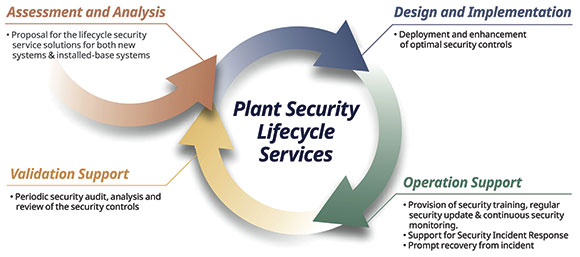
Plant security lifecycle service: Yokogawa’s cybersecurity approach has four phases, starting with an assessment of the system and ending with a validation of the security controls. This approach ensures that the design and implementation are specific not only for the industry, but for each customer’s unique environment.

Phase 2: design and Implementation – deployment and enhancement of optimal security controls.

Phase 3: operational support – provision of security training, regular security updates and continuous security monitoring. Support for security incident response and prompt recovery from incidents.

Phase 4: validation support – periodic security audit plus analysis and review of security controls.

Conclusion

For more than a decade, Yokogawa has developed and provided proprietary cybersecurity solutions and technology for its customers. During this time, the Industrial Cyber Security Group has gained invaluable experience and knowledge from various projects undertaken around the world. The company is therefore in a prime position to co-innovate with customers wanting to minimise security risks and maximise corporate value.

For more information contact Christie Cronje, Yokogawa South Africa, +27 11 831 6300, [email protected], www.yokogawa.com/za


Credit(s)


Share this article:
Share via emailShare via LinkedInPrint this page

Further reading:

Overcoming the bottling industry’s fragmented visibility
Schneider Electric South Africa IT in Manufacturing Electrical Power & Protection
Beverage bottling facilities are among manufacturing’s most energy-intensive environments, yet many still operate without granular insight into where that energy goes. Rezolia Muller-Potluri of Schneider Electric explains how tiered metering architecture and advanced

Read more...
Advancing intelligent apparel manufacturing with industrial AI and humanoid robotics
IT in Manufacturing
Jack Technology, a global maker of industrial sewing equipment, has chosen Siemens software and engineering tools to bring artificial intelligence and humanoid robots into apparel production, aiming to shorten development cycles and lift manufacturing efficiency.

Read more...
New chiller line for high-density AI data centres
Schneider Electric South Africa IT in Manufacturing
Schneider Electric has launched the Uniflair XCA, a new series of air-cooled and free-cooling chillers designed for artificial intelligence-driven, high-density liquid-cooled data centres.

Read more...
Turning system integrators into trusted technology partners
Schneider Electric South Africa IT in Manufacturing System Integration & Control Systems Design
Schneider Electric’s Alliance Partner Programme is repositioning system integrators from hardware suppliers into lifecycle-value partners. Oriel Soupen explains the competency framework, certification model and real-world results that are already helping African system integrators win higher-value, longer-term engagements.

Read more...
Why renewable projects need integrated protection and control
IT in Manufacturing
Fragmented secondary plant integration in renewable energy projects causes costly delays during commissioning. ACTOM Protection and Control’s Secondary Plant Integration solution consolidates all secondary systems under a single engineering framework, reducing risk and accelerating grid

Read more...
When digital twins move from concept to critical tool
IT in Manufacturing System Integration & Control Systems Design Maintenance, Test & Measurement, Calibration
Digital twins are moving out of the lab and onto the mine, the factory floor and the transport network where they predict failures before they happen. Amritesh Anand looks at where they earn their keep, the data and integration work behind them, and the security questions every organisation should ask before switching one on.

Read more...
How a digital foundation can overcome the LNG trilemma
Schneider Electric South Africa IT in Manufacturing SCADA/HMI
The LNG sector is racing to add capacity, but without a digital backbone, growth creates complexity rather than capability. Christophe Begat of Schneider Electric explains how connecting data, systems and analytics across the LNG value chain can resolve the trilemma of secure supply, lower emissions and tighter costs.

Read more...
Decarbonisation is reshaping mining strategy in Africa
Schneider Electric South Africa IT in Manufacturing Electrical Power & Protection
Mining companies across Africa are embedding decarbonisation into operational strategy, driven by investor, regulatory and customer pressure to reduce emissions while improving resilience.

Read more...
Siemens and HighByte partner to scale industrial AI
Siemens South Africa IT in Manufacturing Fieldbus & Industrial Networking
Siemens is expanding its Industrial Edge ecosystem through a partnership with HighByte, enabling customers to connect, contextualise and transform data from operational technology and information technology sources to build AI models and applications at scale.

Read more...
Africa on the edge of a digital future
Schneider Electric South Africa IT in Manufacturing
Edge computing promises lower latency, stronger reliability and real-time responsiveness across Africa, yet its rollout keeps colliding with one stubborn obstacle, power. Steven Santini explores how renewable microgrids, smart energy management and the right partnerships could turn the continent’s energy gap into its biggest edge opportunity.

Read more...


While every effort has been made to ensure the accuracy of the information contained herein, the publisher and its agents cannot be held responsible for any errors contained, or any loss incurred as a result. Articles published do not necessarily reflect the views of the publishers. The editor reserves the right to alter or cut copy. Articles submitted are deemed to have been cleared for publication. Advertisements and company contact details are published as provided by the advertiser. Technews Publishing (Pty) Ltd cannot be held responsible for the accuracy or veracity of supplied material.


© Technews Publishing (Pty) Ltd | All Rights Reserved

