


Fieldbus & Industrial Networking


Automotive electronics

January 2018 Fieldbus & Industrial Networking

Digital sensors return a discrete value of 0 or 1 to a controller. The controller, usually connected to I/O systems over a fieldbus, reads out the bus system data in a set cycle, commonly clocked in the millisecond range. Important to note here is that the bus system needs a degree of determinism and the controller must run in synchronisation with it, even if bus cycles are sometimes longer or shorter. With Beckhoff hardware and software, the synchronisation between controller and bus system are assured, as are the deterministic features of the ultra-fast EtherCAT communication system. This means that PC-based control provides the ideal foundation on which to implement oversampling technology.

Bus cycle subdivision with oversampling

Oversampling involves polling signals at a configurable multiple of the bus cycle time (i.e. in micro cycles) and writing the results to a temporary buffer. The set of process data collected is then transferred during the next bus cycle. Oversampling functionality can avoid situations like the following during signal polling: If, for example, a sensor is queried every 10 ms, only the data available at the precise time of the query is actually acquired. The controller is effectively blind from one query to the next, so details of any changes in the sensor’s state occurring between PLC queries are not recorded. For instance, a sensor’s state might switch from 0 to 1 and stay there for 9.9 ms. If it then reverts to 0, the sensor signal – from the perspective of the controller reading it out – will appear not to have changed at all over the 10 ms cycle.

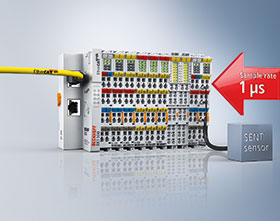
Situations like this can be detected by using an EtherCAT oversampling input terminal such as the EL1262 to connect the sensor. This terminal is able to subdivide the bus cycle into as many as 1000 micro cycles. In the case of a 10 ms bus cycle, an oversampling factor of 1000 translates into a sampling interval of 10 µs. In a 1 ms bus cycle, a sampling interval of just 1 μs can be achieved, which is the shortest that EtherCAT oversampling terminals can currently support. This technology is ideal for reading out SENT sensors.

The pulse width encoding protocol: SENT

Single Edge Nibble Transmission (SENT) is a simple, unidirectional, asynchronous protocol that encodes sensor data based on the time between falling edges in a digital signal.

The pulse length describes the signal value transmitted. A single bit in the SENT protocol generally corresponds to 3 μs, which meets the minimum requirement in terms of sampling precision. The signal level is 5 V. The EL1262-0050 oversampling terminal meets both requirements in that it supports precise data acquisition down to 1 μs and is capable of processing the signal level directly. It can sample each bit of the SENT signal three times – more than enough to read the data transmitted in a signal pulse.

The data sets acquired are then processed in a ready-made function block, which evaluates the pulse lengths recorded, calculates the checksums and then marks the value either as valid or invalid.

The SENT protocol is mainly used for communication between sensors and electronic control units in vehicle electronics. Due to the simplicity of the protocol, the microcontrollers in ECUs are capable of evaluating it. SENT protocol receivers are not available for use in constructing measurement and test benches, but the open Beckhoff control system offers an alternative: The EL9505 power supply terminal can serve as the required 5 V power source, and the EL1262-0050 variant of the EtherCAT digital input terminal can be used to capture the sensor signal. In this way, SENT sensors can be directly and easily connected to the open and modular control platform from Beckhoff. This means that test benches equipped with Beckhoff technology can be used to conduct quality inspections on, say, throttle valve or steering torque sensors and make any necessary adjustments before the sensors are fitted to a vehicle.


Credit(s)


Share this article:
Share via emailShare via LinkedInPrint this page

Further reading:

Introduction to Part 2 loop signatures and process transfer functions
Fieldbus & Industrial Networking
The previous series of loop signature articles dealt with the basics of control loop optimisation, and concentrated on troubleshooting and ‘SWAG’ tuning of simple processes. In this new series, consideration will be given to dealing practically with more difficult issues like interactive processes, and with processes with much more complex dynamics.

Read more...
Siemens sets new standards in drive technology
Fieldbus & Industrial Networking
Siemens is setting new standards in industrial drive technology with the launch of its new high-performance drive system, Sinamics S220. This offers a seamless and innovative drive system with comprehensive simulation and analysis capabilities and advanced connectivity features that enable full integration into digital work processes.

Read more...
PC-based control in the plastics industry
Beckhoff Automation Fieldbus & Industrial Networking
Nissei Plastic, an injection moulding machine manufacturer based in Japan is implementing a worldwide tend towards open automation systems from experienced specialists using PC and EtherCAT-based control technology from Beckhoff.

Read more...
Loop Signature 31: Non-linearity in control loops (Part 2)
Michael Brown Control Engineering Fieldbus & Industrial Networking
This article is a continuation of Loop Signature 30 published in the last issue in this series, exploring reasons for non-linearities which may be encountered in feedback control loops

Read more...
PC-based control for flat wire motors for electric vehicles
Beckhoff Automation Editor's Choice Motion Control & Drives
Special machine manufacturer, ruhlamat Huarui Automation Technologies has unveiled the second generation of its mass production line for flexible stators with bar winding (pins). This enables an extremely short production cycle and line changeover times, supported by PC- and EtherCAT-based control technology from Beckhoff.

Read more...
PC-based control optimises robotic parts handling on plastics machinery
Beckhoff Automation Editor's Choice Fieldbus & Industrial Networking
NEO is a cartesian robot developed by INAUTOM Robótica in Portugal for parts removal on plastics machinery. Its aim is to increase system productivity. NAUTOM Robótica has entered into a strategic partnership with Bresimar Automação to increase the working speed of the cartesian robots using advanced control and motion solutions from Beckhoff. The result is a comprehensive, future-proof automation solution for its entire family of cartesian robots.

Read more...
PC-based control for flat wire motors for electric vehicles
Beckhoff Automation Fieldbus & Industrial Networking
Special machine manufacturer, ruhlamat Huarui Automation Technologies unveiled the second generation of its mass production line for flexible stators with bar winding. This enables extremely short production cycle and line changeover times, supported by PC- and EtherCAT-based control technology from Beckhoff.

Read more...
Hans Beckhoff receives German Mechanical Engineering Award
Beckhoff Automation News
Hans Beckhoff has received the 2025 German Mechanical Engineering Award. This prestigious award honours entrepreneurs who have set standards in machine and system engineering, driven innovation, and taken on social responsibility.

Read more...
Intuitive CNC HMIs with simulation functionality
Beckhoff Automation SCADA/HMI
The TwinCAT 3 automation software from Beckhoff offers two new function libraries for CNC-specific user interfaces. These were used to create an advanced, intuitive HMI application specifically for CNC purposes and to simulate part machining using real-time data.

Read more...
Case History 200: The final case history – desuperheater control problem.
Michael Brown Control Engineering Editor's Choice Fieldbus & Industrial Networking
For this final article I have chosen to relate a problem that existed in a desuperheater temperature control on a boiler in a petrochemical refinery.

Read more...


While every effort has been made to ensure the accuracy of the information contained herein, the publisher and its agents cannot be held responsible for any errors contained, or any loss incurred as a result. Articles published do not necessarily reflect the views of the publishers. The editor reserves the right to alter or cut copy. Articles submitted are deemed to have been cleared for publication. Advertisements and company contact details are published as provided by the advertiser. Technews Publishing (Pty) Ltd cannot be held responsible for the accuracy or veracity of supplied material.


© Technews Publishing (Pty) Ltd | All Rights Reserved

