



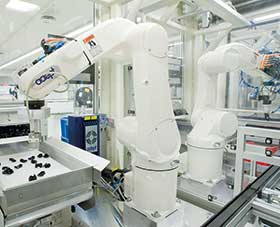
The assembly of the high-tech shaving devices demands the highest level of quality, whereas standard shaver models rely on mostly manual labour. This demand for a high-quality assembly process has made the Drachten plant turn to automation for its production. Reliable assembly processes with integrated quality control assure the highest level of quality of the consumer products. Bremer Werk für Montagesysteme is a company well versed in how to build the necessary equipment for demanding assembly tasks. The specialists had the industry expertise and knowledge, but in the case of Philips, there was much more required than pre-existing solutions.
“The real challenge in finding the right solution for Philips was to cater for the enormous model variety of the high-end shavers,” said Matthias Schaller, head of robotics at Bremer Werk für Montagesysteme. “Currently about 60 product lines culminate in some 600 different models and the product spectrum changes almost every day.”
Beyond that obstacle, Philips outlined a requirement for an assembly solution that demanded much more than just the foresight of the construction engineers. In essence, Philips was insisting on a guaranteed future level of performance of their equipment. Sietze Bremer, senior sourcing specialists at Philips said, “We wanted to implement a future-oriented assembly concept. And we wanted to feel certain that the equipment would still be able to produce shavers ten years from now, without even knowing how they will look. Flexibility is of paramount importance.
The solution: adaptable components from one source
How does one build machinery capable of assembling products when nobody knows for sure how they will look and work in the future? This presented a significant challenge that would test the ambition and creativity of the Bremen people. It turns out, the solution meant Omron Adept. The automation strategist Schaller explained that after first analyses, a system concept emerged, which could only work on the basis of extremely flexible automation components from one source. Due to the multitude of assembly stations, a component mix of different manufacturers would have led to an uncontrollable complexity. “We needed 6-axis robots, vision systems, part feeders and controls, and everything from a single source. In this connection we counted on Adept, as the heavy-duty components meet all our requirements and have already proved their efficiency in similar projects in the past,” he added.
The first item to address was how to achieve the highest levels of flexibility. Maximum flexibility in the automation was delivered in three ways. Firstly, the modular layout of the shavers consists of three main components that can be manufactured independently of one another on different production lines.
The second important factor is the conception of the complete equipment based on modular ideas. In Drachten, the three-head-shavers are currently assembled on a total of thirteen slitting lines each composed of five to eight cells. Each cell operates autonomously and can be connected or disconnected according to the plug and play principle. The concept of smaller and mutually independent lines with autonomous cells does not only mean a flexibility booster but stands also for maximum availability. Because: If it gets stuck at one point, not the entire machine will stop, but only one of the lines.
“We count on Omron Adept completely when expanding the equipment,” said experienced senior manager Sietze Bremer. “The Viper 6-axis robots as well as the Cobra SCARA robots are predominantly equipped with the vision guidance and inspection package, AdeptSight, and arrive already having been tried and tested in existing lines. The robots impress with their precision, speed, and availability and perform the tasks with the high accuracy that is required.”
A key role within the cells relates to the AnyFeeder. Without its approved flexibility, the system concept would not have been feasible. The inherent flexibility of the AnyFeeder systems affected a number of areas throughout the assembly automation process: wherever efficient assembly with a high-degree of individualisation mattered. At the Philips plants, Bremer Werk für Montagesysteme counted on the Adept AnyFeeder SX 240 flexible feeding system. When synchronised with Cobra and Viper robots and AdeptSight vision guidance, the AnyFeeder system redefines what it means to be flexible in small-parts feeding applications.
The majority of the robots on the existing lines were already equipped with vision guidance and all new machines are scheduled to have a vision system. This again reinforces the focus on flexibility: “A robot with integrated vision guidance can be perfectly adopted for varying tasks and, furthermore, can take over additional work contents, for instance in the field of quality control,” concluded Bremer. “These groundbreaking automation solutions guarantee economic and efficient assembly of our high-end shavers. The Philips plant is now one of the most innovative production sites for high-quality shavers.”
| Tel: | +27 11 579 2600 |
| Email: | info_sa@omron.com |
| www: | www.industrial.omron.co.za |
| Articles: | More information and articles about Omron Electronics |






© Technews Publishing (Pty) Ltd | All Rights Reserved
 printer friendly version