



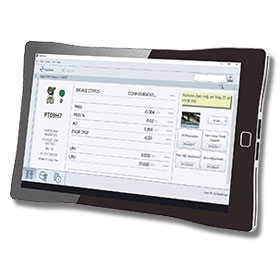
Yokogawa has announced that it has significantly enhanced its FieldMate device management software, and is releasing this as FieldMate R3.02. FieldMate is a versatile software program used to configure, adjust and manage a wide variety of field devices used in factories and other production sites. This latest version of FieldMate includes new functions that reduce maintenance workload by simplifying a number of field maintenance tasks.
Yokogawa will also release an enhanced version of FieldMate Validator, an optional software tool that is used to verify connections between field instruments and control system I/O devices.
Digital communications standards are playing an increasingly important role in communications between plant central control systems and field devices. With a number of digital communication standards in use today, plants often have devices from multiple vendors that use different standards. Software tools are thus required that have the versatility to configure, adjust, and manage these devices.
With its support of a variety of digital communication standards and its ability to configure, adjust, and manage a variety of devices from different manufacturers, FieldMate is up to this challenge. With this latest update, FieldMate has become even easier to use and improves the efficiency of field maintenance operations.
Enhancements
Previous FieldMate versions could run on Windows 7 PCs and tablets. With release 3.02, FieldMate can now be used on PCs and tablets that run Microsoft’s latest operating system, Windows 10. This is particularly significant because Windows 7 and 10 tablets are increasingly being used in the field by maintenance personnel.
Additional key new features of FieldMate R3.02 are as follows:
One-click (touch) operation for complex procedures
Dedicated buttons have been added to the FieldMate home screen for frequently performed field device maintenance tasks such as zero point adjustments and input loop checks. This simplifies complex tasks such as the checking of settings for field devices that formerly required users to navigate to data at several different levels. This greatly improves maintenance efficiency. Linked tasks include the following:
• Zero point adjustment: This procedure is performed to correct for an error in the value displayed by a field device that is often the result of an environmental factor or the device orientation. Zero point adjustment can be performed for a Yokogawa differential pressure/pressure transmitter by simply connecting the FieldMate R3.02 PC or tablet to the target device and clicking (touching) the Zero Point Adjustment button.
• Input loop check: This verifies whether device signals are being received by the controllers and the control system. Previously, depending on the device that was being tested, different procedures needed to be followed to perform this test. Regardless of device model or make, all it takes with FieldMate R3.02 is to click (touch) the Input Loop Check Support button to output a loop check signal from a device. With FieldMate R3.02, the output signal can also be easily set to the desired level to create a test pattern, which can be saved and retrieved. Compared to a conventional handheld terminal, this function reduces work time by one third.
Easy comparison with past settings
FieldMate can save parameters such as field device settings in a database. With FieldMate R3.02, it is possible to compare current values and previous settings for a parameter by just pressing the All Parameters button on the home screen. This function is useful for verifying changes made by field maintenance personnel and for troubleshooting problems.
FieldMate Validator
FieldMate Validator is an optional software tool that is used to verify the connections between newly installed field instruments and control system I/O devices. This product was first made available for use with the N-IO (Network-I/O) field I/O devices that were introduced for the Yokogawa Centum VP R6.01 integrated production control system. With this latest release, FieldMate Validator now supports the I/O devices that were developed to facilitate quick upgrades to Centum VP R6.03.
For more information contact Christie Cronje, Yokogawa South Africa, +27 (0)11 831 6300, [email protected], www.yokogawa.com/za
| Tel: | +27 11 831 6300 |
| Email: | [email protected] |
| www: | www.yokogawa.com/za |
| Articles: | More information and articles about Yokogawa South Africa |






© Technews Publishing (Pty) Ltd | All Rights Reserved
 printer friendly version