



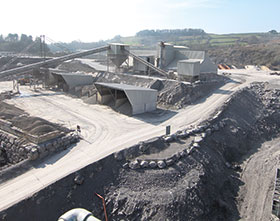
E&JW Glendinning is the largest independent supplier of quarry and concrete products both to the trade and direct to the end-user in the counties of Devon and Cornwall, United Kingdom. It is still wholly owned by the founders’ families and many family members remain actively involved in the day-to-day running of the business – reflecting their belief in self-reliance and independence. Over recent years, they have embarked upon an expansive programme of modernisation and automation, creating a state-of-the-art aggregates processing and supply facilities, which is essential to compete in the modern aggregates market.
As part of this, E&JW Glendinning needs high-tech sensor solutions to deliver the automation and control philosophy they seek. They make high demands on equipment to get the best performance out of their plant.
Level measurement problem in the crusher
The secondary crusher at the heart of the screening and grading plant in the quarry is typical of this requirement. The feed hopper above it is a critical process control point, as this is where the majority of aggregate comes through at some stage. It is a noisy, dusty environment, with unpredictable flow patterns and material behaviours. The crusher itself is capable of processing up to 400 tonnes an hour and the whole plant 4000 tonnes a day. With this level of throughput, it is vitally important to get accurate information and control to optimise productivity, energy consumption and product quality from the crusher.
Originally, as is the case with most sites in the sector, non-contact ultrasonic level sensors were installed. However, the noise, dust and product build up regularly delivered unreliable performance for the control required. Instead of an analog indication of the level in the feed, it was more a series of step changes from low to high and back again, as the reflected echo signals came and went, or they would ‘fail safe high’ through loss of echo. This single measurement problem resulted in regular production halts, poor process and energy management and resets of the sensors to clear the problem. The ultrasonic units required regular maintenance: from cleaning transducers, adjusting angles and tweaking software, to try to make them perform as required.
The engineers needed to improve the performance of the plant to a level both they and their customers require for this busy quarry. With this in mind, they turned to VEGA to trial one of their new Vegapuls 69 radar level sensors in this tricky, critical control point. The application consists of a feed hopper over 8 m high and approximately 5 m square at the bottom, with two sides sloping down onto a central crusher feed. The hopper can be fed from any one of three different conveyors, which can be simultaneous, and the stone size feeding in can be from dust up to 250 mm, as the majority comes from the primary crushing plant. Inside the feed silo it gets a heavy build up of stone on the ‘shoulders’ of the coned section, forming a narrower ‘rat hole’ to the bottom. This material rarely moves, so it was important for the sensor to be able to read down past this point.
The Vegapuls 69 was installed in the existing mounting position of the ultrasonic sensor, very close to the main feed into the bunker. The plug-in programmer on the top of the device was used for commissioning. As soon as it was installed on the empty silo, with no extra adjustments, the sensor was able to read right down to the bottom of the bin to the outlet conveyor, which boded well. Then, with just a few minor adjustments to optimise the performance of the sensor and its output, the radar has worked successfully without incident for over three months, providing a smooth level output to enable operators to control crusher throughput and the conveyor speeds more effectively. This has been done without the need for extra maintenance work and a reduction in downtime caused by measurement problems, a first for this area of the process.
So why is this radar so different?
Vegapuls 69 works with very highly focused 79 GHz microwaves, not sound waves, to provide sensor performance for solids handling. Combined with radar’s natural immunity to inflight dust, filling noise and air turbulence, this makes it a most capable and versatile solids level sensor. The instrument is already proving itself in a number of difficult applications like this one, where previously immeasurable applications are now successfully solved.
The site engineer said, “We like VEGA sensors, as we install them, fit them and they get on with their job. We don’t have to keep going back with minor tweaks. We also like the continuity of the programming system, it’s pretty much the same for the radar sensors as the pressure transmitters, which we use in other areas of the plant. All that is needed to set a sensor up is the PlicsCom display/programmer that simply slots onto the housing that enables access to all of the information and gets a sensor up and running quickly and easily.
“We only need one programmer for all devices and the similar menu structure means the familiarity of operation allows us to quickly get sensors set up without having to keep going back to tweak them, also not having to constantly refer to the operating manual, which we all know is a last resort for any engineer.”
As a result, E&JW Glendinning personnel are confident enough of the radar devices’ performance that they have embarked upon a schedule of installing them across the plant, replacing ultrasonic sensors. By standardising on this non-contact level radar, it has quickly shown a payback in reduced maintenance, outages and increased productivity.
For more information contact Chantal Groom, VEGA Controls SA, +27 (0)11 795 3249, chantal.groom@vega.com, www.vega.com
| Tel: | +27 11 795 3249 |
| Email: | info.za@vega.com |
| www: | www.vega.com/en/home_za |
| Articles: | More information and articles about VEGA Controls SA |






© Technews Publishing (Pty) Ltd | All Rights Reserved
 printer friendly version