Surge protection for petrol stations is critical
October 2015
Electrical Power & Protection
Petrol stations are highly vulnerable to lightning strikes and surges due to their extremely sensitive control and display systems. The necessity of a lightning protection system is essential when considering the highly flammable sources of ignition on site. Prudent building regulations dictate that structures where a lightning strike can easily occur or can have serious consequences due to their location, type of construction or use, must be equipped with permanently effective lightning protection systems. Operators of petrol stations need to ensure that employees, customers and pedestrians are protected against fire and explosion risks caused by fuels and vapours.
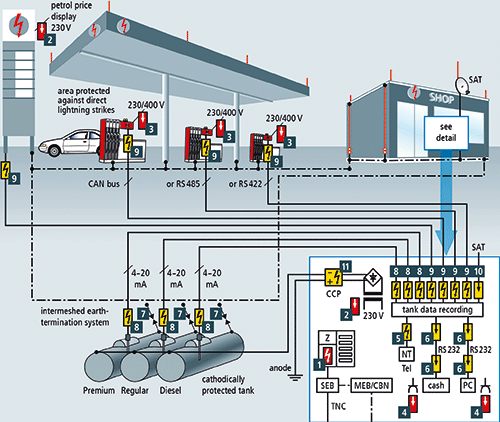
The IEC 60364-1 (HD 60364-1) standard specifies that “property shall be protected against damage as a consequence of over voltages such as those originating from atmospheric events or from switching”. The surge protective devices recommended in this standard must not be installed in Ex zones (zone 0, 1 and 2), if any. If surge protective devices are located in hazardous zones, adequate measures (e.g. approved enclosures and/or approved surge protective devices) must be taken to avoid ignition.
A professional external lightning protection system, consistent lightning equipotential bonding and additional surge protection measures are required to protect petrol stations from direct lightning strikes.
Equipment located in the forecourt, such as the petrol price display, and the incoming utility line are vulnerable to direct lightning strikes. Therefore, lightning current arresters should be installed at the entrance point into the building.
The fuel dispensers are generally located underneath a projecting metal roof and are thus protected against direct lightning strikes. For this reason, and due to the intermeshed earth-termination system, surge arresters are installed at the entrance point of the lines into the petrol station building and at the entrance point of the lines into the fuel dispenser to protect the lines leading to the fuel dispenser electronics.
It is important to interconnect all metal constructions, such as pipes, fuel dispenser enclosures, and tanks, and to connect them to the earth-termination system of the petrol station building. The earth-termination system should have an earth resistance of < 10 Ω (recommendation).
For more information contact Alexis Barwise, Dehn Africa, +27 (0)11 704 1487, [email protected], www.dehn-africa.com
Further reading:
Africa’s net-zero ambition must become operational
Schneider Electric South Africa
Electrical Power & Protection
Schneider Electric’s Rohit Chashta argues that the biggest gap in Africa’s green transition is not ambition but execution, and outlines how advisory services, bankable project roadmaps, digital visibility and SF6-free switchgear can turn sustainability commitments into measurable progress.
Read more...
High-efficiency half-brick DC-DC converters
Vepac Electronics
Electrical Power & Protection
The Supreme series half-brick DC-DC converters from Vepac Electronics use synchronous rectification for high conversion efficiency, in a six-sided metal case built to withstand harsh industrial and transportation environments.
Read more...
Zinc-based batteries power a more sustainable energy future
Electrical Power & Protection
Zinc-based batteries are gaining ground as a safe, recyclable and cost-effective energy storage option, from consumer electronics to grid-scale systems. The International Zinc Association’s Simon Norton explains why zinc is well placed to support the clean energy transition.
Read more...
Energas introduces lower-cost German gas genset for South African market
Electrical Power & Protection
Energas Technologies will supply R Schmitt Enertec’s new Energy Line genset to the South African market, offering German-engineered gas-to-power generation of 400 to 500 kW at a lower entry cost through focused standardisation and a simpler standalone architecture.
Read more...
ACTOM plays key role in large transmission substation project in Swellendam
ACTOM Electrical Machines
Electrical Power & Protection
ACTOM has been appointed to engineer, procure, construct and commission the 1000 MVA main transmission substation for the Overberg Wind Farm in Swellendam, one of the largest substations of its kind in South Africa.
Read more...
Reliable power conversion from high-voltage DC buses
Conical Technologies
Electrical Power & Protection
The MEAN WELL DDRH-240 from Conical Technologies is a high-reliability DIN-rail DC-DC converter with a wide 250 to 1500 V DC input range, deriving stable low-voltage power directly from high-voltage DC buses in renewable energy, storage, charging, railway and industrial installations.
Read more...
AES maintains a strong value and safety stance on boiler retrofits
Electrical Power & Protection
AES Commercial Director Dennis Williams explains when a boiler retrofit makes more sense than replacement, outlines the range of efficiency and emissions upgrades available, and draws the line at safety: a boiler not legally signed off is shut down, no exceptions.
Read more...
The grid needs to become more intelligent
Schneider Electric South Africa
Electrical Power & Protection
South Africa’s power grid is becoming bidirectional and far more dynamic as distributed energy resources proliferate. Schneider Electric’s Nishandra Bajinath explains why digitalisation, DERMS and aggregation are essential to keep this increasingly complex grid stable and efficient.
Read more...
ACTOM’s integrated electrical solutions reduce project risk and accelerate delivery
Electrical Power & Protection
ACTOM has secured multiple orders across four divisions for the Naos-1 hybrid solar and battery project in the Free State, demonstrating its integrated model for supplying the full electrical chain from high-voltage equipment to distribution transformers.
Read more...
Smarter energy management starts with intelligent electrification
ABB South Africa ABB Electrification Products
Electrical Power & Protection
ABB Electrification specialists Adeline Maleka and Nokulunga Dube explain how the convergence of electrification, digitalisation and automation is helping South African industries gain real-time visibility, reduce energy waste and build operational resilience.
Read more...










 printer friendly version