Belt rip detection
October 2015
Maintenance, Test & Measurement, Calibration
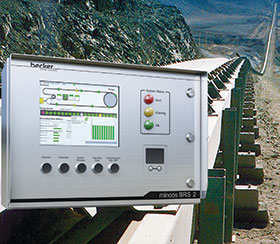
Becker Mining South Africa has launched its latest BRS-2 belt rip detection system, which has been designed to increase the productivity of conveyor belts by detecting belt rips as soon as they occur.
“This belt rip detection system, which is based on the highly efficient design of the original BRS-1 system, is used to detect longitudinal rips on steel cable and fibre conveyor belts,” says Andrew Trentelman, senior general manager: electronics, Becker Mining South Africa. “The BRS-2 uses real time loop diagnostics to continuously monitor the status of the belt and, in the event of a rip, stops the belt drives, which reduces any further damage and minimises downtime.”
To monitor the status of a belt, inductive loops are embedded in the belt. Once installed, the BRS-2 system carries out an identification run and the processor of the belt rip detection system unit (BRS/CU) stores the necessary data. Parameters include the succession of loops in the belt, belt speed and start up time of conveyors. Stored values are protected against power loss and can be entered or changed when necessary.
When the belt is in operation, these inductive loops pass over the transmitter and receiver, which are positioned opposite each other on either side of the belt. An electro-magnetic signal is transmitted via the inductance loop from the transmitter into the receiver. Because this system has recorded the distance between successive loops and belt velocity, it can automatically calculate the time intervals between each loop.
The belt rip sensor that is embedded in the belt operates like a bridge between transmitter and receiver of the belt rip scanner sensor interface (BRS/SI). If a belt is ripped, the BRS/SI cannot measure any analog values from the destroyed loop.
Apart from the detection of belt rips, this system is designed for monitoring belt speed, the detection of belt slip and also for belt sequence control. Access and monitoring of the system is simple, either locally with its 12” TFT screen, five shortcut buttons, a mouse pad and virtual keypad, or remotely via TCP/IP or other bus standards. Other features include real-time graphics, a forward and reverse capability, local and remote password protection and a record of the last 10 000 system changes.
This device can withstand operation in arduous conditions and has a robust stainless steel housing with an IP65 index protection rating to guard against the ingress of dust and water.
This advanced belt rip detection system is designed for use in diverse industries, including manufacturing, food and beverage conveying, packaging and mining applications.
BRS-2 systems enhance Becker Mining South Africa’s extensive range of reliable inter-operable communications, automation and safety systems. These systems include distributed antenna configurations, leaky feeder communications and industrial Wi-Fi systems, as well as tagging and tracking systems, real-time location solutions, traffic information and control systems. They also encompass remote evacuation signalling systems, environmental monitoring equipment and terrestrial radio and data equipment.
For more information contact Andrew Trentelman, Becker Mining South Africa, +27 (0)11 617 6300, [email protected], www.za.becker-mining.com
Further reading:
Infrared thermometers for electrical, industrial and HVAC applications
Comtest
Maintenance, Test & Measurement, Calibration
: Comtest, distributor of Fluke test and measurement equipment, explains how handheld infrared thermometers are transforming maintenance in electrical, industrial and HVAC environments, with three measurement strategies and a wide range of practical applications.
Read more...
Reverse-engineering legacy industrial gearbox parts
Maintenance, Test & Measurement, Calibration
WEG Africa’s turbine workshop uses 3D scanning technology to reverse-engineer components for legacy gearboxes, turbines and compressors, enabling equipment to run for decades after OEM support and spare parts have dried up.
Read more...
Unlocking ICCP remote monitoring
Omniflex Remote Monitoring Specialists
Maintenance, Test & Measurement, Calibration
Cathodic protection keeps buried and submerged pipelines safe from corrosion, but verifying it traditionally means costly, hazardous manual site visits. Omniflex explains how a retrofit module brings remote monitoring to ageing transformer rectifiers without replacing functional infrastructure.
Read more...
Microdieseling – the explosions you never hear
Maintenance, Test & Measurement, Calibration
Microdieseling is a pressure-induced thermal degradation mechanism in which entrained air bubbles are compressed so rapidly that the surrounding oil ignites, producing soot, varnish and sludge. WearCheck explains how it happens, why the damage varies, and how oil analysis detects it.
Read more...
Electrostatic spark discharge – when static strikes back
Wearcheck
Maintenance, Test & Measurement, Calibration
WearCheck technical manager, Steven Lumley explains how static electricity accumulates in modern low-conductivity lubricants, why compact system designs and fine filtration make ESD more likely, and how to recognise the degradation it leaves behind.
Read more...
High-speed cameras for crash testing
Horne Technologies
Maintenance, Test & Measurement, Calibration
Vision Research has expanded its Phantom C-series with two cameras optimised for crash and safety testing, offering 4 and 8 megapixel sensors rated to 170G, up to 1180 frames per second, and Phantom Academy application training planned for South Africa next year.
Read more...
SKF extends remanufacturing expertise to bearing clearance modification
SKF South Africa
Maintenance, Test & Measurement, Calibration
Using its clearance modification expertise, SKF helped a mining equipment OEM salvage spherical roller bearing inventory that would otherwise have been scrapped, confirming a new capability within its remanufacturing services and avoiding redundant procurement.
Read more...
When maintenance-system compliance starts replacing plant reliability
Wearcheck
Maintenance, Test & Measurement, Calibration
WearCheck ARC division manager, Annemie Willer argues that the greatest threat to effective maintenance is no longer a lack of technology, but the gradual replacement of technical judgement by CMMS compliance, leaving no one owning the machine.
Read more...
Automatic lubrication systems drive mobile mine machine reliability and uptime
SKF South Africa
Maintenance, Test & Measurement, Calibration
SKF’s Lincoln P203 progressive lubrication systems are improving reliability and uptime on mobile machines at a Zambian gold mine, with installation of 45 units completing by October 2026.
Read more...
Nitration: the acid you didn’t see coming
Wearcheck
Maintenance, Test & Measurement, Calibration
Nitration is as destructive as oxidation in many engines but far less understood. WearCheck technical manager, Steven Lumley explains how nitrogen oxide gases degrade lubricants, why the process is difficult to detect, and what oil analysis can reveal before damage occurs.
Read more...










 printer friendly version