



Heap leaching
Heap leaching often applies to low-grade ore. The processing plant stacks the ore in a heap on an impermeable liner. Stacking is often preceded by a crushing step to increase the surface area of the ore and permeability of the heap. A sprinkler system above the heap then applies a leaching solution. The solution percolates through the heap, dissolving the target mineral as it migrates in and out of the ore. Heap leaching may take months. The leachate (called ‘pregnant’ solution) collects at the bottom of the heap through a series of ditches and ponds. A process plant will then remove the mineral from the pregnant solution and then return the ‘barren’ solution to a pond to be recycled to the heap once again.
Leach tanks
Leaching ore in vessels is more expensive than heap leaching. But it is often economical for richer grades of ore (high percentage of target mineral). Typically a crushing and milling operation first grinds the ore to a fine powder while the leaching solution is introduced. The slurry of powdered ore and leaching solution flows to a series of leach tanks to provide sufficient time for the leaching action to take place.
Cyanide leaching: gold processing
Cyanide leaching is most common in processing gold and silver ores. Cyanide will dissolve the gold from its host rock provided that the ore exists as an oxide and is not closely bound. In low-grade ore, gold will exist in the form of microscopic particles and be processed via heap leaching. If the gold exists in a larger, more concentrated state, the ore will be finely ground and leached in a tank. A gold cyanide complex will form as the gold dissolves from the rock or pulp (finely ground ore), according to the equation:
4Au + 8CN- + 2H2O +O2 g 4Au(CN)2 + 4OH
The control of pH in a cyanide leach solution is critical both from a safety and cost viewpoint. The process adds cyanide to solution in the form of sodium cyanide (NaCN). Decreased pH values favour the following reaction: NaCN + H2OgHCN + NaOH
The result is the formation of hydrogen cyanide gas, which is lethal in a concentrated state. The reaction also has an economic concern. It generates a high consumption of cyanide as it releases into the atmosphere, never to be recovered. Sodium cyanide is a relatively costly reagent. To control costs and maintain worker safety, most operations will try to keep process acidity in the 11 to 12 pH range.
Understanding leaching of mineral ores
Leaching involves the dissolution of a mineral from a solid (ore). The process contacts the ore with a solution containing reagents that dissolve the desired mineral (and often some undesirable materials). Various methods – carbon adsorption, precipitation, solvent extraction, and electro winning – concentrate the target mineral and remove it from the solution.
Plants commonly use lime as the reagent for pH control. In a heap leach operation, the plant will add lime to the crushed ore or into the barren solution pond. Continuous pH control is neither common nor necessary for heap leach operations. Adjustments are usually made on a batch basis at the barren pond. In a milling operation, the plant usually measures pH in the leach tanks. As mill feed varies, so will the pH of the slurry.
Adjustments of pH with lime will be made to ensure optimum use of cyanide. Plants now also commonly inject oxygen into the leach tanks to help accelerate the leaching process. Since oxygen is a key component in the above reaction, it increases gold recovery for a given residence time in the leach tanks.
Usually the leach tanks are large and contain only cyanide solution and pulp. The slurry then flows into several CIP (carbon in pulp) tanks that contain granulated carbon particles. The carbon captures the dissolved precious metal in solution through a mass transfer process known as adsorption. The carbon moves counter-current to the pulp flow so that the new carbon contacts with the lowest concentration of gold-bearing solution in the final CIP tank. The plant removes the loaded carbon at the first CIP tank and transfers it to the stripping plant (desorption) for further processing.
A common point for lime addition is at the fine-ore feed to the mill. If ore pH varies considerably, control may be more difficult. To maintain tighter control, pH sensors may be located in the mill stream or further lime additions can take place at a point closer to the leach tanks.
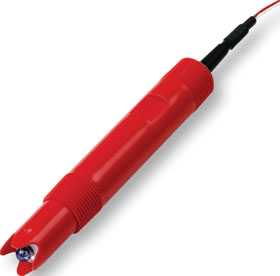
The ABB solution: TB556 for pH measurement
Cyanide leaching is a difficult process as the process liquid is in abrasive slurry which can result in damage to the glass electrode. The use of lime reagents can cause hard calcium scale problems. In the case of scaling or particle accumulation, hydraulic cleaners have been used successfully. The periodic jet of fluid prevents a build-up of pulp or scale, and another problem is the very nature of the fluid.
Cyanide is a strong oxidiser which makes this a very reactive solution. The reference electrolyte and reference element are subject to chemical contamination and lose stability much more rapidly than in a more neutral solution. The ABB TB556 pH sensor with hydraulic cleaner and Teflon Next Step liquid junctions are recommended for this service. If abrasion is a problem, a flat glass measuring electrode may reduce the replacement frequency.
The pH sensor in any mineral processing slurry should be mounted so that there is sufficient velocity past the sensor to minimise lime scale and material build-up. However, a compromise should be attempted so that abrasion to the sensor glass and body are reduced. A good mounting location is at an overflow weir or a transfer point in the leach or CIP tanks.
For more information contact ABB Measurement & Analytics, +27 (0)10 202 6459, instrumentation@za.abb.com, www.abb.com/measurement
| Tel: | +27 10 202 5000 |
| Email: | contact.center@za.abb.com |
| www: | www.abb.com/za |
| Articles: | More information and articles about ABB South Africa |






© Technews Publishing (Pty) Ltd | All Rights Reserved
 printer friendly version