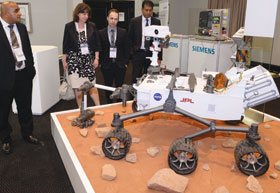
It’s a long way from the red planet to the East Rand, but the Curiosity Mars Rover landed at the Birchwood hotel recently as part of the Siemens’ Future of Manufacturing event. The Siemens’ Curiosity model travels the world to demonstrate how the complex robot was put together, tested and operates day to day – largely using the global engineering firm’s software.
It is known across the world as the robot exploring Mars, but very little is known about the extensive simulation and testing processes on earth that make planetary exploration possible. Its construction had to be perfect to take every risk into account. This includes the design of all 90 000 parts that work together inside the Rover, the complex entry and landing sequence on the Martian surface, as well as the robot’s survival in the harsh Martian environment.
Just one shot on Mars
“We don’t get a chance to try again, we have one shot and it’s usually doing something we’ve never done before,” says Bill Allen, mechanical design engineer at NASA’s Jet Propulsion Laboratory (JPL) in California.
JPL used Siemens computer-aided engineering software to test and simulate how the thousands of parts would work together and how much stress they could take from temperature, friction and pressure changes. Siemens NX programs were also used to generate the code which guided the machines manufacturing the intricate Mars Rover parts to within the accuracy of the width of a human hair. The environment in space is impossible to recreate on earth, so simulation software was also essential. Curiosity was put through the vacuum and extreme cold of deep space, was then re-pressurised in the Martian atmosphere, experienced extreme wind, vibration, noise and G-forces, and then scorching heat and freezing cold – all within hours.
Curiosity’s landing sequence alone was perfected through 8000 simulations. On the day of the Mars landing, NASA only had one shot at the Sky Crane setting down its prized Mars Science Laboratory. Internally, these are referred to as NASA’s seven minutes of terror, and it is one of the great triumphs for the agency.
Even now, Curiosity does not make a move on Mars without it being tested or simulated in some way. An Earth-bound twin, identical except for the nuclear power source, is used at the Mars Yard at JPL to tackle obstacles for its sibling – simulation on earth to spare a Curiosity failure on Mars.
Helping mines get results from water improvements
News
South African mines operate under constrained, water-scarce conditions where every investment must be justified. Xylem’s Chetan Mistry explains how the right water technology partner helps mines prioritise high-value water systems across the mining lifecycle.
Read more...AI-based quality inspection scales across P&G operations Siemens South Africa
IT in Manufacturing
Siemens and Procter & Gamble are expanding an AI-based visual inspection system across P&G’s manufacturing operations worldwide, inspecting products in real time at full line speed, and reducing scrap rates by 10 to 20% depending on the product.
Read more...From the editor's desk: Pushing engineering to the limit Technews Publishing
News
Among the many things robots can do, it’s a lot of fun to follow how fast they are. They go from the Boston Dynamics cheetah, which first reached a record-breaking speed of 45,5 km/h, to the robot Charlie ...
Read more...Schneider Electric concludes Innovation Summit Middle East and Africa Schneider Electric South Africa
News
Schneider Electric's Innovation Summit Middle East and Africa, held in Abu Dhabi with more than 2500 attendees, explored the convergence of energy, AI and industrial software, launched an Industrial AI study and announced the NEST Accelerator Programme for energy and industrial tech startups.
Read more...VEGA brings measurement expertise beyond mining to Electra Mining Africa 2026 VEGA Controls SA
News
VEGA used its Electra Mining Africa 2026 stand to demonstrate that its level and pressure measurement instruments extend well beyond mining, covering water, food and beverage, pharmaceuticals, chemicals, and oil and gas applications across the continent.
Read more...Sustainable solutions for sugar Bearing Man Group t/a BMG
News
BMG received a Special Commendation Exhibition Stand Award at the South African Sugar Technologists’ Association Congress, where it showcased an integrated turnkey drive solution designed to simplify the upgrading of ageing crushing-mill drive systems.
Read more...Measure, Manage, Maintain: The operating model behind SA’s water resilience Siemens South Africa
News
South Africa’s growing water crisis is putting pressure on infrastructure, municipalities and the economy. Siemens highlights how digital technologies, smarter operations and safe water reuse could help shift the country from crisis response towards a more resilient and sustainable water future.
Read more...VEGA brings measurement expertise beyond mining to Electra Mining Africa 2026 VEGA Controls SA
News
VEGA used its Electra Mining Africa 2026 stand to demonstrate that its level and pressure measurement instruments extend well beyond mining, covering water, food and beverage, pharmaceuticals, chemicals, and oil and gas applications across the continent.
Read more...Schneider Electric concludes Innovation Summit Middle East and Africa Schneider Electric South Africa
News
Schneider Electric’s Innovation Summit Middle East and Africa, held in Abu Dhabi with more than 2500 attendees, explored the convergence of energy, AI and industrial software, launched an Industrial AI study and announced the NEST Accelerator Programme.
While every effort has been made to ensure the accuracy of the information contained herein, the publisher and its agents cannot be held responsible for any errors contained, or any loss incurred as a result. Articles published do not necessarily reflect the views of the publishers. The editor reserves the right to alter or cut copy. Articles submitted are deemed to have been cleared for publication. Advertisements and company contact details are published as provided by the advertiser. Technews Publishing (Pty) Ltd cannot be held responsible for the accuracy or veracity of supplied material.










 printer friendly version