Internally fitted industrial fire suppression systems
October 2013System Integration & Control Systems Design
Until recently, the traditional method of fire detection and suppression for buildings and rooms was confined to smoke detection and flooding by a fire suppression medium. These mediums were mostly in a gaseous form, usually having disadvantageous effects on equipment and humans, and environmentally undesirable results like ozone depletion.
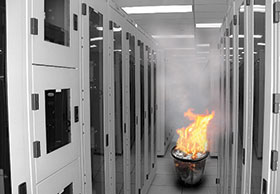
The introduction of fire extinguishing aerosol generators has expanded the choices of fire suppression mediums through both the sensing and actuation methods. The Pyrogen ranges of fire extinguishing aerosol generators have advantages in general room flooding applications. One of these is the ability to be situated internally in the volume to be protected, ranging from engine compartments in vehicles, aircraft, and marine vessels, to electrical and electronic equipment.
This ability for internal fitment is achieved by the various methods of activation, plus the nature and composition of the post-activation residue. Activation methods include electrical, thermal cord and self-activation:
* Electrical, from a conventional fire alarm panel.
• Thermal cord attached to the aerosol generator, initiated when a pre-set temperature is reached.
• Self-activation in the event of the two previously described methods having failed, due to extraneous reasons.
The post-activation residue has 24 kV insulation properties, enabling immediate re-use of electrical equipment following replacement of the components which created the fire.
These design and construction features enhance the normal ‘failure to safety’ required in fire suppression systems. This autonomous system has no external power supply and is on standby 24/7 for the ten years installed life of the Pyrogen unit – all with zero maintenance.
There is an advantage to fire detection and suppression systems fitted internally to electrical equipment, compared to sub-station flooding by fire suppression media.
Electrical equipment by requirement and construction is to a minimum IP55 protection i.e. gasketed doors, covers and fitments. This inhibits the egress of smoke from the compartment until the fire is of major proportions i.e. before the smoke detectors in the sub-station would activate and initiate the release of the fire suppression medium, gas or aerosol.
When activated, the sub-station is flooded with the suppression medium but it has no means of ingress into the switchgear compartments. The result could be a complete burn out and destruction of the electrical switchgear panel in which the fire started.
With Pyrogen aerosol generators, correctly selected for the volume to be protected, the fire source can be localised to minimise collateral damage.
How certified industrial automation channels become co-creators in the AI era Schneider Electric South Africa
System Integration & Control Systems Design
As industrial automation becomes software-driven and AI-enabled, the role of channel partners is shifting from equipment supply to outcome-based consulting, software integration and lifecycle services that require continuous certification and capability development.
Read more...Why integration defines the next competitive edge in pulp and paper
System Integration & Control Systems Design
ABB’s Arvin Ramjee argues that fragmented automation, assembled from different suppliers at different stages of a plant’s lifecycle has become one of the pulp and paper industry’s most overlooked commercial risks, and that true integration, rather than surface-level connectivity, is what delivers measurable business value.
Read more...Integrated automation enhances water treatment at dairy facility Process Dynamics
System Integration & Control Systems Design
Process Dynamics delivered the electrical, instrumentation, control and automation integration for an advanced water treatment and reverse osmosis system at a major South African dairy processing facility, achieving a 50% reduction in the client’s water utility costs.
Read more...Intelligent process control is reshaping cement production in Africa
System Integration & Control Systems Design
Advanced process control, predictive analytics and automation are helping African cement producers cut energy use and stabilise output as they contend with rising electricity costs and tighter margins.
Read more...Process Dynamics – Integrated Automation for Dairy Water Treatment Process Dynamics
System Integration & Control Systems Design Project and industry
Process Dynamics delivered the electrical, instrumentation, control and automation integration for an advanced water treatment and Reverse Osmosis (RO) system at one of South Africa’s ...
Read more...New SI programme strengthens Schneider Electric’s partner ecosystem Schneider Electric South Africa
System Integration & Control Systems Design
Schneider Electric’s SI Energise 2.0 programme offers system integrators a competency-based framework to develop deeper expertise in EcoStruxure and AVEVA software, enabling them to deliver full-lifecycle industrial automation solutions.
Read more...AI and smart solutions for underground proximity detection systems
System Integration & Control Systems Design
Booyco Electronics explains why fitting proximity detection systems underground is far more complex than installing sensors, and how integration, data and intelligent analytics are helping mines manage the challenge.
Read more...Why cloud-ready BMS is reshaping building operations Schneider Electric South Africa
System Integration & Control Systems Design
Smart sensors and non-contact radar are reshaping industrial measurement, feeding connected platforms that predict failures before they happen.
While every effort has been made to ensure the accuracy of the information contained herein, the publisher and its agents cannot be held responsible for any errors contained, or any loss incurred as a result. Articles published do not necessarily reflect the views of the publishers. The editor reserves the right to alter or cut copy. Articles submitted are deemed to have been cleared for publication. Advertisements and company contact details are published as provided by the advertiser. Technews Publishing (Pty) Ltd cannot be held responsible for the accuracy or veracity of supplied material.










 printer friendly version