




Click here for .pdf file.
End-user details
Name: Details withheld at reviewer request
SI details
Name: Xolani Sibisi
Designation: Project engineer
Company: Schneider Electric
Phone: +27 (0)11 254 6400
E-mail: [email protected]
Product details
Product name and version:Citect Facilities Version 7.1
Vendor: Schneider Electric
Phone: +27 (0)11 254 6400
E-mail: [email protected]
URL: www.schneider-electric.com
Application details
Location: Newlands, Gauteng South Africa
Industry: Telecommunications
Application: Facilities Management
Application statistics
Tag count: 4200
Updates per day: 6 048 000
Front ends: 8556 DIO and 2421 AIO across Modicon M340 PLCs and Advantys STB distributed I/O systems
Licences: 1 * Unity Pro Small Single; 1 * HMI VJD Single; 2 * Full 15 000-point CitectSCADA Facilities; 15 * Web Client Concurrent
END-USER RESPONSES
General
Q: Briefly describe the application including information on any pre-existing control system.
The scada has been implemented as an integrated multi-vendor platform on top of HVAC, power monitoring, generators, UPS and the Building Management System (BMS), which includes access control and CCTV. The pre-existing BMS acts as a data source to the scada system.
Q: What was the primary motivation for the project?
To address the need for an integrated user interface across multiple vendor sub-systems and to provide an automated SMS alarm notification system with a built-in escalation.
Q: What were the main goals established for the project?
1. To provide an integrated Facilities Management System.
2. To reduce system downtime.
3. To develop a scalable, replicable model for deployment across multiple sites and enabling consolidation into one global operating centre.
Q: What Project Management principles and/or methodologies did you employ as end-user to mitigate risk, ensuring the pro-ject came out on time and within budget?
Proper planning and pre-testing of new hardware before final installation.
Licensing, maintenance and support
Q: What upgrade agreements are in place for this application?
An annually renewable Enterprise Service Level Agreement (SLA).
Q: How is after-sales support handled on this application?
The Enterprise SLA covers consulting, preventative maintenance, remote support and emergency site deployment.
System architecture
Q: Is the scada system integrated onto an intranet or the Internet? If so, what level of remote monitoring and control is configured?
This system is connected on the Enterprise WAN. The configuration allows for simple remote monitoring and control using Web Clients. Some users have read-only permissions and other users have the ability to adjust setpoints, etc.
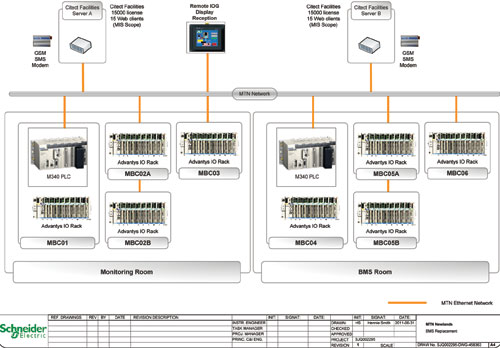
Q: Do you run the scada in conjunction with any third-party application software (Other than MES)?
OSIsoft PI is being used as the enterprise data historian across multiple sites. Enterprise reporting is performed from this platform.
Management reporting and integration
Q: Does the application include data archiving / historian capabilities with an historical data reporting system?
The OSI PI server centrally stores historical data generated at each site. It is used to provide a comprehensive overview of all facility support systems through various reports and dashboards that query the stored data. The facility support systems include power metering, backup power and UPS, coolers and chillers, fire protection systems and HVAC systems.
Q: Is the system integrated with an MES / ERP or other management reporting or control system? (e.g. Baan, SAP, SYSPRO…)
Technologies used for reporting include Microsoft SharePoint, OSIsoft WebParts, OSIsoft ProcessBook, OSIsoft DataLink and OSIsoft AssetFramework. The system also integrates to numerous other systems via OLE DB, UFL file integration and UFL email integration. Approximately 30 interfaces have been implemented to various systems for data acquisition. Notifications allow us to act immediately should there be unforeseen situations, for instance network outage for longer than an allowed time period.
Q: If the answer to Q2.15 was Yes, then who performed this management system integration and was any additional software development needed to accomplish this?
Schneider Electric performed this integration. Additional Citect software licences were required in order to integrate the total system.
Q: Have any production benchmarking tools been configured as part of the scada system?
We configured a dashboard to monitor actual energy efficiency against target values and these are displayed with comparative best and worst figures for the prior 12 month period.
Q: Has any asset management functionality been configured in the application (for software assets, control system assets or for plant assets)?
No.
Q: Has any GIS (Geographic Information Systems) functionality been configured in the application?
No
Q: Are you using tablet PCs or mobile phones to interact with this scada system?
Yes, ASUS Slate EP121 to run the Citect Web Client application.
End-user conclusion
Q: What was the predominant feature (or features) that made you decide to purchase this scada product over all others for this application?
Its ease of integration with existing hardware.
Q: What single feature most impresses you about the product now that it is in operation?
The capability of the system to deliver any required information.
Q: What impresses you most about the architecture?
The scalability provided through support for the Client Server architecture.
SI Responses
Project details
Q: Approximately how many man-hours did the scada configuration take?
120 man-hours.
Q: What tools were used to minimise the man-hours taken?
Schneider Electric in-house tools were used to auto generate scada and PLC tag configurations for data pertaining to trends, alarms and interlocks.
Q: What human factors were taken into consideration in the HMI design process?
Schneider Electric configuration standards for the HMI cover colour and symbol usage. These were negotiated with the customer and documented within the Functional Design Specification.
Q: For the graphics development process did you use standard library images, or did you have to draw images from scratch?
All images were drawn from scratch. Standard libraries could not be used as the project required specific images be drawn to scale.
Q: How would you describe the library of graphic images?
Comprehensive.
Q: Did you use any ‘special’ images (e.g. photographs, 3D images, specialised dashboards, etc.)?
Yes, all the images were 3D.
Q: Did you use any video or multimedia technology in the application?
No.
Q: What alarm management standards or best practices were adopted in configuring the scada system alarms?
Alarms were categorised as Urgent (requiring operator intervention and acknowledgement), Warning (requiring operator acknowledgement) and Event (informational – requiring no operator action). In addition nine specific alarms are identified as critical IOG alarms (trigger an immediate SMS) and are shown on a dedicated HMI at the security desk.
Q: What structured processes were followed to determine expected performance under full load, and during abnormal failure conditions?
A complete library of test sheets exists within the Schneider Electric Quality Management System. During commissioning failures are simulated and results documented against the pre-determined set of acceptable limits. Exceptions are documented as non-conformances and actioned before final hand-over.
Q: What are the key physical communication layers and communication protocols employed in the system?
PLC communications – Modnet – copper and fibre; UPS and DC Plant – SNMP over Ethernet – copper; Air Handling Units – SNMP over Ethernet and Modbus RTU (Serial) to TCP/IP (Ethernet) – copper and fibre; Power Metering – OPC over Ethernet – copper
Q: What levels of redundancy are incorporated in this scada application?
Hot-standby redundant I/O-, Alarm-, Report- and Trend-servers have been implemented with full automated bumpless switchover. Redundant GSM modems.
Q: What specific custom code or scada scripts were written for this project?
Customisation for SMS/email notification with automatic escalation. Customisation for critical alarms representing multiple input points to create a single critical output alarm.
Project management
Q: What Project Management principles and/or methodologies did you as SI employ to mitigate risk and to ensure the project came out on time and within budget?
Schneider Electric’s Customer Project Process (CPP) project lifecycle management system.
Security and data protection
Q: How have authentication, authorisation and role management been configured?
Authentication uses an Active Directory domain (users and groups). Each domain group has been associated with internal Citect groups. Within the Citect environment role-based security is implemented.
Q: Does the design make provision for a DMZ and firewall segregation of process (scada) network and business networks.
Network design is customer managed.
Q: What intrusion detection has been incorporated on the plant network(s) on which this scada system exists?
Network security is customer managed.
Q: What configuration backup and data archive backup methodologies have been adopted?
Backups are customer managed.
SI conclusion
Q: How would you rate the ease of use of the historical reporting system?
Trend data is easily accessible using the Process Analyst tool, which enables the trending of both analog and digital data and easy export to csv.
Q: What impresses you the most about the engineering / configuration aspects of the product now that it is in operation?
The engineering environment is open, enabling third-party tools such as MS Excel to be used for rapid application development. The Citect Graphics Builder allows an engineer to make changes to a library object and then quickly apply those changes to all instances of that object.
Q: What impresses you most about the architecture?
The ease with which it can be scaled up.
VENDOR RESPONSES
Product
See Table 1.

Q: Vendor comments on product / modules?
The Citect scada product is core to Schneider Electric’s automation architecture and is continually enhanced to support integration of Schneider Electric products such as the Web Gate ActiveX for Magelis HMI integration and the Pelco ActiveX for Pelco CCTV integration.
Operating systems / VMware
See Table 2.
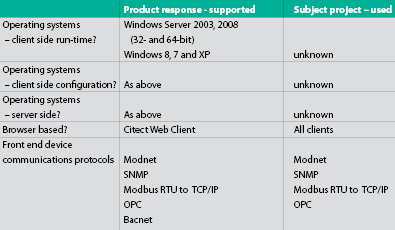
Q: Vendor comments on operating systems
Schneider Electric supports the latest 32- and 64-bit Microsoft Operating Systems.
Licensing, maintenance and support model
Q: What sort of licensing agreement options are offered?
There are three types of licences: Full Server, Client read-only and Client read-write. There is no differentiation between modules and a single Full licence will enable all functionality. A Full licence also acts as a client on the server hardware and the system can be operated from this server.
Q: Are licences sold outright or subject to periodic (e.g. annual) renewal?
Licences are once-off purchases.
Q: What upgrade agreements are offered?
Patches, hotfixes and service packs are available to end users with valid maintenance agreements. Version upgrades are available to those end users with valid maintenance agreements or for a once-off fee.
Q: What after-sales offerings iro support and maintenance are available, and which technologies are used to deliver them?
Support is covered under a paid annual support agreement and includes desktop remoting, telephone, email, online self-help tools, automatic driver updates, product upgrades, security advisory services, user forum (Linked-in group) and online knowledge base repository.
Technology incorporated
See Table 3.

Q: What new technology has been introduced into the product in the last 12 months?
New technologies include:
* Equipment objects and templates.
* Library controls including data grids, scroll bars and trees.
* Alarm templates.
* Sequence of events view.
* Alarm counts.
* OPC A&E, OPC-DA Server and ADO interfaces
* Soft licensing.
* Tighter integration with Schneider Electric’s Historian product offer.
* Time stamping from the source with OFS.
Management reporting and integration
Q: What native historical data reporting options are available?
The application generates reports in either HTML or RTF files. Report formats may be defined using any standard ASCII editor. The Process Analyst provides historical data analysis.
Q: What product specific interfaces does the product have iro well-known MES packages?
An OLE-DB compliant interface, Citect integration API, OPC A&E server and OPC-DA server.
PLC configuration and programming
Q: What capabilities does the scada offer in terms of generation and/or management of PLC configuration files or PLC application code?
None. Citect enables the synchronisation and automatic creation of variable tags using a Unity application project file, CSV file or OPC Server.
Security and data protection
Q: If the scada system generates application files that are transferred to the PLC, how are PLC virus attacks prevented in this process? Please elaborate:
N/A.
Q: What authentication, authorisation and role management models are available for the runtime environment?
Security may be incorporated within the application or through Windows integrated authentication.
Unique selling proposition (USP)
Q: List the top five feature/benefit pairs that contribute to this product’s USP.
* Integrated Process Analyst – analysis facilitates increased productivity through improved plant and production efficiencies.
* Scalable architecture – system can grow while preserving initial investment.
* Redundant architecture - will tolerate failure anywhere in system, without loss of functionality or performance.
* Open architecture – seamless data flow.
* Integration of Schneider Electric automation products – reduces engineering time and ensures all components are able to communicate seamlessly.
| Tel: | +27 11 254 6400 |
| Email: | [email protected] |
| www: | www.se.com/za/en/ |
| Articles: | More information and articles about Schneider Electric South Africa |






© Technews Publishing (Pty) Ltd | All Rights Reserved
 printer friendly version