Superior metal working performance from Roland Electronic
March 2012Maintenance, Test & Measurement, Calibration
Thickness measurement and double sheet detection from one unit.
Some customer specific applications call for innovative thinking and new solutions. The new capacitance double sheet and in-line thickness control system, C100-S from Roland Electronicc, has been developed to accommodate just these and is now part of its standard product range. The machines capacitance principle brings some unique advantages when compared to sensor principles such as magnetism, eddy current and induction.
The measurement is independent of the type of alloy
The capacitance double sheet detection system for metals is entirely independent of the type of metal, alloy or the type of heat treatment applied. For all metals, the system always measures the same thickness regardless of whether it is steel, aluminium or any kind of alloy. This is of special significance for many of the new materials used in automotive lightweight bodies, for example, the so-called duplex and TRIP steels. These and many other new materials often have vastly differing electrical and magnetic properties, which require measurement equipment to be calibrated taking into account many different metallurgical properties. The unique features of the capacitance principle lead to significant and cost effective simplification of the measurement platform and its integration into higher order control systems.
Thickness measurement and double sheet detection in one unit
When a metal sheet is moved into the sensor gap the system determines in-line the absolute thickness as an analogue value, which is then made available to higher order control systems for evaluation. This information is needed to ensure that the material is of the right thickness for further processing, eg, in straighteners, slitters, cut-length lines or blanking presses. Alternatively, the absolute thickness can also be used as a nominal value to generate the lower and upper switching thresholds for double sheet detection. The capacitance system is therefore an excellent substitution for the mechanical double sheet detectors commonly used by manufacturers of press brakes, bending cells, turret punches or laser cutting machines.
Compact design
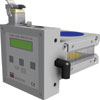
The system consists of a C-measurement frame and a control unit, in each part of the frame there is an electrode with a temperature probe. The C-frame is attached to the enclosure of the control unit C100-S and the measurement value is supplied to the control circuit as an analogue voltage, it is also visible on the LCD display. The integrated double sheet detector issues the output signals 0-1-2 sheets and for reliability, it has integrated air channels for periodic cleaning of the electrodes with an air purge. Metallic brushes at the sensor gap provide the necessary electrical ground contact to the sheet.
Infrared thermometers for electrical, industrial and HVAC applications Comtest
Maintenance, Test & Measurement, Calibration
: Comtest, distributor of Fluke test and measurement equipment, explains how handheld infrared thermometers are transforming maintenance in electrical, industrial and HVAC environments, with three measurement strategies and a wide range of practical applications.
Read more...Reverse-engineering legacy industrial gearbox parts
Maintenance, Test & Measurement, Calibration
WEG Africa’s turbine workshop uses 3D scanning technology to reverse-engineer components for legacy gearboxes, turbines and compressors, enabling equipment to run for decades after OEM support and spare parts have dried up.
Read more...Unlocking ICCP remote monitoring Omniflex Remote Monitoring Specialists
Maintenance, Test & Measurement, Calibration
Cathodic protection keeps buried and submerged pipelines safe from corrosion, but verifying it traditionally means costly, hazardous manual site visits. Omniflex explains how a retrofit module brings remote monitoring to ageing transformer rectifiers without replacing functional infrastructure.
Read more...Microdieseling – the explosions you never hear
Maintenance, Test & Measurement, Calibration
Microdieseling is a pressure-induced thermal degradation mechanism in which entrained air bubbles are compressed so rapidly that the surrounding oil ignites, producing soot, varnish and sludge. WearCheck explains how it happens, why the damage varies, and how oil analysis detects it.
Read more...Electrostatic spark discharge – when static strikes back Wearcheck
Maintenance, Test & Measurement, Calibration
WearCheck technical manager, Steven Lumley explains how static electricity accumulates in modern low-conductivity lubricants, why compact system designs and fine filtration make ESD more likely, and how to recognise the degradation it leaves behind.
Read more...High-speed cameras for crash testing Horne Technologies
Maintenance, Test & Measurement, Calibration
Vision Research has expanded its Phantom C-series with two cameras optimised for crash and safety testing, offering 4 and 8 megapixel sensors rated to 170G, up to 1180 frames per second, and Phantom Academy application training planned for South Africa next year.
Read more...SKF extends remanufacturing expertise to bearing clearance modification SKF South Africa
Maintenance, Test & Measurement, Calibration
Using its clearance modification expertise, SKF helped a mining equipment OEM salvage spherical roller bearing inventory that would otherwise have been scrapped, confirming a new capability within its remanufacturing services and avoiding redundant procurement.
Read more...When maintenance-system compliance starts replacing plant reliability Wearcheck
Maintenance, Test & Measurement, Calibration
WearCheck ARC division manager, Annemie Willer argues that the greatest threat to effective maintenance is no longer a lack of technology, but the gradual replacement of technical judgement by CMMS compliance, leaving no one owning the machine.
Read more...Nitration: the acid you didn’t see coming Wearcheck
Maintenance, Test & Measurement, Calibration
Nitration is as destructive as oxidation in many engines but far less understood. WearCheck technical manager, Steven Lumley explains how nitrogen oxide gases degrade lubricants, why the process is difficult to detect, and what oil analysis can reveal before damage occurs.
While every effort has been made to ensure the accuracy of the information contained herein, the publisher and its agents cannot be held responsible for any errors contained, or any loss incurred as a result. Articles published do not necessarily reflect the views of the publishers. The editor reserves the right to alter or cut copy. Articles submitted are deemed to have been cleared for publication. Advertisements and company contact details are published as provided by the advertiser. Technews Publishing (Pty) Ltd cannot be held responsible for the accuracy or veracity of supplied material.










 printer friendly version