Using IP camera systems with an industrial camera management solution.
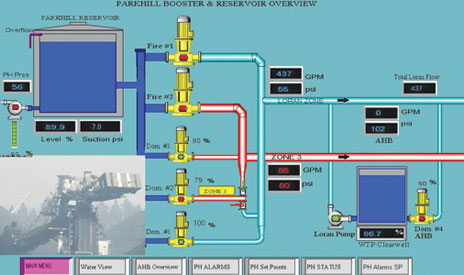
Most industries, be they corporate, commercial, industrial or military, are rapidly moving towards Ethernet – more commonly known as IP – solutions due to the benefits this technology has to offer. The introduction of industrial video and control (IV&C) to industry has realised benefits such as safety when integrated with existing scada/HMI systems.
The keys to a successful implementation are extensive LAN and WAN bandwidth, control of the camera and viewing feeds and integration with existing systems that ensures no interruption of critical processes. An H3iSquared gold mining client was able to see the need for such a system and has now integrated this into its existing underground network and scada system.
The mine is currently making use of analogue cameras underground, as it was not financially viable to replace the existing setup. In this application, a device that is able to convert the analogue feed to an IP protocol was used to create an environment where both analogue and IP Cameras could be combined in a flexible system that offers integration with scada/HMI and remote monitoring.
One of the requirements was to monitor and integrate cameras from the different levels underground. This was achieved by placing port encoders at the relevant levels to convert the existing analogue cameras to IP. Once encoded, these were plugged into the backbone of the network in a VLAN (virtual local area network) configuration to gain access to the control room on the surface.
Once the system was configured, over 64 cameras were able to be viewed from the control room without affecting automation traffic and with growth catered for on the camera network. The next task was to integrate the camera solution with the rest of the automation. The engineers on the mine configured and wired the PLC to the digital input of the camera encoder. Now, when the PLC starts a process such as a conveyer belt, the system automatically activates the relevant cameras with alerts on the monitoring screen, to ensure the environment is safe for the process to begin.
The relay server is the heart of the IV&C system and has the following set of tasks:
* Control the bandwidth consumption from the camera to the NVR (network video recorder).
* Record to the NVR.
* Playback feature through an Internet browser from any accessible PC or hand held device on the network.
* Security restriction based on access via configurable usernames and passwords.
* High security with integration into active directory environments.
* Up to four live simultaneous views.
The client now has a system where the analogue cameras are converted to IP and run on the existing automation network running underground with negligible bandwidth overhead. The benefit is safety – when a process is started, a live feed is displayed remotely in the control room for visual confirmation.
The project started out converting 16 analogue cameras to IP and integrating them into the system. As budgets have allowed, the system has grown to accommodate over 96 camera feeds. With the design and scope of the system, the client is able to expand the system even further, thanks to the bandwidth management of IV&C.
Isolated Modbus gateways with built-in Wi-Fi for industrial IoT applications Vepac Electronics
Fieldbus & Industrial Networking
Vepac Electronics offers the Sielco Sistemi SS10680 series of isolated Modbus gateways with built-in Wi-Fi, providing three configurations for industrial data acquisition: cloud publishing via MQTT, local USB and FTP logging, and straightforward Modbus TCP to Modbus RTU conversion.
Read more...XPlanar aids innovation in laser processing Beckhoff Automation
Fieldbus & Industrial Networking
Aalborg University is among the first in the world to test Beckhoff’s XPlanar intelligent transport system in advanced laser processes, opening the door to faster, tool-free production of metal parts.
Read more...Belden expands edge computing portfolio with ProLinx Edge Gateway
Fieldbus & Industrial Networking
Belden has released the ProSoft Technology ELX3 ProLinx Edge Gateway, combining operational technology protocol conversion with Docker-based edge application hosting on a single ruggedised hardware platform for deployment in harsh industrial environments.
Read more...Anybus Communicators are CRA-ready Industrial Data Xchange (IDX)
Fieldbus & Industrial Networking
HMS Networks has upgraded its Anybus Communicator range to meet new EU cybersecurity rules, giving industrial manufacturers and integrators an easier path to compliance.
Read more...Remote I/O modules provide flexible options for distributed applications
Fieldbus & Industrial Networking
Dinkle International is now stocking the iO-GRID NEMO industrial-grade remote input/output modules, offering support for five leading industrial Ethernet protocols and a range of discrete channel configurations for distributed automation applications.
Read more...Daudin expands fieldbus modular remote I/O series
Fieldbus & Industrial Networking
: The Dinkle iO-GRID X modular remote I/O family is now available, offering fieldbus coupler modules for major industrial Ethernet protocols, and over 20 types of I/O modules to help integrators and equipment builders create flexible, efficient control systems.
Read more...Siemens and HighByte partner to scale industrial AI Siemens South Africa
IT in Manufacturing Fieldbus & Industrial Networking
Siemens is expanding its Industrial Edge ecosystem through a partnership with HighByte, enabling customers to connect, contextualise and transform data from operational technology and information technology sources to build AI models and applications at scale.
Read more...Automotive Ethernet media converter
Fieldbus & Industrial Networking
HMS Networks has introduced its first automotive ethernet product under the PEAK brand. The PAE-Media Converter is a compact device designed to connect automotive Ethernet (100BASE-T1 or 1000BASE-T1) with standard Ethernet (100BASE-TX or 1000BASE-T) networks.
Read more...3D electrical systems design workflow for electromechanical innovation Siemens South Africa
Fieldbus & Industrial Networking IT in Manufacturing
Siemens has announced new 3D electrical design capabilities within its Capital software, enabling electrical and mechanical engineers to work concurrently in a shared 3D environment to reduce late-stage design changes and accelerate time to market for complex electromechanical products.
While every effort has been made to ensure the accuracy of the information contained herein, the publisher and its agents cannot be held responsible for any errors contained, or any loss incurred as a result. Articles published do not necessarily reflect the views of the publishers. The editor reserves the right to alter or cut copy. Articles submitted are deemed to have been cleared for publication. Advertisements and company contact details are published as provided by the advertiser. Technews Publishing (Pty) Ltd cannot be held responsible for the accuracy or veracity of supplied material.










 printer friendly version