


Fieldbus & Industrial Networking


Possibilities for wireless Ethernet

September 2010 Fieldbus & Industrial Networking

Making industrial wireless LANs even more powerful.

IAC has extended its range of Hirschmann products to include the new Hirschmann BAT controllers for centralised management and monitoring of large-scale WLAN networks, as well as the two new access points – BAT300-F X2 and BAT54-Rail Single.

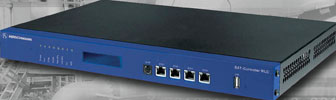
The three new BAT controllers – WLC25, WLC50 and WLC100 – ensure fast data communications and optimum network availability. These controllers are designed for use in switch cabinets and can be used to configure and manage 25, 50 or 100 WLAN access points respectively. They possess four freely configurable gigabit Ethernet ports plus one USB 2.0 and one serial interface and communicate with the access points via a CAPWAP tunnel, while supporting all standard Ethernet LAN and WAN protocols.

When the WLAN network is set up the controller automatically finds all the available access points, checks their firmware and configures the equipment appropriately for the installed application. During normal operation the controller provides the administrator with all the necessary network information. In the event that an access point fails, the controller immediately recognises which device should replace it and automatically integrates it into the network. With their integrated firewall and VPN gateway, these controllers can also be used for security between LAN and WLAN or to link a number of wireless networks over large distances.

Product manager Olaf Schilperoort comments: “WLAN controllers are expensive for small-scale wireless networks, which still need independent industrial standard access points. But where 25 or more access points are used, the investment will always pay off, because it enables the administrator to manage and monitor the network from a centralised location.”

BAT300-F X2 and the BAT54-Rail Single

The BAT300-F X2 is an Atex Zone 2-certified industrial WLAN access point that complies with the IEEE802.11n standard and offers maximum data throughput in environments with high explosion risk. This enables high speed WLAN networks to be installed in hazardous areas rated Ex zone 2. The integrated MIMO antenna technology (multiple input multiple output) ensures a stable wireless connection. Other features of these access points include extensive management, security and quality of service functions plus layer 3 IP routing.

The access point’s wireless module operates either in the 5 GHz or 2,4 GHz waveband. The fast roaming function facilitates uninterrupted connections while passing from one radio cell to another. The integrated IP router can be used to form up to eight sub-networks, and analogue or DSL modems can be connected for WAN routing or remote maintenance. The network can be managed using web interface, Telnet, TFTP, FTP or SNMP V2 and the redundancy methods Rapid Spanning Tree and VRRP ensure a high level of network availability. The quality of service functions as specified by IEEE 802.11e facilitates features such as prioritisation of voice or video streams.

The BAT54-Rail Single complements the lower segment of the product range. This device is designed for mounting on a top-hat rail and can be used both as access point and access client. Unlike the BAT54-Rail, this new access point has only one WLAN interface, making it a cost-effective alternative for applications that do not require a second interface. In common, however, the BAT54-Rail Single offers the full range of functions supported by the powerful HiLCOS operating system.

The series is equipped with integrated firewalls and IP routers, enabling network segments to be isolated and reliably safeguarded. An RJ45 LAN port (10/100 BASE TX) is available for connection to terrestrial networks.

For more information contact Vladimir Milovanovic, IAC, +27 (0)12 657 3600, [email protected], www.iaconline.co.za


Credit(s)


Share this article:
Share via emailShare via LinkedInPrint this page

Further reading:

Introduction to Part 2 loop signatures and process transfer functions
Fieldbus & Industrial Networking
The previous series of loop signature articles dealt with the basics of control loop optimisation, and concentrated on troubleshooting and ‘SWAG’ tuning of simple processes. In this new series, consideration will be given to dealing practically with more difficult issues like interactive processes, and with processes with much more complex dynamics.

Read more...
Siemens sets new standards in drive technology
Fieldbus & Industrial Networking
Siemens is setting new standards in industrial drive technology with the launch of its new high-performance drive system, Sinamics S220. This offers a seamless and innovative drive system with comprehensive simulation and analysis capabilities and advanced connectivity features that enable full integration into digital work processes.

Read more...
PC-based control in the plastics industry
Beckhoff Automation Fieldbus & Industrial Networking
Nissei Plastic, an injection moulding machine manufacturer based in Japan is implementing a worldwide tend towards open automation systems from experienced specialists using PC and EtherCAT-based control technology from Beckhoff.

Read more...
Loop Signature 31: Non-linearity in control loops (Part 2)
Michael Brown Control Engineering Fieldbus & Industrial Networking
This article is a continuation of Loop Signature 30 published in the last issue in this series, exploring reasons for non-linearities which may be encountered in feedback control loops

Read more...
PC-based control optimises robotic parts handling on plastics machinery
Beckhoff Automation Editor's Choice Fieldbus & Industrial Networking
NEO is a cartesian robot developed by INAUTOM Robótica in Portugal for parts removal on plastics machinery. Its aim is to increase system productivity. NAUTOM Robótica has entered into a strategic partnership with Bresimar Automação to increase the working speed of the cartesian robots using advanced control and motion solutions from Beckhoff. The result is a comprehensive, future-proof automation solution for its entire family of cartesian robots.

Read more...
PC-based control for flat wire motors for electric vehicles
Beckhoff Automation Fieldbus & Industrial Networking
Special machine manufacturer, ruhlamat Huarui Automation Technologies unveiled the second generation of its mass production line for flexible stators with bar winding. This enables extremely short production cycle and line changeover times, supported by PC- and EtherCAT-based control technology from Beckhoff.

Read more...
Case History 200: The final case history – desuperheater control problem.
Michael Brown Control Engineering Editor's Choice Fieldbus & Industrial Networking
For this final article I have chosen to relate a problem that existed in a desuperheater temperature control on a boiler in a petrochemical refinery.

Read more...
PC-based control technology in additive manufacturing
Beckhoff Automation Editor's Choice Fieldbus & Industrial Networking
As an open control platform, PC-based control supports different engineering approaches, including low-code programming. The machine builder, Additive Industries uses this to create the code for the TwinCAT runtime of its 3D printers.

Read more...
Suppression and safety solutions for fire and gas in mission-critical industries
Fieldbus & Industrial Networking
By representing world-leading brands and focusing on fully integrated, certified systems, HMA South Africa is positioning itself as a trusted partner in fire detection, suppression and explosion-proof safety solutions across the continent.

Read more...
Integrating fire alarm systems into building management systems
Beckhoff Automation Fieldbus & Industrial Networking
Fire alarm systems work independently of the building automation system. Schrack Seconet has developed a flexible gateway using ultra-compact industrial PCs and TwinCAT from Beckhoff, which can be used to flexibly convert a customer-specific communication protocol to a wide range of transmission standards.

Read more...


While every effort has been made to ensure the accuracy of the information contained herein, the publisher and its agents cannot be held responsible for any errors contained, or any loss incurred as a result. Articles published do not necessarily reflect the views of the publishers. The editor reserves the right to alter or cut copy. Articles submitted are deemed to have been cleared for publication. Advertisements and company contact details are published as provided by the advertiser. Technews Publishing (Pty) Ltd cannot be held responsible for the accuracy or veracity of supplied material.


© Technews Publishing (Pty) Ltd | All Rights Reserved

