Battery impedance test equipment
August 2010
Maintenance, Test & Measurement, Calibration
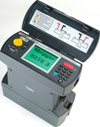
Battery testing just got faster easier and smarter.
Megger’s BITE 3 (battery impedance test equipment) is a new battery tester, which can measure both float and ripple current in addition to impedance, cell voltage and inter cell connection resistance. Used in conjunction with Megger’s ProActive database management software, this combination is a powerful lead-acid battery health analyser.
The unit provides online testing with pass/warning/fail calculations. Built with on-board data analysis, the intelligence of this small, light, handheld instrument enables comparisons with historical data through the recall of previous test results. Ideal for large installations, the tester is fast, accurate and easy to use, eliminating downtime. The accompanying ProActiv software organises and analyses battery data in an MS Access database. The software enables test results to be organised according to the needs and convenience of the end user. Together, BITE 3 and the ProActive software offer a comprehensive data analysis system to provide confident and reliable evaluation of the batteries in a DC network.
The tester determines the condition of lead-acid cells up to 2000 Ah and also measures cell impedance, cell voltage and inter cell connection resistance. With built-in spectrum analyser, the tester can also show the harmonic content of the ripple current. With more than 16 MB of memory, it uses a Windows CE operating system and can store 4000 sets of data in more than 1000 tests. Its unique data analysis screens provide immediate feedback on the status of cell impedance.
“Unlike load cycle testing, which is expensive, non-predictive and time consuming, this tester offers rapid test time and the ability for the operator to easily, quickly and precisely measure cell and string parameters without taking the systems offline,” said Rick Lawrence, product manager at Megger. “This instrument can take battery measurements in as little as five keystrokes.”
Applications include electrical power generation plants, substations, telecommunications facilities, railroad and aircraft power supplies and UPSs. An optional printer is available to allow users to generate reports to be left on site for future reference. The tester supports multiple languages and its firmware is upgradeable.
For more information contact Stuart Ashton, Surgetek, +27 (0)11 792 1303, [email protected], www.surgetek.co.za
Further reading:
Infrared thermometers for electrical, industrial and HVAC applications
Comtest
Maintenance, Test & Measurement, Calibration
: Comtest, distributor of Fluke test and measurement equipment, explains how handheld infrared thermometers are transforming maintenance in electrical, industrial and HVAC environments, with three measurement strategies and a wide range of practical applications.
Read more...
Reverse-engineering legacy industrial gearbox parts
Maintenance, Test & Measurement, Calibration
WEG Africa’s turbine workshop uses 3D scanning technology to reverse-engineer components for legacy gearboxes, turbines and compressors, enabling equipment to run for decades after OEM support and spare parts have dried up.
Read more...
Unlocking ICCP remote monitoring
Omniflex Remote Monitoring Specialists
Maintenance, Test & Measurement, Calibration
Cathodic protection keeps buried and submerged pipelines safe from corrosion, but verifying it traditionally means costly, hazardous manual site visits. Omniflex explains how a retrofit module brings remote monitoring to ageing transformer rectifiers without replacing functional infrastructure.
Read more...
Microdieseling – the explosions you never hear
Maintenance, Test & Measurement, Calibration
Microdieseling is a pressure-induced thermal degradation mechanism in which entrained air bubbles are compressed so rapidly that the surrounding oil ignites, producing soot, varnish and sludge. WearCheck explains how it happens, why the damage varies, and how oil analysis detects it.
Read more...
Electrostatic spark discharge – when static strikes back
Wearcheck
Maintenance, Test & Measurement, Calibration
WearCheck technical manager, Steven Lumley explains how static electricity accumulates in modern low-conductivity lubricants, why compact system designs and fine filtration make ESD more likely, and how to recognise the degradation it leaves behind.
Read more...
High-speed cameras for crash testing
Horne Technologies
Maintenance, Test & Measurement, Calibration
Vision Research has expanded its Phantom C-series with two cameras optimised for crash and safety testing, offering 4 and 8 megapixel sensors rated to 170G, up to 1180 frames per second, and Phantom Academy application training planned for South Africa next year.
Read more...
SKF extends remanufacturing expertise to bearing clearance modification
SKF South Africa
Maintenance, Test & Measurement, Calibration
Using its clearance modification expertise, SKF helped a mining equipment OEM salvage spherical roller bearing inventory that would otherwise have been scrapped, confirming a new capability within its remanufacturing services and avoiding redundant procurement.
Read more...
When maintenance-system compliance starts replacing plant reliability
Wearcheck
Maintenance, Test & Measurement, Calibration
WearCheck ARC division manager, Annemie Willer argues that the greatest threat to effective maintenance is no longer a lack of technology, but the gradual replacement of technical judgement by CMMS compliance, leaving no one owning the machine.
Read more...
Automatic lubrication systems drive mobile mine machine reliability and uptime
SKF South Africa
Maintenance, Test & Measurement, Calibration
SKF’s Lincoln P203 progressive lubrication systems are improving reliability and uptime on mobile machines at a Zambian gold mine, with installation of 45 units completing by October 2026.
Read more...
Nitration: the acid you didn’t see coming
Wearcheck
Maintenance, Test & Measurement, Calibration
Nitration is as destructive as oxidation in many engines but far less understood. WearCheck technical manager, Steven Lumley explains how nitrogen oxide gases degrade lubricants, why the process is difficult to detect, and what oil analysis can reveal before damage occurs.
Read more...









 printer friendly version