Developments from Hirschmann advance industrial networking
September 2006
Fieldbus & Industrial Networking
Hirschmann Automation and Control is offering the managed switches of the Rail, MICE, PowerMICE and MACH 4000 product families, together with industrial profiles which are special software packages. These network components can then be totally integrated in the three standard protocols PROFINET, EtherNet/IP or Modbus TCP. The respective profiles can be selected through the Webshop-Configurator OpenRail and are then copied onto the switches at the factory. This software can also be exchanged later over the Internet.
"With this concept Hirschmann adopts a pioneer role as a neutral manufacturer of network equipment," the head of marketing, Dr Klaus Zwerina, explains. "Because then not only do the standard protocols of large automation manufacturers become accessible to all Ethernet users, but at the same time Hirschmann switches can also be integrated in the application software of these manufacturers."
This integration enables both the configuration and monitoring of the network components according to the plug-and-play principle. Dr Zwerina commented: "This enables a homogeneous, plant-wide engineering from the simple commissioning through the smooth integration in the diagnostic concept to the comfortable exchange of defective components by automatic assignment of the configuration parameters."
OpenRail switches
Rail switches with management functions guarantee high availability of complex automation systems with innovative redundancy solutions and the option of network monitoring.
Modular Rail switches perform due to their flexibility through problem free planning, minimum storage problems and easy adaptation to the most varied network topologies with media modules. One can have customised solutions for all industrial data networks and have the capability to expand due to their modular structure.
Network topologies
To enable all this, the industry demands higher standards on the redundancy of the Ethernet network.
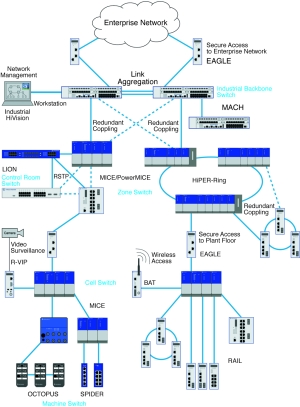
To reach higher redundancies different topologies are necessary. A typical industrial topology is shown in Figure 1. The ring structure plays a very important role in Industrial Ethernet topologies. The reason is that it is easy to install and it gives cable redundancy. It is necessary to use fibre cable for backbone infrastructure. The reasons are immunity against electrical noise, lightning resistant and high bandwidth availability.
Figure 1. A typical industrial topology
Against this background the description of Industrial Ethernet is closely connected with topics such as information technology in automation, Internet in production or web-based operation and observation. Figure 1 shows only the most important elements of the Industrial Ethernet world. The entire complex environment cannot be described in detail here. But taken together it has now become clear that Industrial Ethernet is increasingly becoming the focal point for harmonisation of the systems environment.
For more information contact Industrial Automation & Control, +27 (0) 12 657 3600.
Further reading:
Isolated Modbus gateways with built-in Wi-Fi for industrial IoT applications
Vepac Electronics
Fieldbus & Industrial Networking
Vepac Electronics offers the Sielco Sistemi SS10680 series of isolated Modbus gateways with built-in Wi-Fi, providing three configurations for industrial data acquisition: cloud publishing via MQTT, local USB and FTP logging, and straightforward Modbus TCP to Modbus RTU conversion.
Read more...
XPlanar aids innovation in laser processing
Beckhoff Automation
Fieldbus & Industrial Networking
Aalborg University is among the first in the world to test Beckhoff’s XPlanar intelligent transport system in advanced laser processes, opening the door to faster, tool-free production of metal parts.
Read more...
Belden expands edge computing portfolio with ProLinx Edge Gateway
Fieldbus & Industrial Networking
Belden has released the ProSoft Technology ELX3 ProLinx Edge Gateway, combining operational technology protocol conversion with Docker-based edge application hosting on a single ruggedised hardware platform for deployment in harsh industrial environments.
Read more...
Anybus Communicators are CRA-ready
Industrial Data Xchange (IDX)
Fieldbus & Industrial Networking
HMS Networks has upgraded its Anybus Communicator range to meet new EU cybersecurity rules, giving industrial manufacturers and integrators an easier path to compliance.
Read more...
Remote I/O modules provide flexible options for distributed applications
Fieldbus & Industrial Networking
Dinkle International is now stocking the iO-GRID NEMO industrial-grade remote input/output modules, offering support for five leading industrial Ethernet protocols and a range of discrete channel configurations for distributed automation applications.
Read more...
Local energy solutions rewiring resilience across Africa
News Fieldbus & Industrial Networking
Engineers across Africa are developing practical, scalable energy and mobility solutions supported by the Africa Prize for Engineering Innovation.
Read more...
Daudin expands fieldbus modular remote I/O series
Fieldbus & Industrial Networking
: The Dinkle iO-GRID X modular remote I/O family is now available, offering fieldbus coupler modules for major industrial Ethernet protocols, and over 20 types of I/O modules to help integrators and equipment builders create flexible, efficient control systems.
Read more...
Siemens and HighByte partner to scale industrial AI
Siemens South Africa
IT in Manufacturing Fieldbus & Industrial Networking
Siemens is expanding its Industrial Edge ecosystem through a partnership with HighByte, enabling customers to connect, contextualise and transform data from operational technology and information technology sources to build AI models and applications at scale.
Read more...
Automotive Ethernet media converter
Fieldbus & Industrial Networking
HMS Networks has introduced its first automotive ethernet product under the PEAK brand. The PAE-Media Converter is a compact device designed to connect automotive Ethernet (100BASE-T1 or 1000BASE-T1) with standard Ethernet (100BASE-TX or 1000BASE-T) networks.
Read more...
3D electrical systems design workflow for electromechanical innovation
Siemens South Africa
Fieldbus & Industrial Networking IT in Manufacturing
Siemens has announced new 3D electrical design capabilities within its Capital software, enabling electrical and mechanical engineers to work concurrently in a shared 3D environment to reduce late-stage design changes and accelerate time to market for complex electromechanical products.
Read more...










 printer friendly version