Automation of disinfection process in beverage industry
August 2006
Analytical Instrumentation & Environmental Monitoring
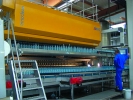
Peracetic acid is a disinfection agent used in the disinfection of re-usable plastic bottles in the beverage industry. 35 000 bottles are disinfected per hour through the addition of this agent. The manual and non-continuous measurement and dosing of peracetic acid lead to the occurrence of overdosage and underdosage. The consumption of the disinfection agent is ideally minimised for both economic and ecological reasons.
The application of JUMO measuring cells allow for a continuous measurement of the peracetic acid, automatic corrective dosing and a continuous display of the concentration.
The bottles pass through the following cleaning stages:
1. Preliminary cleaning and flushing out of any foreign bodies.
2. Cleaning of the bottles with caustic soda (NaOH) at a temperature of 58°C.
3. Upside-down flushing of the bottles.
4. Disinfection of the bottles in an immersion bath, after which the bottles are allowed to drip-dry.
5. The bottles are moved onto the bottle rinser and the cleaning of the bottles with peracetic acid with a dosage of 50 ppm.
6. Finally, the bottles are flushed out with sterile water and moved on for filling.
Peracetic acid passes through the sensor membrane into the electrode chamber, which is filled with electrolyte with an Au cathode and an Ag/AgCl anode. Since the sensor is operating in the diffusion-limited current range, every molecule of disinfectant that reaches the cathode surface is immediately reduced. A corresponding counter-reaction takes place at the anode. The electrical current that is generated by the reactions at the electrodes is proportional to the concentration of the disinfection agent in the solution and serves as the measurement signal, after appropriate conversion and calibration. The calibration procedure requires carrying out an adjustment of the slope (the reference value from the DPD determination). Zero point calibration is not required for the membrane-covered measuring cells in this system.
Further reading:
Matching HVAC to the real demands of buildings and processes
Analytical Instrumentation & Environmental Monitoring
Industrial Climate Engineering director, Alin Gomes explains why effective HVAC goes beyond specifying equipment on capacity, covering load profiling, ventilation requirements, heat recovery and turnkey delivery for specialised manufacturing and processing environments.
Read more...
How SCE approaches sensor selection for critical environments
Specialised Climate Engineering
Analytical Instrumentation & Environmental Monitoring
Specifying the right sensor for a critical climate involves far more than matching a datasheet accuracy figure. As an authorised Vaisala HVAC partner, SCE explains how understanding the environment, the measurement purpose and sensor placement determines effective climate control.
Read more...
Changing gas quality calls for smarter combustion control
Analytical Instrumentation & Environmental Monitoring
As South Africa prepares for a transition from declining Mozambican natural gas to a proposed methane-rich bridge, LNG, industrial users can no longer assume a constant Wobbe Index and calorific value. The compact RMG RGQ 5 provides fast, plant-level gas-quality data to support approved burner and engine settings.
Read more...
Getting the chemistry right
Analytical Instrumentation & Environmental Monitoring
Grace’s European production site has relied on analogue compression load cells from Minebea Intec for decades, with the long-proven measurement concept now serving as the reference for new silo projects as the company expands its capacity.
Read more...
Why measurement matters in smelting
Endress+Hauser South Africa
Analytical Instrumentation & Environmental Monitoring
South African smelters returning to operation after energy constraints face new demands for tighter control, better visibility and environmental compliance. Endress+Hauser explains how modern measurement technology supports safer, more efficient furnace operation and local beneficiation.
Read more...
Sun tracking with pinpoint precision
Senseca
Analytical Instrumentation & Environmental Monitoring
Senseca has introduced the SEMS-2000 solar energy measurement system, a 2-axis solar tracker with pinpoint sun-pointing accuracy that automatically monitors direct, global and diffuse irradiance for unattended outdoor solar installations.
Read more...
AMETEK expands 993X gas analyser series with explosion-proof enclosures
Analytical Instrumentation & Environmental Monitoring
AMETEK Process Instruments has added ATEX and IECEx Zone 1-certified explosion-proof enclosures to its 993X series of gas analysers, enabling reliable installation in Zone 1 hazardous locations where purge gas is unavailable.
Read more...
Why medical device leak testing matters for South Africa's MedTech future
ATEQ South Africa
Analytical Instrumentation & Environmental Monitoring
As South Africa works to grow local medical technology manufacturing, non-destructive leak and flow testing is becoming a strategic quality assurance tool, helping manufacturers verify device integrity, meet regulatory requirements and improve production efficiency.
Read more...
Moving forward with reverse osmosis
Analytical Instrumentation & Environmental Monitoring
Rising water costs and pressure on infrastructure are changing the way industries view reverse osmosis. G-Chem Aquacare is developing tailored, containerised solutions that make the technology more accessible for South African industry.
Read more...
Meteorological data logger with up to 32 analogue sensors
Senseca
Analytical Instrumentation & Environmental Monitoring
Senseca has introduced its advanced data acquisition system for environmental monitoring, which has a universal data logger for up to 32 analogue, pulse and smart digital sensors.
Read more...










 printer friendly version