

Maintenance, Test & Measurement, Calibration


Modular redundancy for boiler safety shutdown system

September 2005 Maintenance, Test & Measurement, Calibration

Shell Canada is a major oil and gas company in Canada. One of Shell's many technical accomplishments is the development of the boiler safety shutdown system at its Sarnia Manufacturing Centre (SMC) located in Corunna, Ontario.

In addressing issues related to the safety of fired equipment, Shell determined that an improved Instrument Protection System (IPS) was needed to safeguard Boilers 3 to 6 at SMC, against spurious shutdowns, unsafe conditions, and unwanted combustion conditions.

The existing boiler protection system relied on instruments that detected the presence of flames and that monitored combustion airflow and steam drum level. If any of these instruments generated an alarm, the corresponding boiler was locked up. This arrangement resulted in many nuisance shutdowns due to instrument failure.

Key project objectives

* The key to eliminating these nuisance shutdowns was the elimination of single-point failures.

* The IPS also had to provide the means to monitor and protect the boiler, including an automated shutdown and purge-cycle that would be activated by alarm conditions.

* A graphic interface was needed to assist the operator in performing a safe boiler start-up.

* The new IPS had to facilitate changes to field devices, allowing a field instrument to be removed from daily service - for repair or maintenance - while the boiler continued to operate safely.

The software

The system integrator, Hinz Consulting of Calgary, Alberta, recommended the GE Fanuc Genius Modular Redundancy (GMR) system, because of previous experience with GMR technology in Shell's Isomax hydrocracker process. These systems, installed at SMC in July 1993, have historically demonstrated the reliability of the GMR system.

In the oil and gas industry where high-availability systems and maintaining stringent regulations are essential, a solution provider with the right kind of experience and expertise is required. GE Fanuc Automation offers critical control solutions that have been field-tested in hundreds of installations around the world with TüV SIL 3 certification. GE Fanuc Automation works with customers as a partner to enable seamless, fault-tolerant systems to ensure continuous uptime.

The solution

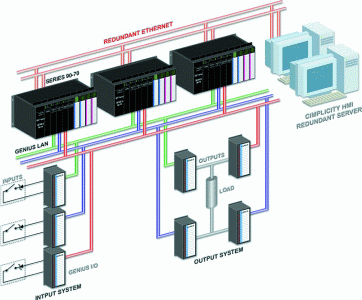
To make the new system cost-efficient, two duplex GMR systems were implemented. GMR requires identical central processing units (CPUs) and application programs. One system monitors Boilers 4 and 5, while the other monitors Boilers 3 and 6.

Each GMR system consists of two Series 90-70 programmable logic controllers (PLCs), individually connected to three buses, A, B, and C. Each bus controls a Genius I/O subsystem for triple or dual redundancy of input field devices.

Each PLC receives triplex or duplex discrete or analog input signals from the three buses and independently performs a two-out-of-three (2003) or 2002 vote on each input. The outcome is placed in the I/O table used by the application program. Single-user discrete outputs are directed from each of the PLCs to Genius output blocks (wired in the H configuration group) where 2003 voting is performed on the command output state.

A second voting stage is then performed by the application program to determine whether the boiler should be shut down on the following conditions: no flame detection, insufficient combustion airflow, or low steam drum level. If shutdown is required, the automatic shutdown sequence is carried out, followed by an automatic purge cycle.

A GE Fanuc Automation Cimplicity human machine interface (HMI) software package is implemented to display realtime data and to assist the operator during start-up of the boilers. Cimplicity software communicates to the PLC through a multidrop Series 90 Protocol (SNP) network.

The benefits

The Boiler Safety Shutdown System was implemented as part of Shell's management plan to ensure the safety and integrity of the facility. GE Fanuc Automation's GMR safety solution met the customer's need for on-line maintenance, calibration, and testing of all equipment and provided the following additional benefits:

* Proven performance for diagnostics coverage (provided by the Genius I/O blocks).

* Cost effectiveness (based on typical PLC pricing).

* Ease of use and high acceptance by experienced PLC users.

* Approval by TüV.

For more information contact Daniel Coetzee, GE Fanuc Automation, 031 583 2602, [email protected]


Share this article:
Share via emailShare via LinkedInPrint this page

Further reading:

Infrared thermometers for electrical, industrial and HVAC applications
Comtest Maintenance, Test & Measurement, Calibration
: Comtest, distributor of Fluke test and measurement equipment, explains how handheld infrared thermometers are transforming maintenance in electrical, industrial and HVAC environments, with three measurement strategies and a wide range of practical applications.

Read more...
Reverse-engineering legacy industrial gearbox parts
Maintenance, Test & Measurement, Calibration
WEG Africa’s turbine workshop uses 3D scanning technology to reverse-engineer components for legacy gearboxes, turbines and compressors, enabling equipment to run for decades after OEM support and spare parts have dried up.

Read more...
Unlocking ICCP remote monitoring
Omniflex Remote Monitoring Specialists Maintenance, Test & Measurement, Calibration
Cathodic protection keeps buried and submerged pipelines safe from corrosion, but verifying it traditionally means costly, hazardous manual site visits. Omniflex explains how a retrofit module brings remote monitoring to ageing transformer rectifiers without replacing functional infrastructure.

Read more...
Microdieseling – the explosions you never hear
Maintenance, Test & Measurement, Calibration
Microdieseling is a pressure-induced thermal degradation mechanism in which entrained air bubbles are compressed so rapidly that the surrounding oil ignites, producing soot, varnish and sludge. WearCheck explains how it happens, why the damage varies, and how oil analysis detects it.

Read more...
Electrostatic spark discharge – when static strikes back
Wearcheck Maintenance, Test & Measurement, Calibration
WearCheck technical manager, Steven Lumley explains how static electricity accumulates in modern low-conductivity lubricants, why compact system designs and fine filtration make ESD more likely, and how to recognise the degradation it leaves behind.

Read more...
High-speed cameras for crash testing
Horne Technologies Maintenance, Test & Measurement, Calibration
Vision Research has expanded its Phantom C-series with two cameras optimised for crash and safety testing, offering 4 and 8 megapixel sensors rated to 170G, up to 1180 frames per second, and Phantom Academy application training planned for South Africa next year.

Read more...
SKF extends remanufacturing expertise to bearing clearance modification
SKF South Africa Maintenance, Test & Measurement, Calibration
Using its clearance modification expertise, SKF helped a mining equipment OEM salvage spherical roller bearing inventory that would otherwise have been scrapped, confirming a new capability within its remanufacturing services and avoiding redundant procurement.

Read more...
When maintenance-system compliance starts replacing plant reliability
Wearcheck Maintenance, Test & Measurement, Calibration
WearCheck ARC division manager, Annemie Willer argues that the greatest threat to effective maintenance is no longer a lack of technology, but the gradual replacement of technical judgement by CMMS compliance, leaving no one owning the machine.

Read more...
Automatic lubrication systems drive mobile mine machine reliability and uptime
SKF South Africa Maintenance, Test & Measurement, Calibration
SKF’s Lincoln P203 progressive lubrication systems are improving reliability and uptime on mobile machines at a Zambian gold mine, with installation of 45 units completing by October 2026.

Read more...
Nitration: the acid you didn’t see coming
Wearcheck Maintenance, Test & Measurement, Calibration
Nitration is as destructive as oxidation in many engines but far less understood. WearCheck technical manager, Steven Lumley explains how nitrogen oxide gases degrade lubricants, why the process is difficult to detect, and what oil analysis can reveal before damage occurs.

Read more...


While every effort has been made to ensure the accuracy of the information contained herein, the publisher and its agents cannot be held responsible for any errors contained, or any loss incurred as a result. Articles published do not necessarily reflect the views of the publishers. The editor reserves the right to alter or cut copy. Articles submitted are deemed to have been cleared for publication. Advertisements and company contact details are published as provided by the advertiser. Technews Publishing (Pty) Ltd cannot be held responsible for the accuracy or veracity of supplied material.


© Technews Publishing (Pty) Ltd | All Rights Reserved