Quality control in metal making
November 2003
Analytical Instrumentation & Environmental Monitoring
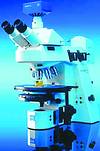
Many microscope users do not know that microscopes can be applied not only in medicine and biology, but also in the materials sector in the steel, automotive and mechanical engineering sectors. Swiss Steel, based in Germany, produces more than 400 000 tons of steel every year; about 200 types for more than 250 international customers, mostly car manufacturers and their suppliers and the manufacturers of plants and machines.
Quality control at Swiss Steel is monitored by a staff of more than two dozen and the spectroscopy laboratory monitors the precise dosage of alloying materials in various molten steels. The biggest laboratory, however, deals with metallography. Here production samples (~20 mm diameter) are ground, finely polished using a diamond suspension and then examined under the microscope. Due to their great influence on steel properties, the determination of non-metallic inclusions (NMI) - oxides, sulphides and silicates which can make steel brittle and result in failure of the finished steel components in the case of high strain - is a major routine check in steel laboratories.
Ever since the laboratory has used Axioplan 2 microscopes from Carl Zeiss, metallurgists need do no more than look into the eyepieces for control purposes. As soon as the samples are placed under the objective, the relevant software does everything else: it controls the microscope, creates the image on the monitor and archives the image data.
The software specifically detects the data about NMIs, including the distribution, size and type. Although the KS 400 software from Carl Zeiss was designed for image analysis and not the requirements of a steel laboratory, an integrated macro editor enables the users to program their own routine procedures.
Digital image recording not only offers the benefit of automatic evaluation, but also facilitates archiving of the images needed for documentation purposes. In the past a member of staff was constantly taking photos - this was before 1999, when Carl Zeiss microscopes and digital processing techniques were used for the first time.
Carl Zeiss launched a new range of materials microscopes last year with a number of new techniques providing options for more efficient and more precise analysis in the steel industry. These include the existing software for NMI examinations as well as special grain boundary programme, which eliminates the need to create a special macro under KS 400. There are now special prefabricated application solutions for measurement of the graphite portion, determination of grain sizes and particle analysis support evaluation in compliance with international (ASTM) and DIN standards.
For more information contact Gail Giordani, Carl Zeiss, 011 886 9510, [email protected], www.zeiss.co.za
Further reading:
Matching HVAC to the real demands of buildings and processes
Analytical Instrumentation & Environmental Monitoring
Industrial Climate Engineering director, Alin Gomes explains why effective HVAC goes beyond specifying equipment on capacity, covering load profiling, ventilation requirements, heat recovery and turnkey delivery for specialised manufacturing and processing environments.
Read more...
How SCE approaches sensor selection for critical environments
Specialised Climate Engineering
Analytical Instrumentation & Environmental Monitoring
Specifying the right sensor for a critical climate involves far more than matching a datasheet accuracy figure. As an authorised Vaisala HVAC partner, SCE explains how understanding the environment, the measurement purpose and sensor placement determines effective climate control.
Read more...
Changing gas quality calls for smarter combustion control
Analytical Instrumentation & Environmental Monitoring
As South Africa prepares for a transition from declining Mozambican natural gas to a proposed methane-rich bridge, LNG, industrial users can no longer assume a constant Wobbe Index and calorific value. The compact RMG RGQ 5 provides fast, plant-level gas-quality data to support approved burner and engine settings.
Read more...
Getting the chemistry right
Analytical Instrumentation & Environmental Monitoring
Grace’s European production site has relied on analogue compression load cells from Minebea Intec for decades, with the long-proven measurement concept now serving as the reference for new silo projects as the company expands its capacity.
Read more...
Why measurement matters in smelting
Endress+Hauser South Africa
Analytical Instrumentation & Environmental Monitoring
South African smelters returning to operation after energy constraints face new demands for tighter control, better visibility and environmental compliance. Endress+Hauser explains how modern measurement technology supports safer, more efficient furnace operation and local beneficiation.
Read more...
Sun tracking with pinpoint precision
Senseca
Analytical Instrumentation & Environmental Monitoring
Senseca has introduced the SEMS-2000 solar energy measurement system, a 2-axis solar tracker with pinpoint sun-pointing accuracy that automatically monitors direct, global and diffuse irradiance for unattended outdoor solar installations.
Read more...
AMETEK expands 993X gas analyser series with explosion-proof enclosures
Analytical Instrumentation & Environmental Monitoring
AMETEK Process Instruments has added ATEX and IECEx Zone 1-certified explosion-proof enclosures to its 993X series of gas analysers, enabling reliable installation in Zone 1 hazardous locations where purge gas is unavailable.
Read more...
Why medical device leak testing matters for South Africa's MedTech future
ATEQ South Africa
Analytical Instrumentation & Environmental Monitoring
As South Africa works to grow local medical technology manufacturing, non-destructive leak and flow testing is becoming a strategic quality assurance tool, helping manufacturers verify device integrity, meet regulatory requirements and improve production efficiency.
Read more...
Moving forward with reverse osmosis
Analytical Instrumentation & Environmental Monitoring
Rising water costs and pressure on infrastructure are changing the way industries view reverse osmosis. G-Chem Aquacare is developing tailored, containerised solutions that make the technology more accessible for South African industry.
Read more...
Meteorological data logger with up to 32 analogue sensors
Senseca
Analytical Instrumentation & Environmental Monitoring
Senseca has introduced its advanced data acquisition system for environmental monitoring, which has a universal data logger for up to 32 analogue, pulse and smart digital sensors.
Read more...










 printer friendly version