



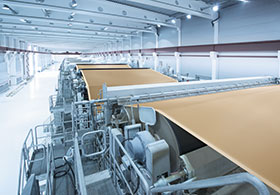
VEGA measurement technology for the paper industry comprises instruments for level, limit level, pressure, density, flow and interface measurement. The product line includes contact as well as non-contact sensors. There are also technologies for converting and transmitting measurement signals (interface systems), for visualising measurement data and for managing inventories (asset management systems).
These technologies apply to almost all areas of the paper industry, from pulp production to water/wastewater. In addition, there are a large number of other measurements for monitoring process variables such as temperature, flow rate and consistency, as well as quality variables such as whiteness, grammage, gloss, opacity, etc. Typical applications are storage towers, chests, sorters, refiners, headbox, tanks with paper chemicals, and the vacuum system.
Many of the measuring methods described above operate in contact with the media, i.e. they are directly exposed to the process conditions. This means they can be abraded by required substances such as titanium dioxide and also by undesirable substances in the waste paper like staples, iron etc.
For these reasons, non-contact measuring methods are becoming more and more important for users, especially for level and throughput measurement. These are mostly based on electromagnetic waves.
Radar for level measurement
The term ‘radar sensor’ is used when the transmission frequencies are in the microwave range and ‘radiometric sensor’ when the transmission frequencies are in the range of gamma radiation.
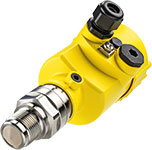
A radar sensor for non-contact level measurement is installed on top of a vessel and, once in operation, sends microwaves down to the product surface. The microwaves are reflected there and then received by the sensor. This is how the distance to the surface is measured. After the empty and full adjustment the sensor calculates the level from the signal data. Such a radar sensor works nearly independently of the product properties and process conditions – from vacuum to the highest pressures, from the lowest to the highest temperatures.
Using radar, the goal is to transmit with a very small beam angle and receive with the highest possible signal gain. For this reason, the larger the antenna and the higher the frequency, the smaller is the beam angle. A smaller beam angle means better focusing. VEGA’s 80 GHz-Sensor has a beam angle of only 3°.
With this small beam angle, and its measuring range of 30 m, this sensor can be used universally for a wide variety of applications from large storage tanks to reactors and IBC containers to small dosing or bottling vessels. The dream of planners and maintenance engineers becomes reality – one sensor for all applications. The 80 GHz device has a large dynamic range and this ensures a high degree of measurement certainty. It measures very reliably in applications with foam, turbulent product surfaces, condensate or build-up on the antenna, as well as at high temperatures.
The solution for level measurement in the pulper
Level measurement in the pulper is responsible for the automated process of stock dissolution. It regulates the mixing ratio between supplied fibres and process water, thus ensuring the stock consistency required for the discharge process.
Level measurement in the pulper was not possible using sensors until recently. This was due to limitations from disturbing installations, turbulent product surfaces and build-up on the antenna. But thanks to good focusing, 80 GHz radar technology now makes this possible. Its use results in considerable simplifications in the design of the vessel. The sensor is easily accessible even when the pulper is full. Water flushing is no longer necessary. Due to its simple mounting, retrofitting or rebuild is easily possible.
Radiometry – the universal measurement technology
In industrial application of gamma rays, a radiation source (transmitter) and an opposing detector (receiver) together form a measuring unit. A low radioactive substance emits focused gamma rays. This radiation is attenuated depending on the density of the material that is penetrated. From the intensity of the incoming radiation, the detector calculates the measured variable, whether level, point level, density or flow rate.
It also works in pipelines, for example in alkali regeneration. The processes there run at high temperatures and pressures; the media are aggressive and sometimes abrasive.
With solids the radiation source is mounted above the conveyor belt. The radiation penetrates the wood chips and the conveyor belt. The detector below the conveyor belt detects the radiation. The measuring signal is dependent on the current loading height. A higher load means a smaller measuring signal, while a lower load means a larger one.
Solution for the pulper feed
In a customer´s revamping project, a decommissioned stock preparation line was to be put back into operation. This was done to enable a separate grinding of long and short fibre and to increase capacity and production volume. The pulper, instead of its usual batch operation, was now to be operated continuously in order to increase output. The smallest unit of one pulp bale, weighing approximately 250 kg, had to be detected by a suitable measuring system.
Common measuring systems did not meet process requirements. Since an absolutely reliable, maintenance-free and long-term reproducible measurement is required here, the decision was made to install a radiometric measuring system. As this was a rebuild of an existing system, the measurement had to be selected and adapted to the customer’s circumstances. The small space between the building wall and the pulper opening was a special challenge.
Due to the limited distance between the radiation source and the pulper belt, two radiation sources were required for complete detection of the individual cellulose bales. With this arrangement, it was possible to ensure that each detected bale actually landed in the pulper.
The bales are loaded onto the conveyor belt and unwired. The DCS fills 50% of the amount of water into the pulper, demands a bale via the mass flow measurement, and finally fills the remaining 50% of the water needed. This ensures that no bale is fed in without the necessary quantity of water. However, this requires a reliable measurement that also detects ‘phantom bales’ (pulp bale wrapping) and, if necessary, bales placed close to each other on the pulper. Due to its accuracy, the system allows a fully automatic accounting of the pulp inventories.
Summary
Radiometric sensors allow non-contact measurement. This ensures reliable operation independent of the process conditions, as well as being free of wear and maintenance. For that reason they are often used for continuous mass flow measurement.
The newest generation of radar sensors for liquids operates with 80 GHz technology. These very high transmission frequencies allow exact focusing on the measuring point, while interference from the environment is virtually eliminated. Therefore, even the most challenging tasks, such as level measurement of fibre/water mixtures in the pulping process, can be realised.
The successful combination of radar and radiometry measurement has a great future in the paper industry.
For more information contact Chantal Groom, VEGA Controls SA, +12 11 795 3249, chantal.groom@vega.com, www.vega.com
| Tel: | +27 11 795 3249 |
| Email: | info.za@vega.com |
| www: | www.vega.com/en/home_za |
| Articles: | More information and articles about VEGA Controls SA |






© Technews Publishing (Pty) Ltd | All Rights Reserved
 printer friendly version