



Endress+Hauser has completed its portfolio of radar instruments with Micropilot FMR60, FMR62 and FMR67. The new Micropilot series provides the first instruments with 80 GHz technology. These have been developed according to the safety-by-design concept of IEC 61508. Furthermore, they belong to the first generation of level instruments which, like many flow instruments from Endress+Hauser, support Heartbeat Technology.
Endress+Hauser has completed its portfolio of radar instruments with Micropilot FMR60, FMR62 and FMR67. The new Micropilot series provides the first instruments with 80 GHz technology. These have been developed according to the safety-by-design concept of IEC 61508. Furthermore, they belong to the first generation of level instruments which, like many flow instruments from Endress+Hauser, support Heartbeat Technology.
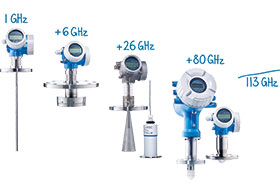
Product manager, Jan Gerritsen presents the new campaign. He says that nobody can do anything with 113 GHz. All that is needed is to add the frequencies of existing instruments to demonstrate the overall competence of Endress+Hauser in the radar range. The new level campaign is called ‘113 GHz + Your Wavelength’. Gerritsen describes the idea: “We are not concerned with faster, higher, further. At present, everybody is talking about the highest radar frequencies in the industry. But the real issue is finding the best fitting frequency for each application. In order to accomplish that, we have to listen very carefully to the requirements of our customers so that we can give them really good advice. The aim is to find a common wavelength that is a common understanding.”
In the area of tank gauging, Endress+Hauser has launched Micropilot NMR81, the first highly accurate instrument with 80 GHz technology for the oil and gas industry. Now, the company is adding Micropilot FMR6x to serve other industries. Accuracy is at stake, but first and foremost safety and the provision of simpler processes for customers is paramount. For the first time, an 80 GHz process radar is available which pursues the safety-to-design concept, thus making the life of customers much easier in terms of safety. In addition, the product offers a wide selection of Ex approvals. Improved focusing of the radar signal as well as dynamic algorithms provide reliable, stable measurements with a measuring range of up to 125 metres and an increased measuring accuracy. The measurement is unaffected by baffles or obstacles at the tank walls. Due to the innovative antenna design, build-up and condensate do not impair the measuring result. The interactive commissioning software makes this task fast and easy.
Heartbeat Technology
Instruments with their own pulse beat incorporating Heartbeat Technology have only been available at Endress+Hauser in flow instrumentation thus far. The preconditions for predictive maintenance and documented verification have already been created in the new Micropilot. This means that every measuring point can be verified and documented in assembled condition and without any interruptions. A simple, predefined procedure leads the maintenance staff through the verification and documents the results in an unambiguous manner. The guided SIL proof test according to the safety manual and included documentation also saves time and costs. An automatically generated test protocol supports the evidence concerning regulations, laws and standards. The monitoring area of Heartbeat Technology provides instrument and process data, thus facilitating trend recognition for predictive maintenance. The aim is always the optimisation of processes in a targeted manner. Therefore, a combination of instrument and process parameters provides all important details for a respective analysis.
Operating plants with minimum costs using Heartbeat Technology
Endress+Hauser has expanded its offering in the free space radar market with the addition of the new FMR 60, 62 and 67. These units use Frequency Modulated Continuous Wave Technology (FMCW) of 80 GHz compared to the other units 6 GHz or 26 GHz which are also pulsed frequencies.
The use of the high frequency of 80 GHz brings several advantages to the table. This allows for larger measuring ranges-up to 125 m compared to 70 m of pulse radar technology. Because of the shorter wavelength of the higher frequency this also leads to a more accurate measuring result of up to 0,5 mm. FMCW evaluation with slightly higher dynamic range combined with the narrow beam of the 80 GHz also helps in demanding applications.
The addition of these units to Endress+Hauser’s existing Free Space Radar units provides for the best fit frequency for every application.
In addition to the new FMCW technology Heartbeat Technology, a trend-setting and innovative smart sensor diagnostics and self-test concept, is also introduced. These parameters were available previously but were not as accessible as it is now with Heartbeat. This saves the customer costs in planning, commissioning and maintenance.
Endress+Hauser has had Heartbeat Technology since 2012, and this technology has led to rethinking instrument verification: Since then, more safety may be achieved with considerably less costs. The new FMR60, 62 and 67 series already features the preconditions for predictive maintenance and documented verification. This means that every measuring point may be verified and documented in situ without any interruption of the process. A simple, predefined procedure guides the person responsible for maintenance through the verification procedure and, in the end, the verification results are documented in an unambiguous manner. The SIL test according to the safety manual and documentation saves time and reduces costs, too. An automatically generated verification protocol supports the evidence demanded by regulations, laws or plant standards. Heartbeat Technology provides instrument and process data thus facilitating trend recognition for predictive maintenance. The goal is always the optimisation in a targeted manner. Therefore, a combination of instrument and process parameters provides all of the important information for the next steps in maintenance or process optimisation.
For more information contact Hennie Blignaut, Endress+Hauser, +27 (0)11 262 8000, [email protected], www.za.endress.com
| Tel: | +27 11 262 8000 |
| Email: | [email protected] |
| www: | www.endress.com |
| Articles: | More information and articles about Endress+Hauser South Africa |






© Technews Publishing (Pty) Ltd | All Rights Reserved
 printer friendly version