




Industrial IoT (IIoT) is having a huge impact across the plant floor. In just one example of this, rather than inspecting equipment manually and using paper-based systems to communicate and store the results, plant maintenance staff can now take advantage of IIoT-enabled automated systems. This improves both data quality and quantity. IIoT-enabled remote asset monitoring also dramatically expands the number and variety of parameters that can be monitored cost effectively.
Combined with today’s more advanced analytics, these data enable industrial organisations to implement new, more effective maintenance strategies to progress further along on the maturity continuum from reactive, to preventive, to condition-based, to predictive, and, ultimately, to prescriptive maintenance.
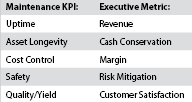
With higher maintenance maturity, comes broader business benefits that go beyond reducing maintenance costs. These include improved on-time shipments, revenue, customer satisfaction, quality/yield, safety, and work-in-process (WIP) inventory. These benefits align with executive metrics, increasing the likelihood of obtaining both approval for projects and the resources needed for project success.
IIoT advances maintenance maturity
For maintenance-related activities, IIoT brings a need to revisit the higher levels of maintenance maturity and associated definitions. ARC’s recent review of current maturity models uncovered many versions and inconsistencies. Also, the industry lacks a standard to build upon. This lack of clarity makes it difficult to compare solutions, leading to confusion among potential users and delaying the application of solutions.
While industry participants generally have a good understanding of both reactive and preventive maintenance, we’ve encountered a variety of interpretations for condition-based, predictive maintenance and prescriptive maintenance approaches, and where IIoT comes into play. A clearer definition of these upper maintenance maturity levels is needed for users to be able to better assess the available alternatives.
Reactive, preventive, condition-based, predictive, and now prescriptive maintenance maturity models
Since first publishing the Asset Management Maturity Model in an ARC report in 2015, we’ve taken a closer look at the impact of IIoT on the maturity model. We now classify maintenance maturity into five types, or levels: reactive, preventive, condition-based, predictive and prescriptive.
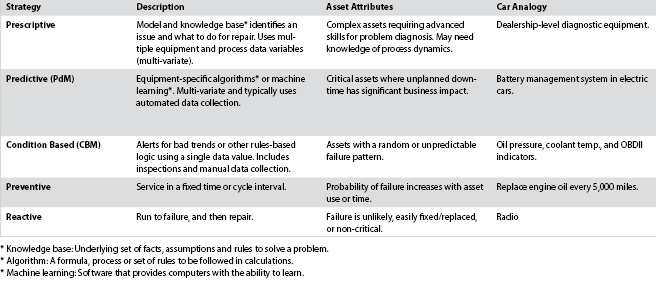
Asset management maturity model
Reactive maintenance
Reactive (run to failure) maintenance is the most common approach for equipment, since most assets have a very low probability of failure and are non-critical. This approach helps control maintenance costs, but is only appropriate for non-critical assets.
Preventive maintenance
Here, maintenance is performed based on either time (analogous to replacing the batteriesin your household smoke detectors once a year), or usage (changing your car’s oil every 15 000 km). Preventive maintenance applies to assets with an age-related failure pattern where the frequency of failure for the asset increases with age, run-time, or number of cycles.
Condition-based maintenance
Condition-based maintenance (CBM) involves monitoring a specific asset parameter. The focus tends to be the amplitude of the value, with vibration monitoring being the most common. CBM typically applies to production (rotating equipment) and automation (instruments and the control system) equipment. For stationary plant equipment such as steam boilers, piping and heat exchangers, periodic inspections and condition evaluations are often used.
Predictive maintenance
Predictive maintenance (PdM) uses engineered algorithms and/or machine learning with multiple input parameters to provide higher accuracy (fewer false positives or missed issues) and more advanced warning before failure. It combines ‘small data’ from a particular device or system with algorithms that model that type of equipment (sometimes called virtual equipment or ‘digital twin’) to monitor condition and raise an alert when appropriate. This provides the more advanced notice needed to schedule and execute the maintenance during planned shutdowns.
Prescriptive maintenance
Prescriptive maintenance builds on PdM with alerts that provide diagnostics and guidance for repair. Information for determining the timing and impact of failure is also included to help assess priority and urgency.
Increasing maturity typically involves more engineering investment. For specific types of equipment, one benefit of the engineered algorithm or model for predictive and prescriptive maintenance is the ability to replicate it like a template across many similar devices – like doors on a passenger train or transformers in power transmission lines. This approach provides economies of scale and a basis for financial justification of the inherently larger engineering and development costs.
Benefits of higher maintenance maturity
Users have reported that moving from preventive maintenance to predictive or prescriptive approaches provides 50% savings in maintenance labour and MRO materials. Using predictive and prescriptive maintenance, near zero unplanned downtime for critical equipment can be achieved. This level of equipment reliability ripples into other significant business benefits, including improvements in on-time shipments, revenue, customer satisfaction, quality/yield, safety, and work-in-process (WIP) inventory.
Unfortunately, maintenance and operations personnel tend to focus on cost reductions for labour and MRO materials to financially justify a project. A broader viewpoint with higher business impact usually gets executive attention and the resources needed to succeed.
Where to go from here
The IIoT allows organisations to move from manual inspections for collecting data, to automated systems. This vastly improves data quantity and quality, enabling improvements in maintenance strategies. How can you best leverage this capability to improve your organisation’s operating performance? ARC recommends the following actions for manufacturers and other industrial organisations:
• Use the updated maintenance maturity chart to communicate your strategy to others.
• Include the supplier’s IIoT services in the selection criteria for sourcing new equipment.
• Get started with an IIoT project for critical equipment that has high visibility and has been problematic with significant business impact or safety/environment incidents.
• Leverage the initial success into a broader programme to achieve near zero unplanned downtime for critical assets and broader business benefits.
• Establish a consistent set of IIoT technologies for the predictive and prescriptive maintenance applications to improve project sustainability.
• If your organisation lacks technical and/or IT resources, engage with an appropriate local, regional, national, or global service provider to support implementation.

Ralph Rio
Ralph Rio, vice president, Enterprise Software at ARC Advisory Group, has more than 40 years’ experience with manufacturing and industrial applications. He holds a BS in Mechanical Engineering and an MS in Management Science from Rensselaer Polytechnic Institute, and has been with ARC since 2000.
For more information contact Paul Miller, ARC Advisory Group, +1 781 471 1141, [email protected], www.arcweb.com






© Technews Publishing (Pty) Ltd | All Rights Reserved
 printer friendly version