



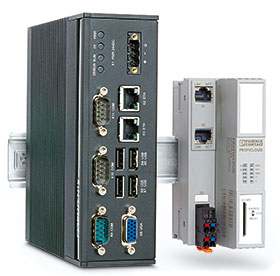
A combination of forward-looking standards gives rise to innovative solutions that cut costs and enhance competitiveness. An excellent example is Phoenix Contact’s Proficloud technology, with which, for instance, remote applications are significantly easier to implement.
The Profinet communications protocol continues to gain importance in automation technology and is being further developed by the members of the Profibus & Profinet International (PI) user organisation. Its
technology is based on Ethernet TCP/IP. The demand for quick data exchange over Ethernet networks has prompted the data transfer standard to be defined in the second layer of the OSI (Open System Interconnection) model. While using the data link layer allows real-time communication, it limits the solution’s routing ability.
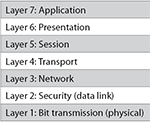
The goal of the OSI model is easy forwarding of data through a variety of technical systems. To achieve this, it establishes seven successive layers. Each layer completes specific, strictly limited tasks. Users at the same layer with coordinated interfaces can use designated network protocols to exchange information.
Automatic connection to the Proficloud
Profinet allows the implementation of a variety of solutions, from mechanical and production engineering, to process and building automation, to the entire spectrum of drive technology. The data transfer standard even allows implementation of motion-control applications, which require isochronous operation. The Proficloud technology from Phoenix Contact now connects the Profinet networks of automation technology with the Internet. Proficloud is expanding the communication standard to include the unlimited capabilities of the World Wide Web.
A standard Proficloud application consists of at least one Proficloud coupler, one Proficloud device, and one Profinet controller. The Profinet controller can be obtained from any controller manufacturer as long as the device meets Profinet specifications. The Proficloud coupler connects the local Profinet network with the Proficloud via two Ethernet interfaces. While one of the interfaces is used for linking to the local Profinet system, connection to the Internet is established via the second Ethernet interface.
Subsequently, the coupler automatically initiates a connection with the Proficloud and is ready for operation after a short period of time. The same applies to Proficloud devices, which are also easily linked to the Internet and automatically connect to the Proficloud. Then, the user must only register the Proficloud devices with the UUID (Universal Unique Identifier) in the Proficloud and assign them a Proficloud coupler. The UUIDs are used as clearly identifying information in distributed systems. A UUID is a 16-byte hexadecimal number that is subdivided into five groups. After registration, the Profinet system begins communicating through the cloud.
Flexible combination of physical and virtual devices
The question is then how the local Profinet network can be expanded through the Internet, even though it is not capable of routing. To do so, the Proficloud device sends its process data to the Proficloud as soon as a connection to the Internet, and thus to the cloud has been made. In this portion of the connection, web sockets are used to create an HTTP-based coupling between the Proficloud device and the Proficloud. This connection can only be set up by the Proficloud coupler or the Proficloud device. The limitation to ‘outbound connection’ ensures that nobody from the Internet can initiate undesired communication with the Proficloud devices.
When the connection to the Proficloud through the Internet has been made, a Profinet instance of every coupled Proficloud device is generated in the Proficloud coupler. All Proficloud devices receive their own IP and MAC addresses, which are mapped in the local Profinet network. The user can then program any Proficloud device as though it were a local Profinet device. Proficloud devices can be either physical I/O devices or virtual Proficloud modules. For the physical Proficloud I/O devices, derivatives of the AXC 1050 Axiocontrol compact controller are used. A special firmware and the Proficloud stack allow them to use the Bayeux Protocol to communicate with the Proficloud. The virtual Proficloud device can represent any sort of Internet service, which is then connected to the Profinet system. An example would be weather or recipe data, energy prices, or virtual data loggers.
Reliable prevention of unwanted communication
Because data transmission by the Proficloud coupler and devices is protected by TLS (Transport Layer Security) encoding, and the connection can only be established by the Proficloud device, two fundamental aspects of Proficloud data security are observed.
Even the web application for parameterisation of the Proficloud is forwarded to the user through HTTPS (HyperText Transfer Protocol Secure), making it safe against unauthorised access. Of course, the user is free to install additional security measures to increase the level of safety for the application. In a complementary approach to protecting the local Profinet network from unwanted Internet access, the two Proficloud coupler Ethernet ports have been physically separated from each other and only connected in the application layer. Despite all these security precautions, Proficloud remains user-friendly and firewall-friendly because Internet port 443 is used as the standard port for data exchange. Port 443 is the connection channel for secure HTTPS communication that is officially registered with IANA (Internet Assigned Numbers Authority) in TCP (Transmission Control Protocol) connections.
Conclusion
In summary, users can easily integrate the Proficloud into existing systems because the solution is based on the Profinet protocol established in automation technology. A costly configuration of IT systems or VPN components can thus be avoided. In this way, Phoenix Contact makes integrating automation solutions into the cloud as simple and secure as possible, enabling end users to take advantage of the many options provided by Internet technology.
For more information contact Kevin Preston, Phoenix Contact, +27 (0)11 801 8200, kevinp@phoenixcontact.co.za, www.phoenixcontact.co.za
| Tel: | +27 11 801 8200 |
| Email: | sbritz@phoenixcontact.co.za |
| www: | www.phoenixcontact.co.za |
| Articles: | More information and articles about Phoenix Contact |






© Technews Publishing (Pty) Ltd | All Rights Reserved
 printer friendly version