



Introduction
Two-phase flow is notoriously problematic for most flow technologies. Assume, for instance, 3% gas by volume entrained in a liquid stream. A velocity meter (eg, mag, vortex, turbine, ultrasonic, etc) calculates volume flow by multiplying measured velocity by the free cross sectional area of the meter body (or pipe in the case of non-intrusive, clamp on ultrasonic meters). Even with a fully-developed flow profile with relatively high Reynolds Number, coupled with theoretically zero velocity error, the desired liquid measurement would be overstated by the amount of ‘gas void fraction’ (GVF), in this case resulting in just over 3% error.
Coriolis flowmeters are direct mass measurement devices. As such, Coriolis meters are not affected by GVF in the same way as other flow technologies. In the presence of entrained gas, Coriolis meters are capable of overstating the desired liquid mass by only the mass of entrained gas, which is usually inconsequential. Although entrained gas will contribute to the Coriolis effect, the mass of gas is relatively small compared to the mass of the entire fluid stream or target fluid. Simply stated, bulk mass flow rate of an aerated stream is extremely close to its liquid mass flow rate. Accordingly, mass meters will typically outperform other flow technologies at least in the presence of relatively small amounts of entrained gas.
GVF and transmitter solutions
GVF has varying effects on mass flow measurement accuracy depending upon several process conditions. For instance, ABB Coriolis meters perform nearly at ½% of actual flow rate on highly viscous fluid streams with upward of 50% GVF. One key reason for such success is that viscous fluids tend to enable entrained gas to remain uniformly distributed within a fluid stream so that layers of gas or stratification does not occur. In cases in which gas decouples from the liquid phase, slugs of gas are created along the inner flow tube walls, hence the term ‘slug flow’. Slug flow is an undesirable flow regime because liquid rushing into gas cavities that is not flowing at the same speed as the liquid phase causes a dampening of the sensor-tubes’ vibration. If the flow tubes cannot vibrate at their ideal design frequency and tube amplitude, or if energy to the tubes induced by the driver coil reaches intrinsic safety limitations resulting in driver coil saturation, the correlation of mass-acceleration to tube deflection (reflected in the meter’s flow coefficient) is no longer reliable.
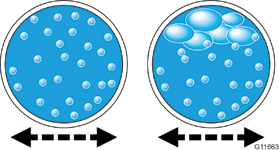
In other words, the same mass flow rate of an homogeneous fluid as compared to a stream with slugs of gas does not create the same tube distortion and resultant phase shift between sensor sine waves. See Figure 1.
Over the past 12 years, significant attention has been given to improving Coriolis measurement techniques in the presence of slug flow. ABB has developed sophisticated control algorithms and sensitivity adjustments that enable the metering system to operate better during two-phase upsets. Faster drive current control along with enhanced tube amplitude stability and noise filtering techniques results in better mass measurement during GVF upsets. Through digital signal processing unpertubated driver frequencies are synthetically generated and stored, which enables the meter to maintain an ideal frequency of vibration when slug flow inhibits resonance frequency. In addition, ABB Coriolis meters are capable of holding ‘last measured value’ for a pre-specified duration. This enhanced functionality can be triggered by a programmable tube amplitude set point.
GVF and tube geometry considerations
For years GVF upsets have been placed back on the customer as a process problem. More recently Coriolis manufacturers have been eager to take on the challenge of providing a more robust solution to GVF upsets. There are, of course, valve, piping and meter orientation considerations that are widely understood; what has not been as apparent is that flow tube geometry often exasperates, if not also creates havoc for the metering system. It is not uncommon that complex correlative algorithms that attempt to relate actual changes in drive gain and apparent changes in density to measured flow rates are needed in order to overcome problems that are at least in part caused by the flow tube itself! In a word, in many cases transmitters are designed to overcome the resultant problems inherent to the sensors they operate.
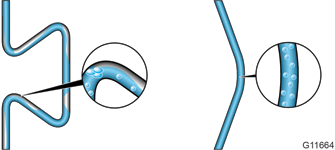
Small bubbles uniformly distributed in the flow stream tend to travel at the same velocity as the liquid phase at higher Reynolds Numbers (where inertial forces significantly overcome viscous forces). Several key variables influence whether a flow regime will enable the liquid to carry small bubbles through the meter without gas separation, stratification or decoupling. For one thing, pressure drop through the meter is critical. If normal process pressure can be maintained through the meter, bubbles have a better chance of not breaking out of the fluid stream and dampening out tube vibration. Many Coriolis manufacturers, due to circuitous or tortuous tube geometry, often have to increase the otherwise recommended meter size in order to maintain a lower pressured drop when slug flow is anticipated (or being experienced after a meter is installed). Aside from having to supply larger and often bulkier meters at a higher cost, reducing pressure drop in this way comes at the expense of lower fluid velocity and consequently less mixing of the entrained gas within the liquid phase; this too can result in phase decoupling (especially around hairpin tube radii) as the velocity profile becomes increasingly asymmetrical, or at best more parabolic than at higher velocities. The ideal design of the FCB series of flowmeters yields low pressure drop while maintaining relatively high fluid velocity resulting in less GVF upsets and consequently a more precise flow measurement.
The FCB series of Coriolis meters is designed with a ‘softer’ tube radius and larger tube ID that allows for 80% more flow capacity at 1 bar pressure drop on 57 API oil when compared to another meter. FCB series flow meters allow for an easy path of escape for slugs of gas. There is no location for gas ‘hold-up’ in the vertical orientation and in horizontal installations even relatively small inertial forces generated at low flow rates can easily overcome the entrained gas buoyancy effect that might otherwise aid in entrapping gas bubbles in older, more triangular and U-shaped tube designs.
Lastly, zero stability is virtually unaffected by ABB’s higher capacity, which is a function of linearisation and realistic pressure drop for customer applications; zero stability has to do with signal to noise ratio, which pertains to many physical properties including but not limited to case and manifold design, patented sensing coil location, tube-geometry induced sensitivity and, of course, transmitter considerations. High flow capacity due to geometry and linearisation need not impinge upon zero stability. In the case of ABB’s FCB series, it does not.
A more holistic approach incorporates electronics and sensor technology
In summary, ABB is tackling the two-phase flow problem through an entire meter-design approach, which entails a state of the art electronics platform (also available in an onboard Modbus smart-sensor) and innovative sensor technology. See Figure 2.
For more information contact Jacolize Goosen, ABB South Africa, +27 (0)10 202 5000, [email protected], www.abb.com/za
| Tel: | +27 10 202 5000 |
| Email: | [email protected] |
| www: | www.abb.com/za |
| Articles: | More information and articles about ABB South Africa |






© Technews Publishing (Pty) Ltd | All Rights Reserved
 printer friendly version