



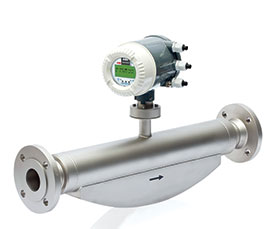
The right flowmeter will save you money, something Frank Frenzel has seen many times. As the ABB global product manager for Coriolis mass flowmeters, one of his favourite examples is a chemical manufacturer that changed its process for fulfilling customer specified concentrations of acid, which were sold by weight.
Originally, its process involved pumping a calculated amount of acid into a tanker truck, and then adding another calculated amount of water to reduce the concentration. If all went well, a truck could be filled in 40 minutes to a final weight and concentration that were within the contractual tolerance.
Today, using a Coriolis mass flowmeter, the acid and additive are mixed inline and pumped into the tanker in single process; the proper concentration is assured by the Coriolis meter’s ability to measure density; the proper weight is assured by its ability to measure the flow of mass.
As a result of the change, the time it took to fill a truck was reduced by half. With 5000 loads produced per year, the savings amounted to 1650 hours – about 10 weeks. The new flowmeter improved margins on existing business and created an effective capacity increase that allowed the company to add new contracts.
Measuring flow of a gas or liquid through an industrial process often presents a series of technical challenges, but it is often also a decision that can impact business. To simplify the process of selecting the appropriate flowmeter, ABB’s Frenzel suggests synthesising the variables into just three universal values:
Capacity: the most important value, it refers to how much flow a meter of a particular size can handle, and the extent of the resulting pressure drop.
Accuracy: most applications demand a high degree of consistency in results, but not all require the same level of accuracy.
Physical dimensions: according to Frenzel, the meter’s footprint is taking on increasing importance – particularly when a system is being upgraded and a new meter needs to fit into the same space as the old one that it’s replacing.
More and more, this three-sided approach to the selection of a flowmeter points to the Coriolis-type as a viable technology for a given application. That’s particularly true given advancing technology in the design of the latest generation of devices.
Coriolis technology
Commercially introduced in the 1980s, the Coriolis mass flowmeter has become one of the most versatile and reliable means for measuring the flow of liquids or gases in nearly any environment. Its strength is in the ability to measure multiple attributes over sustained periods with high repeatability and little maintenance. Today, older Coriolis meters are being replaced to take advantage of efficiencies offered by newer models. Meanwhile, industries that have previously bypassed the Coriolis technology are taking a second look and recognising its value.
Fundamental versatility
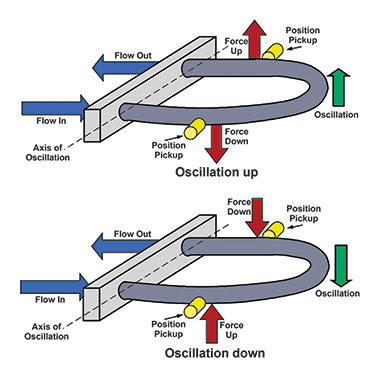
Coriolis meters work by measuring the mass flow rate and density of a fluid or gas as it flows through a vibrating tube. The process also requires ongoing monitoring of temperature, allowing additional calculations about the substance’s concentration.
ABB’s CoriolisMaster meters have a double tube design and don’t have any moving parts that come in direct contact with the measured substance – whether gas or fluid. That means they require little maintenance or upkeep. Once calibrated at the factory, they tend to remain calibrated throughout their lifecycle.
In addition, because mass remains constant regardless of temperature and pressure, Coriolis meters have the added benefit of being able to measure density as well as mass flow. This makes them particularly useful for filling operations in chemical, food and other such process industries.
The combined ability to measure mass and density also allows Coriolis meters to deal with issues that cripple other technologies. For example, where flow is turbulent, other metering technologies may require a run of straight pipe to smooth the flow before it’s measured; Coriolis meters don’t require such measures and can therefore be installed in a small footprint.
Finally, the technology offers benefits where the density of the measured substance isn’t uniform – such as in upstream oil and gas operations. “There are applications where industry traditions have excluded using the Coriolis meter, but they are changing now,” says Frenzel. “Upstream oil and gas is an example where there are still a lot of mechanical flowmeters in use. But mechanical meters lose accuracy over time and entrained gases can destroy them. So, especially for remote locations, industry is looking for equipment that won’t require regular maintenance and calibration.
“Coriolis meters are an excellent fit as they measure multiple attributes: mass flow, density, concentration and temperature. A single meter can do the work of multiple instruments – potentially reducing costs by allowing separate processes to be combined. Fewer processes also mean fewer spare parts and reduced overall maintenance.”
New-generation capabilities
ABB has been at the forefront of technological advancement in Coriolis mass flow and recently launched their FCB330 and FCB350 compact Coriolis mass flowmeters for measuring gases and liquids.
Newer devices are more compact, saving more than 40% in length and meter volume, easier to operate, and increasingly accurate. Accuracy options are available to save costs where very high accuracy is not needed.
ABB’s line of CoriolisMaster mass flowmeters has been designed with thick chamber walls to negate the impact of external vibration. In addition to monitoring substance temperature, the housing temperatures are measured constantly to compensate for the impact of changes in ambient temperature.
Perhaps most important, new Coriolis meters have become more efficient over time. They require up to 25% less pump energy to operate and they create a smaller pressure drop – often 20% less than older models. “Less loss of pressure equates to increased production,” concludes Frenzel. “If you can increase capacity simply by replacing a meter in your line, it is an easy ROI calculation.”
| Tel: | +27 10 202 5000 |
| Email: | [email protected] |
| www: | www.abb.com/za |
| Articles: | More information and articles about ABB South Africa |






© Technews Publishing (Pty) Ltd | All Rights Reserved
 printer friendly version