



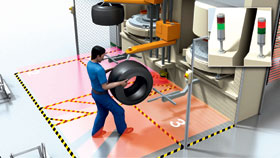
For over half a century, safety mats have been used in virtually every industry as a standard form of area protection in the plant environment. For an old technology in a technological age, safety mats have proven quite resilient.
Typically, safety mats operate using an open switch. When a specified minimum weight is brought to bear on the mat, the switch closes. This sends a signal to the controller that, in turn, sends a protective stop signal to the machine being guarded by the mat.
However, safety mats are subject to abuse: physical, environmental and operational. Since the introduction of safety mats in the 1950s, a host of new technologies have emerged for safety applications, including safety laser scanners in the 1990s. Until recently, the argument for safety mats has been that scanners are four times the cost.
But now, cost of laser safety scanners has fallen significantly when total cost-of-ownership is considered. Users who have to replace a safety mat once or twice have exceeded the cost of a safety scanner; this does not even factor in the improved safety and higher productivity scanners enable. These latter factors are the principal reasons laser scanners have largely supplanted safety mats in the EU, particularly the improved safety functionality.
A closer look at scanner technology
Safety laser scanners use time-of-flight technology. A pulsed laser beam is emitted and reflected if it meets an object. The scanner’s receiver registers the reflection. The time between transmission and reception of the impulse is directly proportional to the distance between the scanner and the object. An internal rotating mirror deflects the pulsed laser beam so that a fan-shaped scan is made of the surrounding area. The contour of the target object is determined from the sequence of impulses received. The measurement data is available in real time for evaluation via the data interface.
Safety laser scanners define safety and warning fields, also referred to as zones. These zones are freely programmable (with configuration access rights) and can be changed dynamically by an input to the device. Once an object is detected in the defined warning field, the scanner initiates a warning output signal (an audible or visible indicator) that can be used to notify someone in the area that they are entering an area where there are potential hazards. When an object enters the safety field, a safety stop can be initiated to safely stop the hazardous motion of the machine.
Advantages of the technology include non-contact functionality, adjustability, one-piece design and warning field protection.
Non-contact functionality
Safety laser scanners function without needing physical object contact by providing protection through infrared lasers. One of the biggest issues with safety mats is that they stop working, either because people repeatedly step on them (after all, that is what they are designed for) or because tools, products, lubricants, fork trucks, or other environmental ‘hazards’ come into contact with them. This causes downtime and increases the frequency of replacement.
In contrast, safety laser scanners are typically mounted in a secure, recessed area of the machine. Since its only active mechanism is an outgoing laser, nothing physical will impair operation. Further, scanners have enhanced flexibility. For example, oil and grease problems in a protected environment will not cause the laser scanner to trip because parameters can be adjusted so the device ignores these types of issues.
Adjustability
Safety mats are often limited in use by their initial application. In manufacturing facilities, they are purchased to cover specific machines; for example, one machine setup may require 4 x 4 mats, while another uses 6 x 6 mats. In other cases, such as when new machines are bought, an operation grows into new facilities, or floor plans are adjusted within existing facilities, an original safety mat designed for a 4 x 4 area may no longer satisfy the requirement. A new mat must be purchased or a different one secured from stock. On the other hand, with the safety laser scanner and its warning and safety fields, everything is freely programmable. Using the original scanner, a user can easily configure the fields to whatever size needed for operations, however they change.
Warning field protection
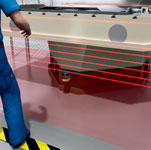
The importance of the warning field is that it provides another indication – to operators, people moving through the area, fork truck drivers – that they are getting too close to the machine and will interfere with its operation if they come any closer. Like the safety field, the warning field is freely programmable.
If the scanner senses somebody in the described warning field, it gives a discrete output, typically attached to a flashing light or some sort of siren. Consider this safety mat alternative where a machine is running producing parts. In a typical situation, operators can see where the safety mat is if they are paying attention. If not, and they step on the mat, they will stop the machine.
A smart choice
There was a time when safety mats made sense, but safety laser scanners are negating that now. By providing better protection and ensuring continuity of production at less cost over the life of a machine or facility, safety laser scanners have become the component of choice for machine safeguarding and other safety applications within the plant environment. Maximum productivity and protection at minimum cost over time – that is the smart choice.
For more information contact Stephen Eltze, SICK Automation SA, +27 (0)11 472 3733, stephen.eltze@sickautomation.co.za, www.sickautomation.co.za
| Tel: | +27 10 060 0550 |
| Email: | info@sickautomation.co.za |
| www: | www.sick.com/za/en/ |
| Articles: | More information and articles about SICK Automation Southern Africa |






© Technews Publishing (Pty) Ltd | All Rights Reserved
 printer friendly version