




Each of us has a responsibility to ensure that our own companies or employers survive and prosper in the present challenging economic environment.
Introduction
As I wrote in my wrap-up of the MMP conference in last month’s SA Instrumentation and Control, the recurring themes of the conference were:
*Relationships in engineering and IT convergence.
* Standards.
* Compliance.
* Lifecycle costs and TCO.
So I thought that I should research and write about some of the tools (in the broadest sense) that might help southern African industry to become more effective and competitive by reducing the fixed and variable costs associated with its finished products and services.
Collaboration
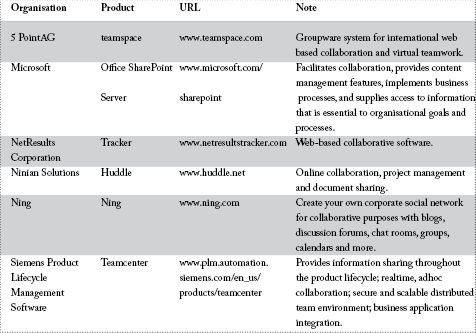
Establishing a collaborative infrastructure across an enterprise will not only help to bridge the divide between engineering and IT, it will also provide many other benefits. Web-based collaborative tools are being used by engineers, IT professionals, marketers, government and educational institutions to improve group effectiveness in tasks like:
* Accountability.
* Bug and issue tracking.
* Compliance management.
* Document management.
* Help desks.
* Knowledge management.
* Lifecycle and change management.
* Management and team communication in software development and engineering projects.
* Self-service customer support.
* Workflow and process enforcement.
Collaborative tools help to improve business processes, providing groups with secure worldwide access to documents, spreadsheets and knowledge bases; facilitate task allocation, progress monitoring and scheduling of personnel and resources; keep users up-to-date via SSL. They can also be used for delivering podcasts and hosting group discussions.
In the engineering world they ensure that all team members are working with the same set of data (for instance the latest revision of documents) and can significantly shrink costs by reducing or eliminating travel costs, printing costs and the delays associated with these activities. By centralising important data, collaborative systems simplify backup and restore procedures and improve data integrity while reducing corporate risk associated with data loss.
Table 1 lists some possible solutions to investigate.
Technical standards
Adopting technical standards and recommended practices in engineering disciplines is critical to keeping an organisation agile and minimising product costs.
The benefits of this approach are well-documented and include:
* Acceptability to international client base where product design and manufacture or engineering technique is to a globally accepted standard.
* Code re-usability through the application of object-oriented design principles and class-based programming techniques.
* Improved interpersonal and intersystem communication achieved through common object model and vocabulary.
* Ease of globalisation – facilitating outsourcing of components or engineering packages to low-cost producers.
* Facilitation of paperless manufacturing management using electronic records.
* Improved and simplified integration and interoperability with plant systems such as scada and MES through standards and standard file formats like OPC, PDF and XML.
* Improved system modularity and maintainability.
* Increased flexibility.
* Increased safety.
* Maintainability and reduced MTTR where technicians are familiar with the standards to which a product is designed and manufactured.
* Reduced engineering costs.
* Reduced total cost of acquisition and ownership.
* Reduced validation effort for regulated industries – aid compliance with FDA 21CFR Part 11.
* Simplification through standardisation of support and training.</i>
Engineers, systems integrators, equipment suppliers and users of equipment have a responsibility to keep up to date with available standards; to know the difference between voluntary standards and mandatory technical regulations and to comply with the legal requirements of the latter.
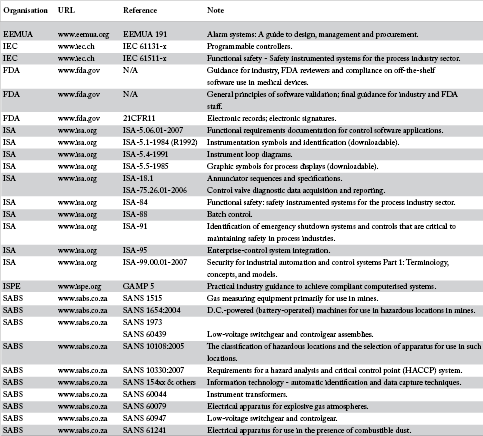
In control and automation the main bodies for technical standards are the International Society of Automation (ISA) and the International Electrotechnical Commission (IEC) with other bodies like the Engineering Equipment & Materials Users’ Association (EEMUA) and the International Society for Pharmaceutical Engineering (ISPE) providing valuable standards in associated fields.
In South Africa we have the South African Bureau of Standards (SABS) which is responsible for the development and publication of standards. Especially relevant to control and automation engineers are those standards that pertain to the application of apparatus in hazardous environments.
Some standards resources of particular interest to automation and control engineers are listed in Table 2.
Technical regulations
Various government organisations like the US Federal Drug Administration (FDA) and our own Department of Labour (DoL) and Department of Minerals and Energy (DME) are also actively involved in establishing and controlling technical regulations, which are closely allied to standards. Regional and international standards are often incorporated into legislation through technical regulations.
Standard
A document approved by a recognised body that provides, for common and repeated use, guidelines or characteristics for products or related processes or production methods, with which compliance is not mandatory. It may also deal extensively with terminology, symbols, packaging, marking or labelling requirements as they apply to a product, process or production method. The World Trade Organization Agreement on Technical Barriers to Trade
Technical Regulation
A document which lays down product characteristics or their related processes production methods, including the administrative provisions, with which compliance is mandatory. It may also deal extensively with terminology, symbols, packaging, marking or labelling requirements as they apply to the product, process or production method. The World Trade Organization Agreement on Technical Barriers to Trade

About the author
Andrew Ashton has electrical, mechanical and business qualifications and has been active in automation and process control since the early 1980s. Since 1991 he has headed up a company that has developed formulation management systems for the food, pharmaceutical and chemical manufacturing industries and manufacturing solutions involving the integration of various communication technologies and databases. Developed systems address issues around traceability, systems integration, manufacturing efficiency and effectiveness. Andrew is features editor for SA Instrumentation and Control and editor of Motion Control in Southern Africa.
For more information contact Andrew Ashton, Technews, +27 (0)11 886 3640, [email protected], www.technews.co.za
| Tel: | +27 11 543 5800 |
| Email: | [email protected] |
| www: | www.technews.co.za |
| Articles: | More information and articles about Technews Publishing |






© Technews Publishing (Pty) Ltd | All Rights Reserved
 printer friendly version